
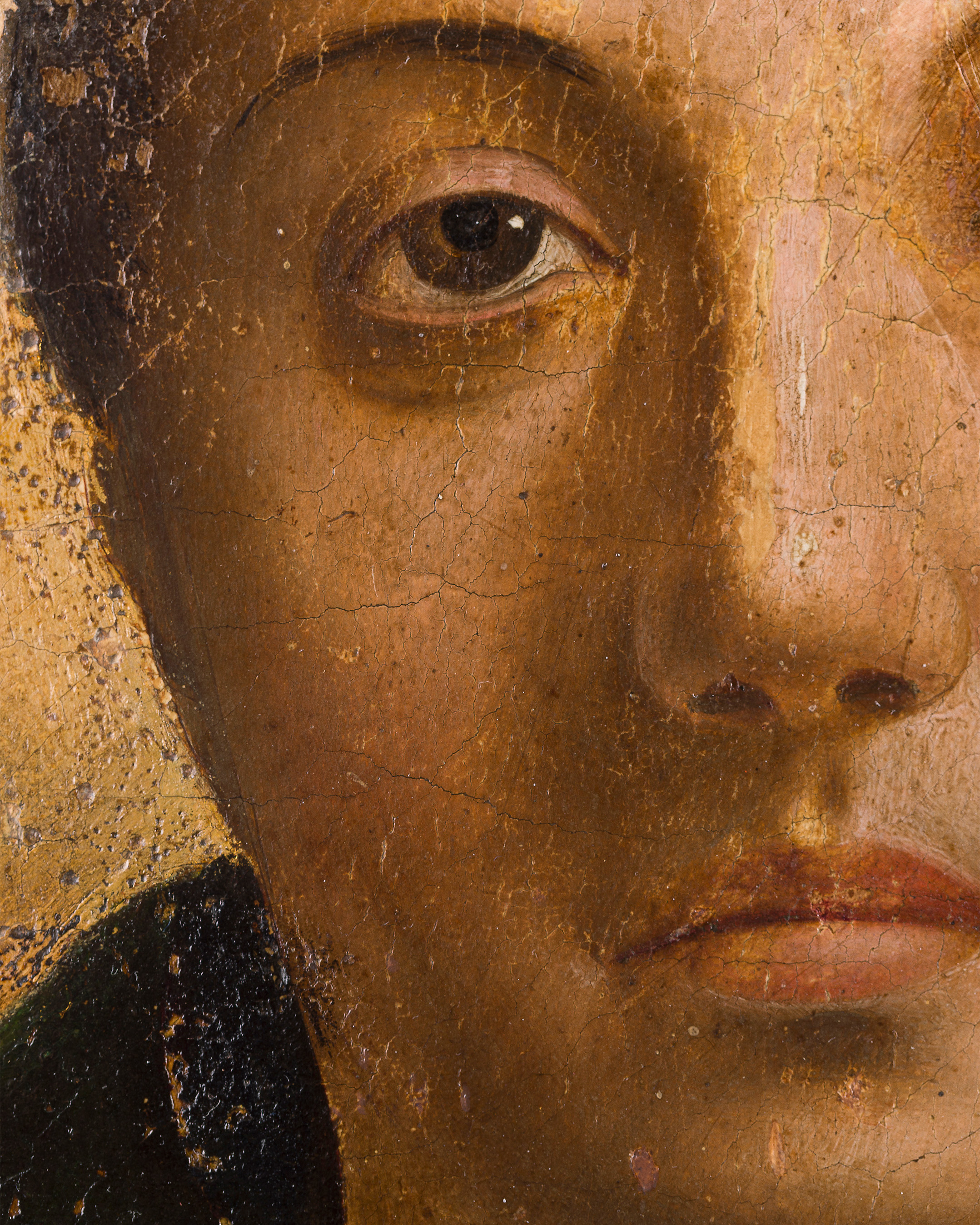
Antonello da Messina, Portrait of a Young Saint
Antonello da Messina is a legend in Western art. Like Leonardo da Vinci or Vermeer, he is known for a very small number of powerful and famous works. Only about forty of his paintings have survived, including some fifteen iconic portraits and twenty-five religious subjects. Suffice it to say that any new addition to his body of work is a significant contribution.
Ever since Vasari’s *Vite*, he has been credited with introducing the medium of oil painting to the Italian Peninsula and with bridging the gap between the realist tradition of Van Eyck and Petrus Christus in Flanders and the early Italian Renaissance. He knew how to combine the Dutch sense of description with the Italian emphasis on psychological immediacy, humanizing a sacred subject through a direct and intimate style that invites the viewer to identify emotionally with it. Antonello’s ability to assimilate diverse influences? Northern technical mastery, Florentine spatiality, the soft light of Piero della Francesca, and his dialogue with Giovanni Bellini during his stay in Venice—all these elements make his synthesis the quintessence of Quattrocento art, just before Leonardo da Vinci took his discoveries even further.
These characteristics are present in our previously unpublished panel, as is the artist’s tendency to idealize the form of a face into an ovoid geometric volume. The frontal orientation of the figure, sometimes enhanced by a very slight rotation that highlights the face and its distinctive features, is another typical aspect found in several of his paintings. The gold background and the shape of the hallmarks on the halo are comparable to some of his works still preserved in Sicily, notably the Infant Jesus from the Saint Gregory polyptych (Regional Museum of Messina, c. 1472–1475). Our saint shares many elements with his universally renowned masterpieces painted during his stay in Venice: *The Condottiere* (Louvre Museum) and, above all, the San Cassiano Altarpiece (Vienna, Kunsthistorisches Museum), where the faces almost overlap. The way the gaze is rendered is identical. The rare colors, such as that of Saint Lucy’s robe, can be compared to the green hue of the velvet collar, and beneath it one can discern the beginnings of a brown-and-gold brocade that also appears on the Madonna in the Viennese painting.
Our figure shares with the Saint Sebastian from the Gemäldegalerie Alte Meister in Dresden the same sculptural quality, with the sunken brow ridge, hollowed out by shadow, making the eyeball stand out in relief, the line of the nasal ridge extending to the eyebrows, and the rounded chin—all contributing to the same pursuit of idealization and individualization of the model.

In the absence of a specific iconographic attribute, it is difficult to identify this figure. He was certainly a clergyman, but did not hold the office of bishop. He may have been a deacon. The opening of the robe at the neck would seem to indicate a white dalmatic and a brown robe underneath. The tonsure of the hair might suggest the Dominican Order, although their habit is still white and black today. Dominic de Guzmán could have been a possible candidate, but his iconography includes more specific allusions, such as the star that often accompanies him above the halo. We could also consider Saint Lawrence, a deacon of Sixtus II who died young, as depicted standing by Giovanni Bellini in two altarpieces.
Professor Mauro Lucco suggests that our painting may have been the central panel of a gonfalone. We know that upon his return to Sicily, Antonello created several such gonfalones for the churches of Catania: Santa Barbara, San Luca, and Santa Maria della Misericordia. We should also mention the document dated March 6, 1480, in which his son Jacobello made a commitment to four brothers of the Church of the Disciplinanti of San Michele in Catania to complete a gonfalone left unfinished by his father at the time of his death, which was to include a panel painted with several figures. The entire piece was likely to be set in a richly carved and plastered frame, to be shipped to Messina before the following August to be gilded and painted there. While the term “gonfalone” today evokes a fabric banner, generally intended to be carried in processions, in 15th-century Sicily, it referred instead to a wooden object, consisting of a painted section—usually small—and an imposing frame, richly openwork and gilded, mounted atop a pole. We can get an idea of what these carved wooden banners looked like from those preserved at Galladoro in the province of Messina.
This document does not mention our painting, but indicates that, in the face of an unchanging tradition that required the image of the Virgin and Child for “gonfalone,” Antonello had broken with tradition in Catania by depicting other figures such as Saint Barnabas, Saint Luke, or the Virgin of Mercy, as well as other unspecified subjects. A note on the type of wood used: the pine that grows in Sicily is used less frequently in Italy than poplar. Conifers are sometimes used as supports in Venice, as Vasari noted, particularly in Giovanni Bellini’s circle. This material is well-suited, for example, for a processional banner, thanks to its lighter weight.
We thank Mauro Lucco for confirming the attribution of the painting following an in-person examination in September 2025, and for his assistance in drafting this entry.
Date of the sale
Tuesday, June 16, at 2:30 p.m.
Viewing:
Saturday, June 13, from 11:00 a.m. to 6:00 p.m.
Monday, June 15, from 11:00 a.m. to 6:00 p.m.
Tuesday, June 16, from 11:00 a.m. to 12:00 p.m.
Location: Hôtel Drouot, Room 9
General contact: marc.guyot@ader-paris.fr
Press contact: paul.rocle@ader-paris.fr