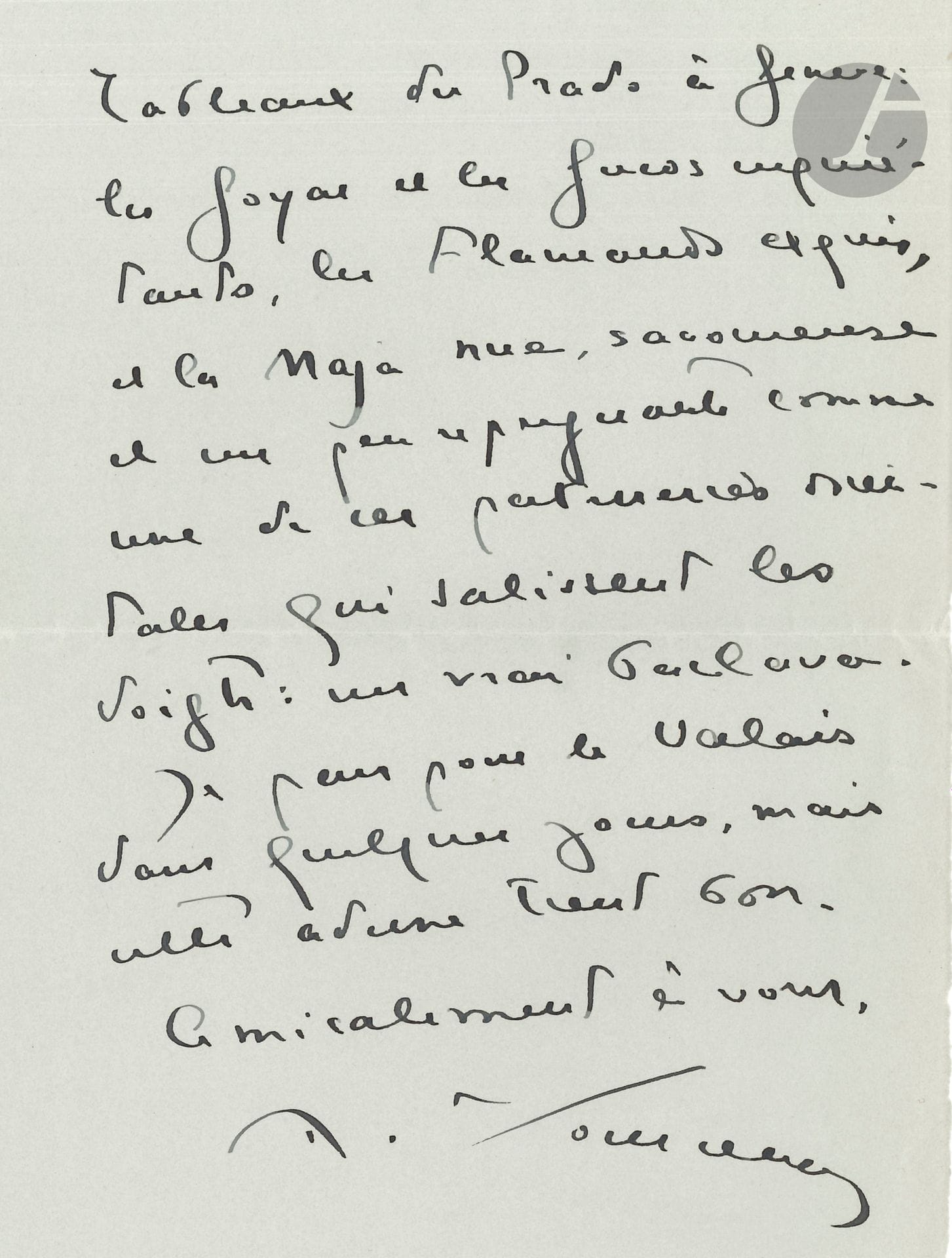
Marguerite YOURCENAR (1903-1987). 4 L.A.S., June-December 1939, to Maurice Sachs; 17pages in-8. Beautiful correspondence on the birth of a friendship. Hôtel Wagram [Paris] June 25. His warm letter touched her: "Without knowing you, I have often heard of you through a mutual friend - André Fraigneau - and it is with pleasure that I found at the bottom of your letter a name that is already so familiar. I thank you for loving as I do this beautiful and pathetic true story [Le Coup de grâce], which still moves me."... - July 9. "Your letter delights me, and especially perhaps the so human and charming way in which you associate the young woman who first spoke to you about me with this beginning of friendship. [...] I would be happy to meet you again before I leave"... Ouchy-Lausanne August 11. She was slow to reply: "It took the chance of a sunny day, when the sound of birds woke me at daybreak, for me to find myself momentarily free of all work, and in a position to chat with you at length. And the cries of the birds were no doubt cries of astonishment, for Switzerland, at least since my arrival, seems quite unaccustomed to the sun. I envy you Corsica, and the ghost of young Bonaparte. [...] Paintings from the Prado in Geneva: the disquieting Goyas and Grecos, the exquisite Flemish, and the naked Maja, tasty and a little disgusting like one of those oriental pastries that make your fingers dirty: a real baclava". She leaves for the Valais... New York December 17. She received his "wise letter - let's remain ourselves - it's the best response to events"... She had tried to find him in Paris in September-October: "What a strange month, spent in a city where new friendships were being formed, but where true friends were suddenly as if lost. So here you are in Caen, an interpreter like André Maurois himself! But it doesn't matter, because you're working. Lulled - a little harshly - by the pitching of the Manhattan on a sea strewn with pitfalls, I was reading this diary of a young Bourgeois [Au temps du Boeuf sur le Toit] which you're wrong to speak so ill of, of course, it's not you, but it's a very pleasant read. Here, I work and give a few lectures in French - clubs, colleges - which bring me a lot of trouble, and some much-needed money. And then, I'm convinced that everything is useful, and that these not always funny experiences will make me a better writer when I have time again to work on my own books". She talks about her Introduction to Kavafy, published by Church and Paulhan in Mesures, "which, by the way, gave me great pleasure, comforted as I was by the idea that the war had not completely stifled these great pensive cello tunes". Her lectures deal with "Europe on the eve of war"; she is thinking of producing "a volume of impressions, of shots: Vienna, Prague, Athens, Constantinople, Paris, Rome, during these last years, and the reactions of people in the street to events: the old priest in Tirana, the Greek chauffeur, the prostitute in Vienna, all very 'historical' already, and very 'discursive' (a bit like Coup de grâce, where there would only be the atmosphere and not the novel - or a bit like the diary of the young bourgeois, tender and tragic)"... After a "Paris all black [...] similar to I don't know what deserted city by Chirico, the thousand lights of New York have the effect of splendid debauchery"... We enclose 2 postcards a.s. to M. Sachs, [New York October 24 and December 19, 1939].
Estimate
€2,000 - €2,500
Result
€3,640
Buyer's premium
30%
Marguerite YOURCENAR (1903-1987). 4 L.A.S., June-December 1939, to Maurice Sachs; 17pages in-8.
Beautiful correspondence on the birth of a friendship.
Hôtel Wagram [Paris] June 25. His warm letter touched her: "Without knowing you, I have often heard of you through a mutual friend - André Fraigneau - and it is with pleasure that I found at the bottom of your letter a name that is already so familiar. I thank you for loving as I do this beautiful and pathetic true story [Le Coup de grâce], which still moves me."... - July 9. "Your letter delights me, and especially perhaps the so human and charming way in which you associate the young woman who first spoke to you about me with this beginning of friendship. [...] I would be happy to meet you again before I leave"...
Ouchy-Lausanne August 11. She was slow to reply: "It took the chance of a sunny day, when the sound of birds woke me at daybreak, for me to find myself momentarily free of all work, and in a position to chat with you at length. And the cries of the birds were no doubt cries of astonishment, for Switzerland, at least since my arrival, seems quite unaccustomed to the sun. I envy you Corsica, and the ghost of young Bonaparte. [...] Paintings from the Prado in Geneva: the disquieting Goyas and Grecos, the exquisite Flemish, and the naked Maja, tasty and a little disgusting like one of those oriental pastries that make your fingers dirty: a real baclava". She leaves for the Valais...
New York December 17. She received his "wise letter - let's remain ourselves - it's the best response to events"... She had tried to find him in Paris in September-October: "What a strange month, spent in a city where new friendships were being formed, but where true friends were suddenly as if lost. So here you are in Caen, an interpreter like André Maurois himself! But it doesn't matter, because you're working. Lulled - a little harshly - by the pitching of the Manhattan on a sea strewn with pitfalls, I was reading this diary of a young Bourgeois [Au temps du Boeuf sur le Toit] which you're wrong to speak so ill of, of course, it's not you, but it's a very pleasant read. Here, I work and give a few lectures in French - clubs, colleges - which bring me a lot of trouble, and some much-needed money. And then, I'm convinced that everything is useful, and that these not always funny experiences will make me a better writer when I have time again to work on my own books". She talks about her Introduction to Kavafy, published by Church and Paulhan in Mesures, "which, by the way, gave me great pleasure, comforted as I was by the idea that the war had not completely stifled these great pensive cello tunes". Her lectures deal with "Europe on the eve of war"; she is thinking of producing "a volume of impressions, of shots: Vienna, Prague, Athens, Constantinople, Paris, Rome, during these last years, and the reactions of people in the street to events: the old priest in Tirana, the Greek chauffeur, the prostitute in Vienna, all very 'historical' already, and very 'discursive' (a bit like Coup de grâce, where there would only be the atmosphere and not the novel - or a bit like the diary of the young bourgeois, tender and tragic)"... After a "Paris all black [...] similar to I don't know what deserted city by Chirico, the thousand lights of New York have the effect of splendid debauchery"...
We enclose 2 postcards a.s. to M. Sachs, [New York October 24 and December 19, 1939].
Sale
Tuesday 8 October 2024・14:00 (Europe/Paris)
Sale location coming soon
3, rue Favart
75002 Paris