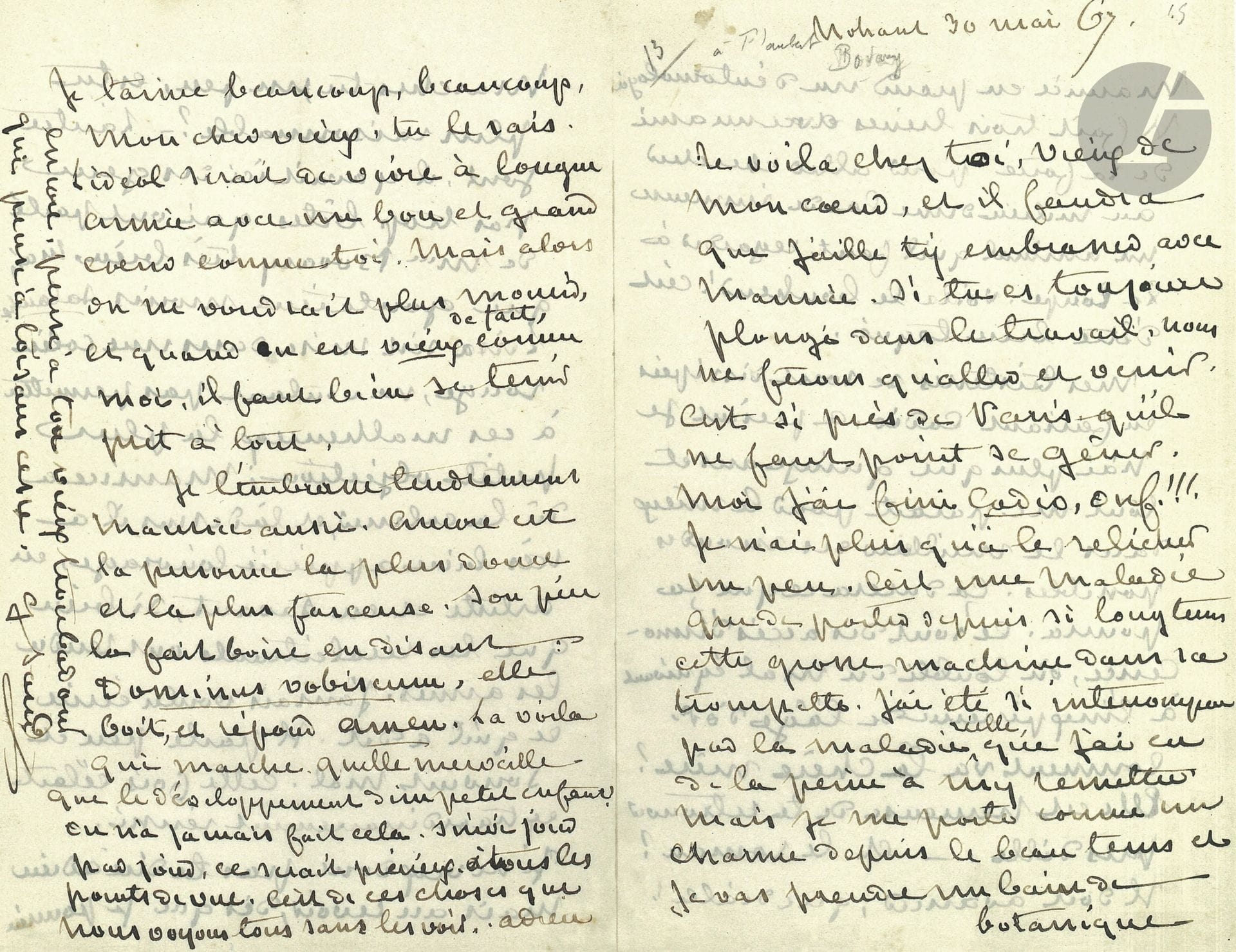
George SAND (1804-1876). L.A.S., Nohant May 30, 1867, to Gustave Flaubert; 4pages in-8. Beautiful letter of literary friendship from Sand to Flaubert: "Here you are at home, old friend of my heart, and I'll have to go and kiss you there with Maurice [her son]. If you're still immersed in your work, we'll just come and go. It's so close to Paris, we shouldn't be in the way. I've finished Cadio, phew! All I have to do now is loosen him up a bit. It's a sickness to carry this big machine in your trumpet for so long. I was so interrupted by the actual illness that I had a hard time getting back into it. But I'm feeling great now that the weather's fine, and I'm going to take a botanical bath. Maurice is taking an entomological one. He travels three leagues with a friend of his strength to find an animal in the middle of a vast moor that needs to be looked at with a magnifying glass. That's happiness! it's to be well ticked. My sadness dissipated when I made Cadio. Now I'm only fifteen, and everything seems to be for the best in the best of all possible worlds. It'll last as long as it lasts. These are fits of innocence, where forgetting evil is equivalent to the inexperience of the golden age. How is dear mother? She's happy to have you back with her! - And the novel [L'Éducation sentimentale]? It's got to get going, damn it! Are you walking a bit? Are you being more reasonable? - The other day, there were some not too stupid people here who spoke very highly of Mme Bovary, but were less fond of Salammbô. Lina [his daughter-in-law] flew into a rage, not wanting to allow these unfortunate people the slightest objection; Maurice had to calm her down, and on that score, he very much appreciated the work, as an artist and a scholar, so much so that the recalcitrants gave up. I wish I could have written what he said. He speaks little and often badly. This time it was extraordinarily successful. So I don't want to say goodbye, but goodbye, as soon as I can. I love you very, very much, my dear old man, you know that. The ideal thing would be to live for many years with a good, big heart like you. But then one wouldn't want to die, and when one is old in fact, as I am, one has to be ready for anything. My love to you, Maurice too. Aurore [his granddaughter] is the sweetest and most mischievous of people. Her father makes her drink by saying: Dominus vobiscum, she drinks and answers amen. There she goes. What a marvel the development of a little child is! It's never been done before. Followed day by day, it would be precious from every point of view. It's one of those things we all see without actually seeing. Adieu again, think of your old troubadour, who thinks of you constantly." Correspondance, t. XX, n° 13135. Correspondance Flaubert-Sand (ed. A, Jacobs), p. 139. Former Daniel Sickles collection (XII, 5080).
Estimate
€1,000 - €1,500
Result
€2,340
Buyer's premium
30%
George SAND (1804-1876). L.A.S., Nohant May 30, 1867, to Gustave Flaubert; 4pages in-8.
Beautiful letter of literary friendship from Sand to Flaubert: "Here you are at home, old friend of my heart, and I'll have to go and kiss you there with Maurice [her son]. If you're still immersed in your work, we'll just come and go. It's so close to Paris, we shouldn't be in the way. I've finished Cadio, phew! All I have to do now is loosen him up a bit. It's a sickness to carry this big machine in your trumpet for so long. I was so interrupted by the actual illness that I had a hard time getting back into it. But I'm feeling great now that the weather's fine, and I'm going to take a botanical bath. Maurice is taking an entomological one. He travels three leagues with a friend of his strength to find an animal in the middle of a vast moor that needs to be looked at with a magnifying glass. That's happiness! it's to be well ticked.
My sadness dissipated when I made Cadio. Now I'm only fifteen, and everything seems to be for the best in the best of all possible worlds. It'll last as long as it lasts. These are fits of innocence, where forgetting evil is equivalent to the inexperience of the golden age.
How is dear mother? She's happy to have you back with her! - And the novel [L'Éducation sentimentale]? It's got to get going, damn it! Are you walking a bit? Are you being more reasonable? - The other day, there were some not too stupid people here who spoke very highly of Mme Bovary, but were less fond of Salammbô. Lina [his daughter-in-law] flew into a rage, not wanting to allow these unfortunate people the slightest objection; Maurice had to calm her down, and on that score, he very much appreciated the work, as an artist and a scholar, so much so that the recalcitrants gave up. I wish I could have written what he said. He speaks little and often badly. This time it was extraordinarily successful.
So I don't want to say goodbye, but goodbye, as soon as I can. I love you very, very much, my dear old man, you know that. The ideal thing would be to live for many years with a good, big heart like you. But then one wouldn't want to die, and when one is old in fact, as I am, one has to be ready for anything.
My love to you, Maurice too. Aurore [his granddaughter] is the sweetest and most mischievous of people. Her father makes her drink by saying: Dominus vobiscum, she drinks and answers amen. There she goes. What a marvel the development of a little child is! It's never been done before. Followed day by day, it would be precious from every point of view. It's one of those things we all see without actually seeing. Adieu again, think of your old troubadour, who thinks of you constantly."
Correspondance, t. XX, n° 13135. Correspondance Flaubert-Sand (ed. A, Jacobs), p. 139.
Former Daniel Sickles collection (XII, 5080).
Sale
Tuesday 8 October 2024・14:00 (Europe/Paris)
Sale location coming soon
3, rue Favart
75002 Paris