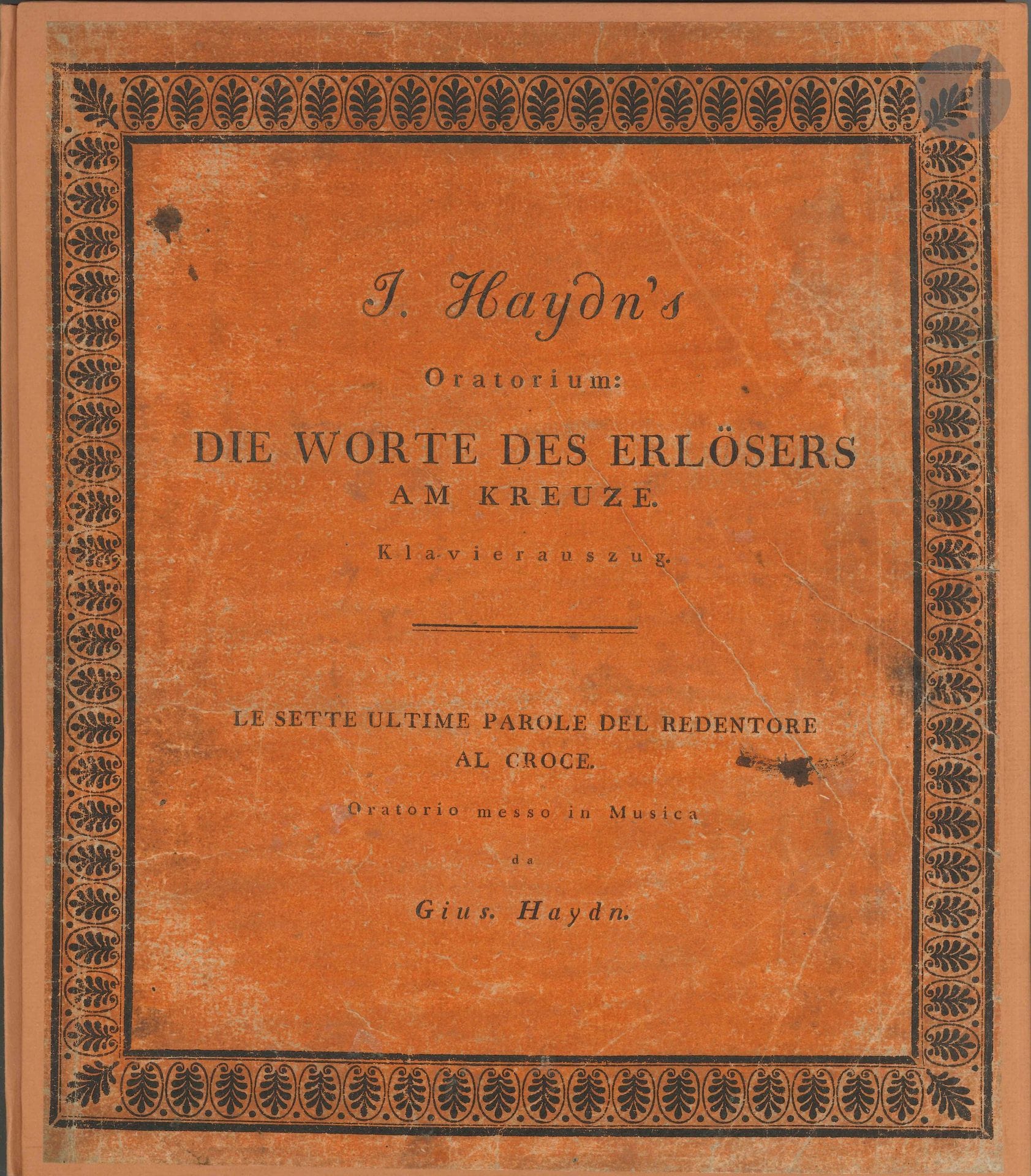
Joseph HAYDN. Die Worte des Erlœsers am Kreuze [Hoboken XX, 2] (Leipzig, Breitkopf & Härtel, [1801]); a folio-sized volume of 68 pages (including 2 blank pages), in a modern brick-red cardboard binding onto which the original printed cover has been mounted. First edition of the vocal-piano score of the oratorio *The Seven Last Words of Christ on the Cross*, with the text in Italian and German; published around the same time as the orchestral score. The cover, printed on brick-red paper, bears the inscription: “J. Haydn’s Oratorio: Die Worte des Erlœsers am Kreuze. Klavierauszug. – Le Sette Ultime Parole del Redentore al Croce, Oratorio messo in Musica da Gius. Haydn.” In the German foreword printed at the beginning, dated Vienna, March 1801, Haydn recounts the circumstances surrounding the work’s creation: the commission was placed around 1785 by a canon from Cádiz, who had asked Haydn to compose instrumental music based on the Seven Last Words of Jesus on the Cross. To meet liturgical requirements, seven adagios were needed, each lasting about ten minutes; the music was originally without text... After an initial version for large orchestra, the work was adapted for string quartet, and finally for this “Oratorio” version with added text [premiered in Vienna on March 26 and 27, 1796]. The work consists of a long orchestral introduction followed by the seven vocal movements; it concludes with “Il Terremoto.”
Estimate
€500 - €700
Result
€1,187
Buyer's premium
32%
Joseph HAYDN. Die Worte des Erlœsers am Kreuze [Hoboken XX, 2] (Leipzig, Breitkopf & Härtel, [1801]); a folio-sized volume of 68 pages (including 2 blank pages), in a modern brick-red cardboard binding onto which the original printed cover has been mounted.
First edition of the vocal-piano score of the oratorio *The Seven Last Words of Christ on the Cross*, with the text in Italian and German; published around the same time as the orchestral score.
The cover, printed on brick-red paper, bears the inscription: “J. Haydn’s Oratorio: Die Worte des Erlœsers am Kreuze. Klavierauszug. – Le Sette Ultime Parole del Redentore al Croce, Oratorio messo in Musica da Gius. Haydn.”
In the German foreword printed at the beginning, dated Vienna, March 1801, Haydn recounts the circumstances surrounding the work’s creation: the commission was placed around 1785 by a canon from Cádiz, who had asked Haydn to compose instrumental music based on the Seven Last Words of Jesus on the Cross. To meet liturgical requirements, seven adagios were needed, each lasting about ten minutes; the music was originally without text... After an initial version for large orchestra, the work was adapted for string quartet, and finally for this “Oratorio” version with added text [premiered in Vienna on March 26 and 27, 1796].
The work consists of a long orchestral introduction followed by the seven vocal movements; it concludes with “Il Terremoto.”
Sale
Wednesday 14 October・14:00 (Europe/Paris)
Sale location coming soon
3, rue Favart
75002 Paris