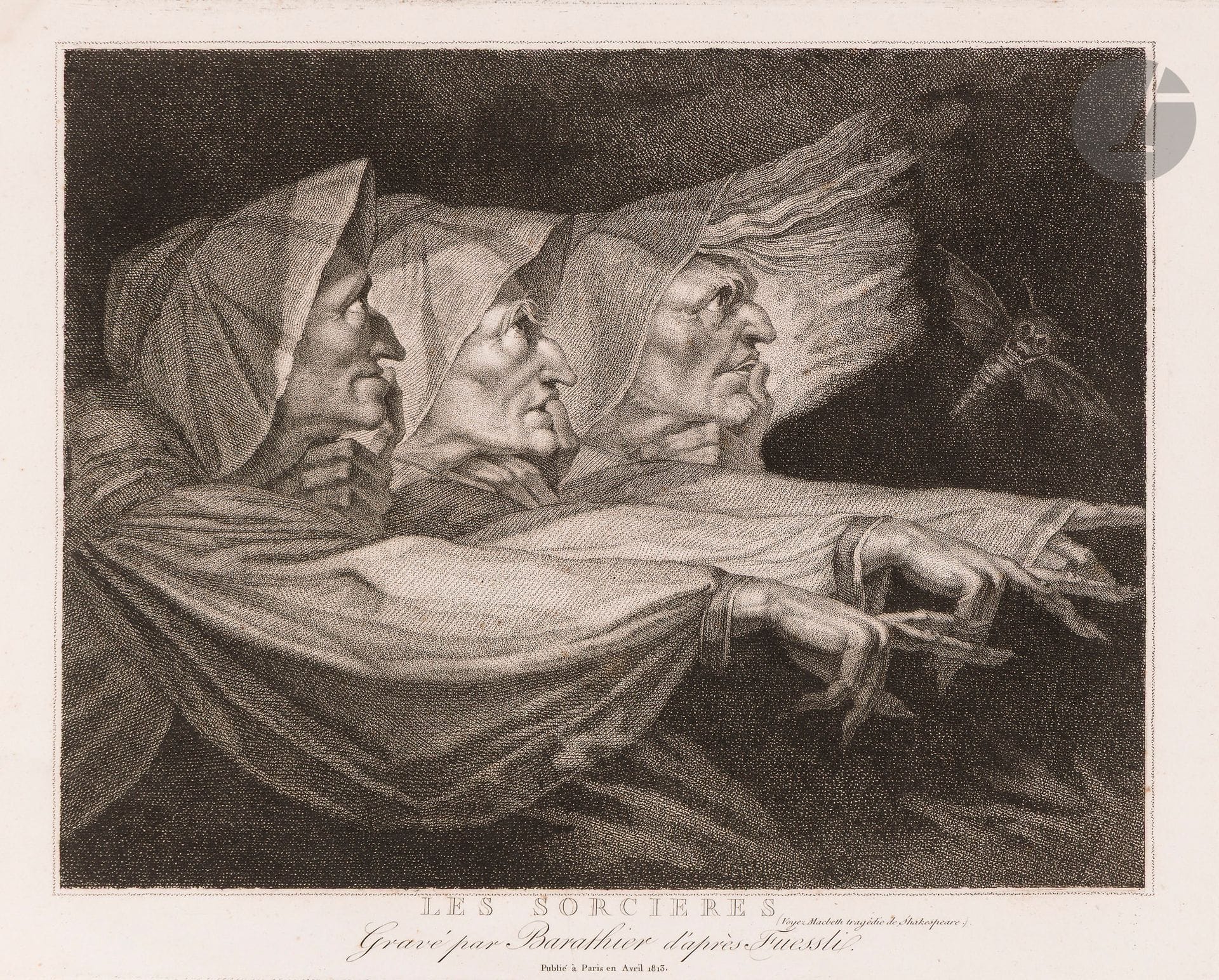
Johann Heinrich Füssli (1741-1825) (after) The Witches. 1813. Dotted engraving by Barathier after the eponymous painting of 1783. 295 x 233. Very fine proof on white vellum. The plate cut slightly fractured on the right and formerly consolidated on the reverse. Very light moisture stain in the upper left corner. Minimal foxing. Short tear at head. Full margins. Very rare. Füssli's original painting is preserved in the Royal Shakespeare Collection in Stratford-upon-Avon. The subject was inspired by the three witches in Macbeth, Act I, Scene 3. Born in Switzerland, Füssli had already been a clergyman for three years when he arrived in London in 1764. A theater enthusiast, he attended numerous performances of Shakespeare's plays. Macbeth was one of the plays that most inspired him. In addition to the witches, whom he painted on several occasions, he also depicted Lady Macbeth in the throes of guilt-ridden madness. Ref: Valérie Sueur-Hermel. Fantastic!l'estampe visionnaire de Goya à Redon. Exhibition cat., Paris, Petit Palais, October 1, 2015-January 17, 2016. Paris, Bibliothèque Nationale de France, 2015, p. 183.
Estimate
€600 - €800
Result
€3,250
Buyer's premium
30%
Johann Heinrich Füssli (1741-1825) (after)
The Witches. 1813. Dotted engraving by Barathier after the eponymous painting of 1783. 295 x 233. Very fine proof on white vellum. The plate cut slightly fractured on the right and formerly consolidated on the reverse. Very light moisture stain in the upper left corner. Minimal foxing. Short tear at head. Full margins. Very rare.
Füssli's original painting is preserved in the Royal Shakespeare Collection in Stratford-upon-Avon. The subject was inspired by the three witches in Macbeth, Act I, Scene 3. Born in Switzerland, Füssli had already been a clergyman for three years when he arrived in London in 1764. A theater enthusiast, he attended numerous performances of Shakespeare's plays. Macbeth was one of the plays that most inspired him. In addition to the witches, whom he painted on several occasions, he also depicted Lady Macbeth in the throes of guilt-ridden madness. Ref: Valérie Sueur-Hermel. Fantastic!l'estampe visionnaire de Goya à Redon. Exhibition cat., Paris, Petit Palais, October 1, 2015-January 17, 2016. Paris, Bibliothèque Nationale de France, 2015, p. 183.
Sale
Wednesday 28 May 2025・14:00 (Europe/Paris)
Sale location coming soon
3, rue Favart
75002 Paris