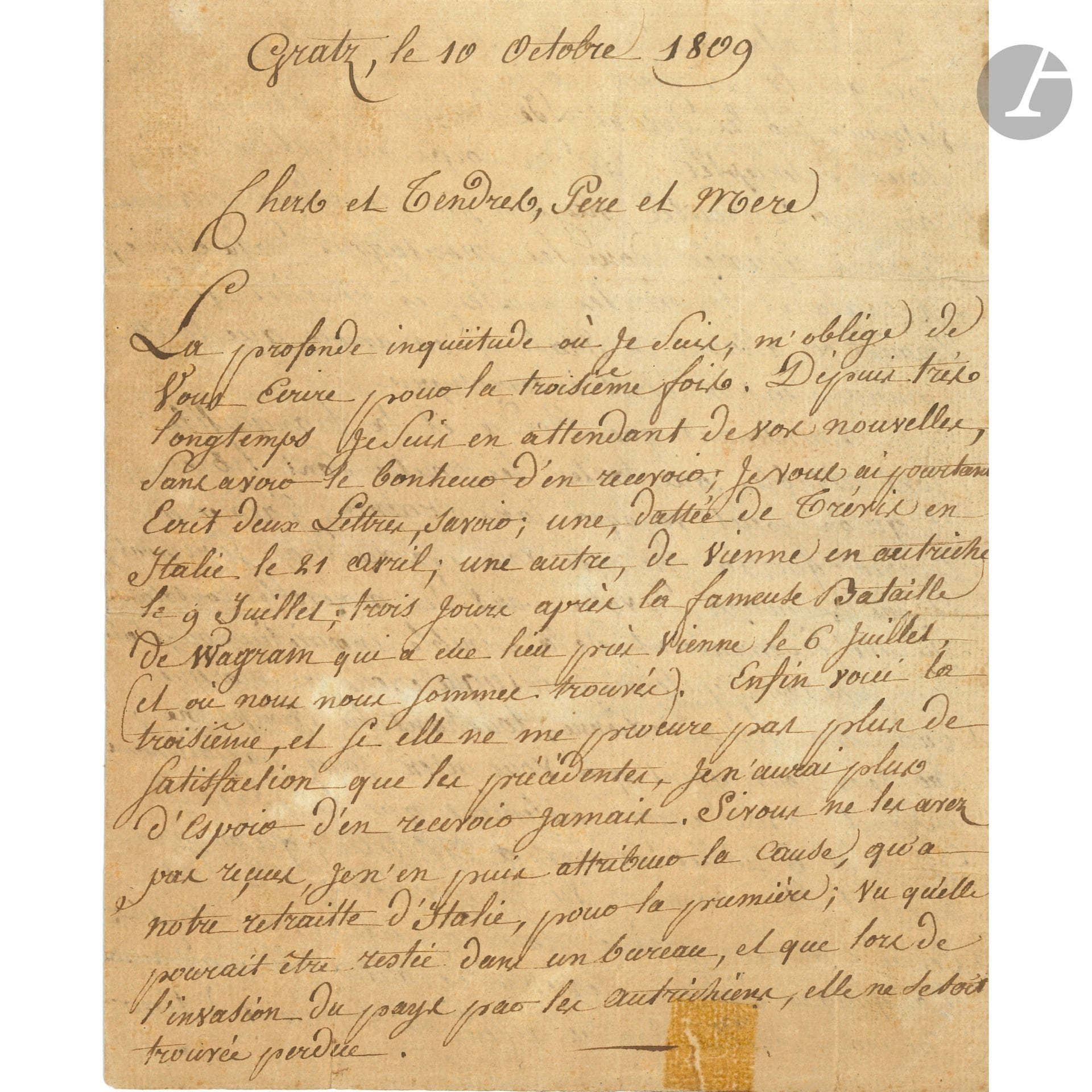
Battle of WAGRAM (July 5–6, 1809). Letter from Private LAVOLLÉ, Gratz, October 10, 1809, to his parents in Bracieux (Loir-et-Cher); 3½ pages, quarto size, addressed with a postmark from the Army of Germany (small tear repaired). A vivid account of the Battle of Wagram. He is worried about not having heard from his parents, to whom he had written two letters, including one on July 9, “three days after the famous Battle of Wagram.” He fears his letters may have been lost, and he recounts the battle, which, “on July 5 and 6, was such that perhaps nothing like it has ever been seen; it took place on a vast plain stretching as far as the eye could see in every direction and some distance from Vienna on the other side of the Danube. At least a thousand cannons fired ceaselessly from morning until evening, making a terrifying noise. From all sides one could hear the whistling of cannonballs tearing through the air, and I can assure you that, despite the fine weather, the sun was obscured by the smoke from the cannons rising into the air; all one could see in every direction were the wounded, dragging themselves along to escape the danger of death! The plain was covered with corpses and unfortunate wounded men crying out for help; one could see brave soldiers carrying as many as two of their comrades on their backs to bring them relief. The Emperor kept moving from one position to another, right in the midst of the danger, and whenever he appeared, cries of “Long live the Emperor!” rang out from all sides; his presence seemed to inspire the soldiers with renewed courage. The fighting continued in this manner until nightfall. The enemy held very advantageous positions and defended them resolutely; but French courage redoubled; the troops charged them, drove them from their positions, and put them to flight. A large number of prisoners, many cannons, and other military equipment fell into our hands; then the fighting ceased, and the soldiers, exhausted from fatigue, finally enjoyed a little rest—which they had not had for more than three days—and wept silently for the loss of their brothers in arms”… He is now stationed in Graz, the capital of Styria, “awaiting peace or war”…
Estimate
€400 - €500
Buyer's premium
31.8%
Battle of WAGRAM (July 5–6, 1809). Letter from Private LAVOLLÉ, Gratz, October 10, 1809, to his parents in Bracieux (Loir-et-Cher); 3½ pages, quarto size, addressed with a postmark from the Army of Germany (small tear repaired).
A vivid account of the Battle of Wagram.
He is worried about not having heard from his parents, to whom he had written two letters, including one on July 9, “three days after the famous Battle of Wagram.” He fears his letters may have been lost, and he recounts the battle, which, “on July 5 and 6, was such that perhaps nothing like it has ever been seen; it took place on a vast plain stretching as far as the eye could see in every direction and some distance from Vienna on the other side of the Danube. At least a thousand cannons fired ceaselessly from morning until evening, making a terrifying noise. From all sides one could hear the whistling of cannonballs tearing through the air, and I can assure you that, despite the fine weather, the sun was obscured by the smoke from the cannons rising into the air; all one could see in every direction were the wounded, dragging themselves along to escape the danger of death! The plain was covered with corpses and unfortunate wounded men crying out for help; one could see brave soldiers carrying as many as two of their comrades on their backs to bring them relief. The Emperor kept moving from one position to another, right in the midst of the danger, and whenever he appeared, cries of “Long live the Emperor!” rang out from all sides; his presence seemed to inspire the soldiers with renewed courage. The fighting continued in this manner until nightfall. The enemy held very advantageous positions and defended them resolutely; but French courage redoubled; the troops charged them, drove them from their positions, and put them to flight. A large number of prisoners, many cannons, and other military equipment fell into our hands; then the fighting ceased, and the soldiers, exhausted from fatigue, finally enjoyed a little rest—which they had not had for more than three days—and wept silently for the loss of their brothers in arms”… He is now stationed in Graz, the capital of Styria, “awaiting peace or war”…
Sale
Thursday 10 December・14:00 (Europe/Paris)
Sale location coming soon
3, rue Favart
75002 Paris