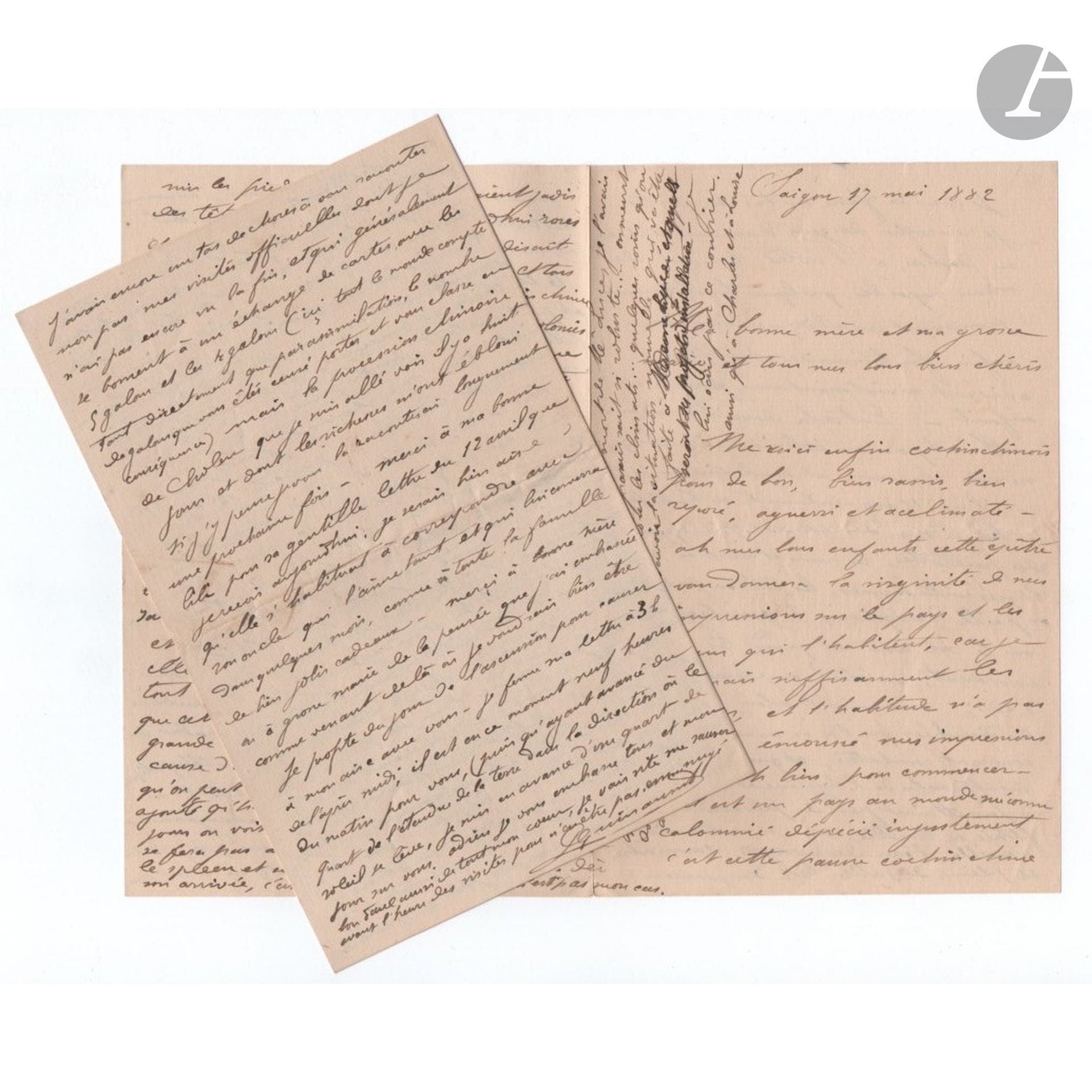
TONKIN. Archive of L. Guillaumot, chief accountant in Tonkin in the late 19th century. 10 letters to his family, “Aboard the Anadyr” and Saigon, April 3–June 3, 1882; 65 pages, in-8 or folio format. A lengthy and interesting correspondence detailing his journey from France to Tonkin, his settlement in Saigon, and his exploration of Tonkin during the French conquest. Excerpt: “Yesterday I went to Cho-Len, the Chinese town 11 kilometers away. Nothing is as curious or as interesting as that; no one knows exactly how many inhabitants there are—estimates range from 125 to 1,500. To maintain order there, there is half a company of Annamite riflemen and a few gendarmes. I saw a temporary pagoda intended to remain open for just one day for some festival or other. There I saw a collection of curiosities the likes of which the Chinese Museum in Paris cannot begin to convey. About a hundred chandeliers (unfortunately lit by kerosene lamps with porcelain globes)—these chandeliers are made of some kind of gilded, carved material, adorned with figures, statuettes, and pendants; it’s dazzling; there are also altars, bronze incense burners, trees carved into the shapes of fish, birds, people, etc., etc. In short, in five days there will be a grand procession that may go as far as Saigon, in which more than 300 people, wearing historical costumes and bearing emblems, will escort enormous dragons. What will make my trip even more interesting is the ease of traveling to Cambodia, to the mountainous regions of Siam and Tonkin, aboard the gunboats, whose officers never fail to invite their acquaintances along on the voyage. Several of our people have already gone on some most interesting excursions. Have the newspapers told you about the recent events in Tonkin? That was all anyone was talking about when I arrived. Our troops ended up fighting the Tonkinese forces holed up in the citadel of Hanoi. The engagement lasted no more than an hour, and we suffered no casualties. Today we are sending 150 men as reinforcements. “Which, together with the approximately 500 already there, will constitute a veritable occupation army quite capable of conquering Tonkin for us—unless our representatives step in to throw a wrench in the works and do the bidding of the British and the Germans”… Etc. Glossary containing several ideograms and their French translations; and some Indochinese terms related to the seasons (1 folio page). Map of the vicinity of Hanoi, consisting of 9 unassembled printed sections (20.5 x 18 cm), to form a map measuring 61.5 x 56 cm. File on the Poignand-Frotier affair, a case of fraud and embezzlement of public funds that took place in Saigon in the 1880s: 5 letters and notes (23 pp., in-4 and in-fol., 1883–1885); plus 2 copies of the newspaper *Le Saïgonnais* containing an article on this case (April 13, 1884).
Estimate
€800 - €1,000
Buyer's premium
31.8%
TONKIN. Archive of L. Guillaumot, chief accountant in Tonkin in the late 19th century.
10 letters to his family, “Aboard the Anadyr” and Saigon, April 3–June 3, 1882; 65 pages, in-8 or folio format. A lengthy and interesting correspondence detailing his journey from France to Tonkin, his settlement in Saigon, and his exploration of Tonkin during the French conquest. Excerpt: “Yesterday I went to Cho-Len, the Chinese town 11 kilometers away. Nothing is as curious or as interesting as that; no one knows exactly how many inhabitants there are—estimates range from 125 to 1,500. To maintain order there, there is half a company of Annamite riflemen and a few gendarmes. I saw a temporary pagoda intended to remain open for just one day for some festival or other. There I saw a collection of curiosities the likes of which the Chinese Museum in Paris cannot begin to convey. About a hundred chandeliers (unfortunately lit by kerosene lamps with porcelain globes)—these chandeliers are made of some kind of gilded, carved material, adorned with figures, statuettes, and pendants; it’s dazzling; there are also altars, bronze incense burners, trees carved into the shapes of fish, birds, people, etc., etc. In short, in five days there will be a grand procession that may go as far as Saigon, in which more than 300 people, wearing historical costumes and bearing emblems, will escort enormous dragons. What will make my trip even more interesting is the ease of traveling to Cambodia, to the mountainous regions of Siam and Tonkin, aboard the gunboats, whose officers never fail to invite their acquaintances along on the voyage. Several of our people have already gone on some most interesting excursions. Have the newspapers told you about the recent events in Tonkin? That was all anyone was talking about when I arrived. Our troops ended up fighting the Tonkinese forces holed up in the citadel of Hanoi. The engagement lasted no more than an hour, and we suffered no casualties. Today we are sending 150 men as reinforcements. “Which, together with the approximately 500 already there, will constitute a veritable occupation army quite capable of conquering Tonkin for us—unless our representatives step in to throw a wrench in the works and do the bidding of the British and the Germans”… Etc.
Glossary containing several ideograms and their French translations; and some Indochinese terms related to the seasons (1 folio page).
Map of the vicinity of Hanoi, consisting of 9 unassembled printed sections (20.5 x 18 cm), to form a map measuring 61.5 x 56 cm.
File on the Poignand-Frotier affair, a case of fraud and embezzlement of public funds that took place in Saigon in the 1880s: 5 letters and notes (23 pp., in-4 and in-fol., 1883–1885); plus 2 copies of the newspaper *Le Saïgonnais* containing an article on this case (April 13, 1884).
Sale
Thursday 10 December・14:00 (Europe/Paris)
Sale location coming soon
3, rue Favart
75002 Paris