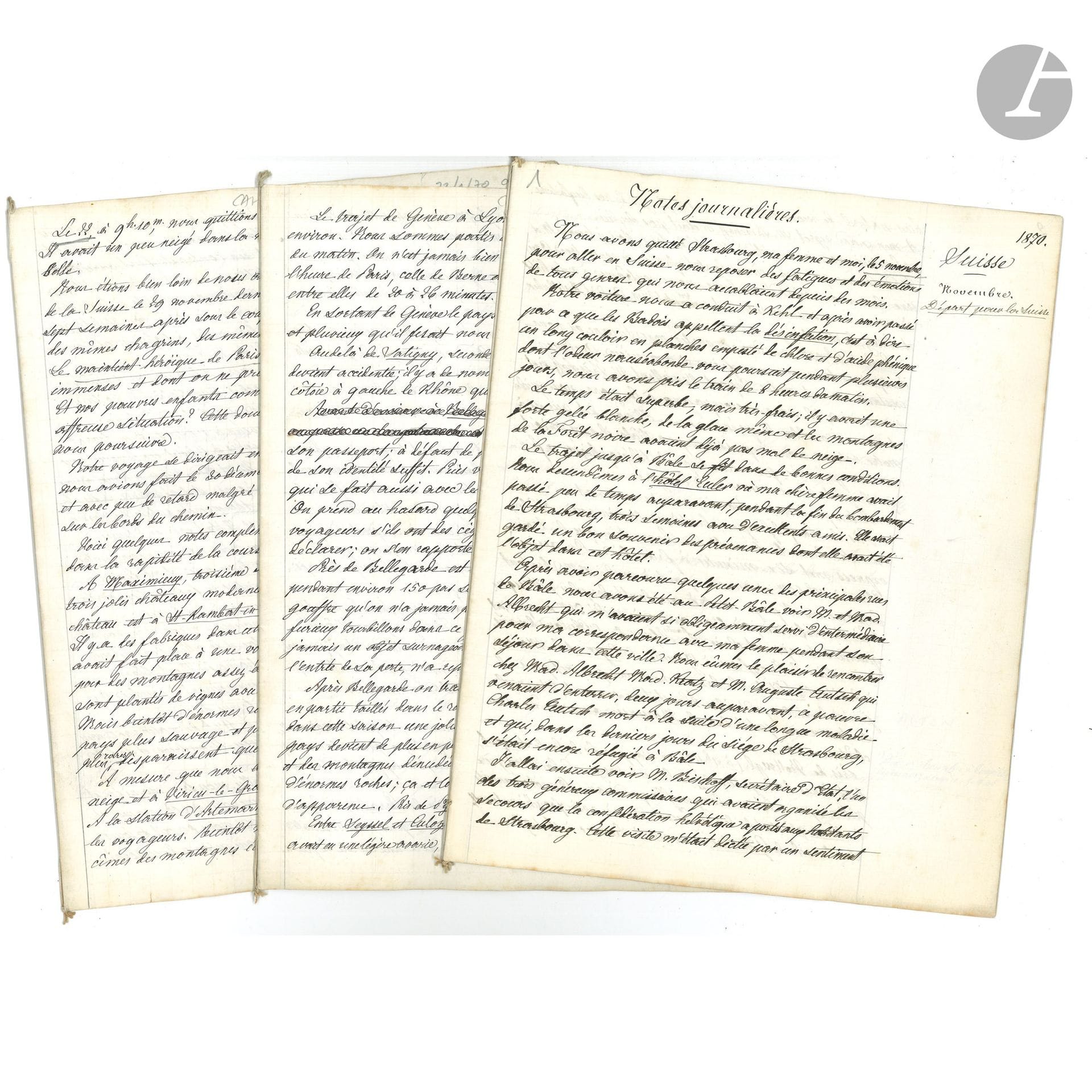
Gustave SILBERMANN (1801–1876), an Alsatian printer. Autograph manuscript, consisting of summary notes followed by daily notes, 1870–1874; 710 pages, in-4 format, in 28 quires (26.5 x 21 cm), housed in a cardboard folder with a cloth-covered spine and cord closures. A very interesting account of the end of the 1870 war, the Prussian occupation, the Paris Commune and the Bloody Week, the early days of the Republic in Versailles, and the postwar period. Gustave Silbermann began working in 1823 at the family printing business in Strasbourg and, in the 1830s, developed a major printing firm, one of the most prosperous of the Second Empire; After selling his printing business to Charles Fischbach (1817–1881) in 1872, he left Alsace and settled in Versailles. This journal falls between the one kept during the siege of Strasbourg (August–October 1870) and the one kept in Versailles from 1874 to 1876 (our auction of October 13–14, 2026, lots 534–535). This diary covers the period from November 5, 1870, to May 16, 1874, and is preceded by “Summary Notes” (4 pages, from October 6 to November 1). It is written in very legible handwriting, with margins in which Silbermann has jotted down headings or additional notes; newspaper clippings have been inserted on several occasions. Each entry begins with a weather report; and Silbermann records in detail all his activities, his travels, his walks, the visits he makes or receives, the lunches or dinners he hosts or to which he is invited, his gardening work, etc. We can offer here only a brief overview of this remarkable journal. After the surrender of Strasbourg, Silbermann asked his wife, who had taken refuge in Basel, to return; on November 1, 1870, he sold his business to the German printer Schauenburg, then left for Switzerland on November 5: Basel, Lucerne, Vevey (where a letter delivered by hot-air balloon informed him that his daughter Mathilde had given birth to a boy named Maurice); outings in the surrounding area: Chillon, Clarens, Montreux, La Tour-de-Peilz, Villeneuve; then Lausanne and Geneva; On November 30, he returned to the family home in Tain (Drôme). Contradictory news from the armies; conscripts and volunteers from the Tain and Valence regions gather at the Sathonay camp near Lyon; an ambulance from Perrache to Lyon, where the wounded are pouring in… Interesting details on the delivery of letters (balloon mail, carrier pigeons, Moulins balls, transit through the Prussian postal system…). In January 1871, a trip to Switzerland and a stay in Basel (visits to the museums and the botanical garden), while Jules Favre was about to sign the armistice and Paris was being heavily bombarded. “The Swiss continue their generous charity toward our unfortunate compatriots. In addition to the warm welcome and aid of every kind they hasten to provide to our wounded soldiers, the sick, or prisoners who reach Swiss territory, they have for several days been sending numerous convoys of food to the area around Montbéliard and to all the neighboring French towns where misery and famine have been caused by the war”… Having obtained a permit, Silbermann traveled to Paris in late February to reunite with his daughter Mathilde, his son-in-law Edmond Hartung, and their son Maurice, who had grown thin due to the harsh conditions of the siege; “the sight of Paris is very sad”; there were large numbers of soldiers and reservists; many trees had been cut down on the outer boulevards and in the Bois de Boulogne; the outskirts of Paris are devastated; “the statue of Strasbourg on the Place de la Concorde is covered with flags, garlands of foliage and flowers, and wreaths of everlasting flowers bearing inscriptions. […] The omnibuses are running, but there are very few carriages because most of the horses have been eaten.” Great commotion on February 27, as fears mount that the Prussians will enter Paris. Newspaper clipping on the signing of the preliminary peace terms. March 1, an account of the Prussians’ entry onto the Champs-Élysées and the Place de la Concorde: “Barricades made of artillery carriages block the bridges and streets, which the enemy will be unable to approach. […] The statues of France’s major cities on the Place de la Concorde have their faces veiled in black [...] in the streets, the national flag is flown draped in black crepe. Throughout Paris, stores, restaurants, and cafés are closed […] it is a day of general mourning made as visible as possible”… Signing of the peace treaty; Prussian troops evacuate Paris… “Rents have fallen considerably. All luxury has disappeared; almost all the women are dressed in black”… Paris Commune (the account of the Commune and its suppression takes up more than
Estimate
€2,500 - €3,000
Buyer's premium
31.8%
Gustave SILBERMANN (1801–1876), an Alsatian printer. Autograph manuscript, consisting of summary notes followed by daily notes, 1870–1874; 710 pages, in-4 format, in 28 quires (26.5 x 21 cm), housed in a cardboard folder with a cloth-covered spine and cord closures.
A very interesting account of the end of the 1870 war, the Prussian occupation, the Paris Commune and the Bloody Week, the early days of the Republic in Versailles, and the postwar period.
Gustave Silbermann began working in 1823 at the family printing business in Strasbourg and, in the 1830s, developed a major printing firm, one of the most prosperous of the Second Empire; After selling his printing business to Charles Fischbach (1817–1881) in 1872, he left Alsace and settled in Versailles. This journal falls between the one kept during the siege of Strasbourg (August–October 1870) and the one kept in Versailles from 1874 to 1876 (our auction of October 13–14, 2026, lots 534–535).
This diary covers the period from November 5, 1870, to May 16, 1874, and is preceded by “Summary Notes” (4 pages, from October 6 to November 1). It is written in very legible handwriting, with margins in which Silbermann has jotted down headings or additional notes; newspaper clippings have been inserted on several occasions. Each entry begins with a weather report; and Silbermann records in detail all his activities, his travels, his walks, the visits he makes or receives, the lunches or dinners he hosts or to which he is invited, his gardening work, etc. We can offer here only a brief overview of this remarkable journal.
After the surrender of Strasbourg, Silbermann asked his wife, who had taken refuge in Basel, to return; on November 1, 1870, he sold his business to the German printer Schauenburg, then left for Switzerland on November 5: Basel, Lucerne, Vevey (where a letter delivered by hot-air balloon informed him that his daughter Mathilde had given birth to a boy named Maurice); outings in the surrounding area: Chillon, Clarens, Montreux, La Tour-de-Peilz, Villeneuve; then Lausanne and Geneva; On November 30, he returned to the family home in Tain (Drôme). Contradictory news from the armies; conscripts and volunteers from the Tain and Valence regions gather at the Sathonay camp near Lyon; an ambulance from Perrache to Lyon, where the wounded are pouring in… Interesting details on the delivery of letters (balloon mail, carrier pigeons, Moulins balls, transit through the Prussian postal system…). In January 1871, a trip to Switzerland and a stay in Basel (visits to the museums and the botanical garden), while Jules Favre was about to sign the armistice and Paris was being heavily bombarded. “The Swiss continue their generous charity toward our unfortunate compatriots. In addition to the warm welcome and aid of every kind they hasten to provide to our wounded soldiers, the sick, or prisoners who reach Swiss territory, they have for several days been sending numerous convoys of food to the area around Montbéliard and to all the neighboring French towns where misery and famine have been caused by the war”… Having obtained a permit, Silbermann traveled to Paris in late February to reunite with his daughter Mathilde, his son-in-law Edmond Hartung, and their son Maurice, who had grown thin due to the harsh conditions of the siege; “the sight of Paris is very sad”; there were large numbers of soldiers and reservists; many trees had been cut down on the outer boulevards and in the Bois de Boulogne; the outskirts of Paris are devastated; “the statue of Strasbourg on the Place de la Concorde is covered with flags, garlands of foliage and flowers, and wreaths of everlasting flowers bearing inscriptions. […] The omnibuses are running, but there are very few carriages because most of the horses have been eaten.” Great commotion on February 27, as fears mount that the Prussians will enter Paris. Newspaper clipping on the signing of the preliminary peace terms. March 1, an account of the Prussians’ entry onto the Champs-Élysées and the Place de la Concorde: “Barricades made of artillery carriages block the bridges and streets, which the enemy will be unable to approach. […] The statues of France’s major cities on the Place de la Concorde have their faces veiled in black [...] in the streets, the national flag is flown draped in black crepe. Throughout Paris, stores, restaurants, and cafés are closed […] it is a day of general mourning made as visible as possible”… Signing of the peace treaty; Prussian troops evacuate Paris… “Rents have fallen considerably. All luxury has disappeared; almost all the women are dressed in black”…
Paris Commune (the account of the Commune and its suppression takes up more than
Sale
Thursday 10 December・14:00 (Europe/Paris)
Sale location coming soon
3, rue Favart
75002 Paris