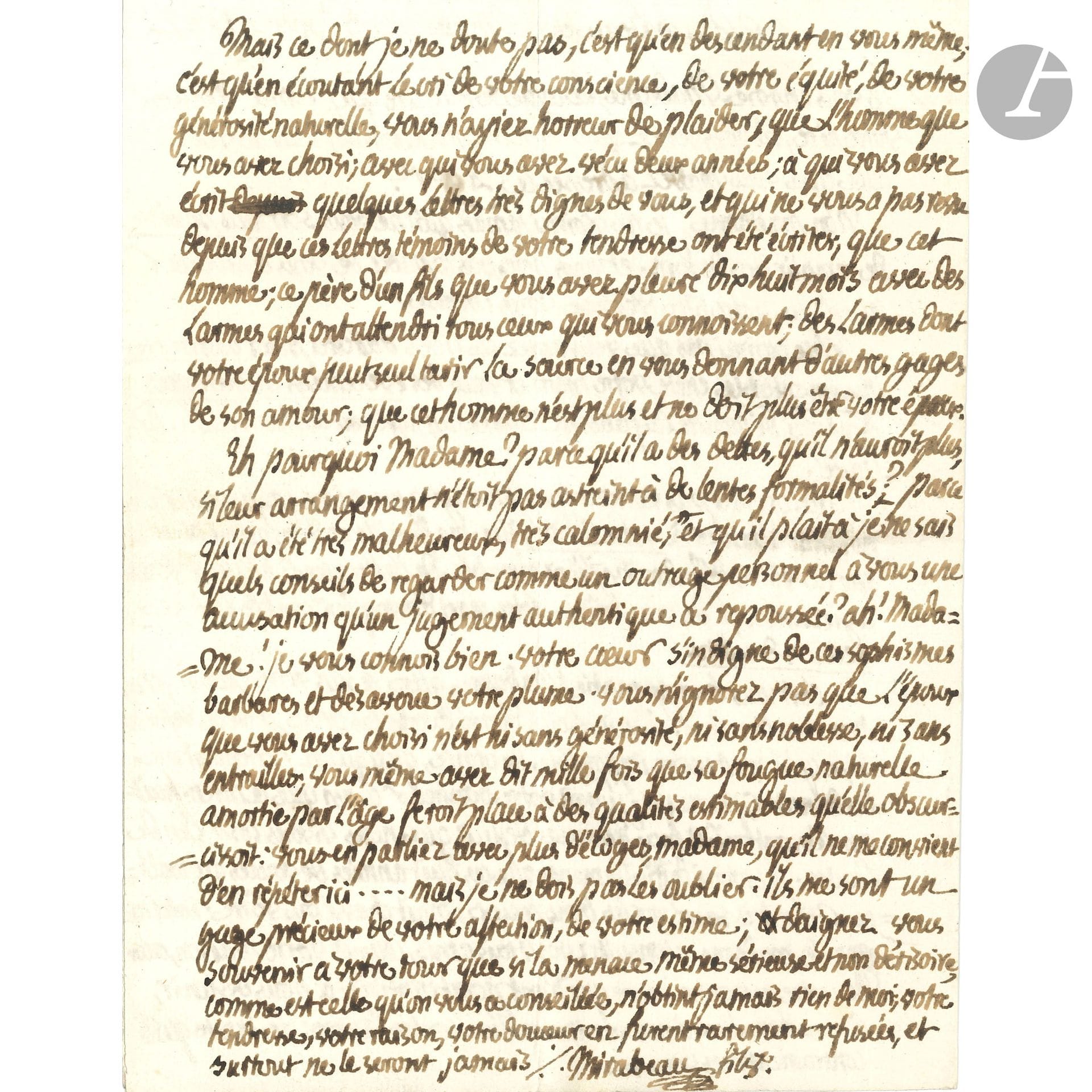
Honoré Gabriel Riquetti, Count of MIRABEAU (1749–1791). Autograph letter, written at the Château de Mirabeau on November 6, 1782, to his wife; 2 pages, in-4. A surprising attempt at reconciliation with his wife, who had filed for legal separation. Mirabeau wrote to his father-in-law, the Marquis de Marignane… “No, Madame, I shall never believe that it is no longer possible for you to fulfill your duties; and you are not capable of concealing from yourself those duties that your title as a wife imposes upon you. I will not believe that you could have conceived of citing as an insurmountable barrier between you and your husband those fanciful events whose falsity I have demonstrated, as an authentic judgment has declared. Above all, I will not believe that you could have suspected me of attempting to infringe upon your freedom—which my entire family, as well as yours, would defend were I capable of attacking it—nor that you yourself threatened your husband by invoking the protection of the law against him. It is under their guarantee, Madam, that I am your husband; and that title is very dear to me. I am resolved to claim my rights as such and to defend them, […] because I see in them your happiness as well as my own. Eight years have matured my youth since we have lived apart. I find it hard to believe that these eight years devoted to misfortune—a title held in the highest regard by good hearts—have driven me from yours. Ask Madame; consult your true friends—those in your household, those closest to you; those who have no interest in driving a wedge between us, in causing a rift, or in turning us against one another: I doubt they would stand in the way of my wishes. But what I do not doubt is that, if you look deep within yourself; that by heeding the voice of your conscience, your sense of justice, and your natural generosity, you will be horrified at the very thought of arguing that the man you chose—with whom you lived for two years, to whom you wrote several letters most worthy of you, and who has not seen you since those letters—testaments to your tenderness—were written; that this man, the father of a son [Victor, who died in 1778] whom you mourned for eighteen months with tears that moved all who know you; tears whose flow only your husband can stem by giving you further proofs of his love—that this man is no longer, and must never again be, your husband. Why, madam? Because he has debts—debts he would no longer have if their settlement were not subject to tedious formalities? Because he has been very unhappy, very slandered, and because it pleases I know not what advisors to regard as a personal affront to you an accusation that an authentic judgment has rejected? Ah! Madam! I know you well. Your heart is outraged by these barbaric sophisms and disavows your pen. You are well aware that the husband you have chosen is neither without generosity, nor without nobility, nor without compassion; you yourself have said a thousand times that his natural impetuosity, tempered by age, would give way to admirable qualities”; these, and other such praises, are “a precious token of your affection and esteem; deign to remember, in turn, that while even the most serious threats […] never extracted anything from me, your tenderness, your reason, and your gentleness were rarely refused, and above all, will never be refused.” ” [Pursued by creditors, Mirabeau was imprisoned, at his father’s request, at Fort de Joux; free to come and go as he pleased, he had an affair with Sophie de Monnier, with whom he fled to Holland in 1776; after their arrest and the birth of their daughter, the two lovers parted ways, and Mirabeau attempted to reconcile with his family; the separation from Émilie de Marignane was finalized in 1783.]
Estimate
€2,000 - €2,500
Buyer's premium
31.8%
Honoré Gabriel Riquetti, Count of MIRABEAU (1749–1791). Autograph letter, written at the Château de Mirabeau on November 6, 1782, to his wife; 2 pages, in-4.
A surprising attempt at reconciliation with his wife, who had filed for legal separation.
Mirabeau wrote to his father-in-law, the Marquis de Marignane… “No, Madame, I shall never believe that it is no longer possible for you to fulfill your duties; and you are not capable of concealing from yourself those duties that your title as a wife imposes upon you. I will not believe that you could have conceived of citing as an insurmountable barrier between you and your husband those fanciful events whose falsity I have demonstrated, as an authentic judgment has declared. Above all, I will not believe that you could have suspected me of attempting to infringe upon your freedom—which my entire family, as well as yours, would defend were I capable of attacking it—nor that you yourself threatened your husband by invoking the protection of the law against him. It is under their guarantee, Madam, that I am your husband; and that title is very dear to me. I am resolved to claim my rights as such and to defend them, […] because I see in them your happiness as well as my own. Eight years have matured my youth since we have lived apart. I find it hard to believe that these eight years devoted to misfortune—a title held in the highest regard by good hearts—have driven me from yours. Ask Madame; consult your true friends—those in your household, those closest to you; those who have no interest in driving a wedge between us, in causing a rift, or in turning us against one another: I doubt they would stand in the way of my wishes.
But what I do not doubt is that, if you look deep within yourself; that by heeding the voice of your conscience, your sense of justice, and your natural generosity, you will be horrified at the very thought of arguing that the man you chose—with whom you lived for two years, to whom you wrote several letters most worthy of you, and who has not seen you since those letters—testaments to your tenderness—were written; that this man, the father of a son [Victor, who died in 1778] whom you mourned for eighteen months with tears that moved all who know you; tears whose flow only your husband can stem by giving you further proofs of his love—that this man is no longer, and must never again be, your husband.
Why, madam? Because he has debts—debts he would no longer have if their settlement were not subject to tedious formalities? Because he has been very unhappy, very slandered, and because it pleases I know not what advisors to regard as a personal affront to you an accusation that an authentic judgment has rejected? Ah! Madam! I know you well. Your heart is outraged by these barbaric sophisms and disavows your pen. You are well aware that the husband you have chosen is neither without generosity, nor without nobility, nor without compassion; you yourself have said a thousand times that his natural impetuosity, tempered by age, would give way to admirable qualities”; these, and other such praises, are “a precious token of your affection and esteem; deign to remember, in turn, that while even the most serious threats […] never extracted anything from me, your tenderness, your reason, and your gentleness were rarely refused, and above all, will never be refused.” ”
[Pursued by creditors, Mirabeau was imprisoned, at his father’s request, at Fort de Joux; free to come and go as he pleased, he had an affair with Sophie de Monnier, with whom he fled to Holland in 1776; after their arrest and the birth of their daughter, the two lovers parted ways, and Mirabeau attempted to reconcile with his family; the separation from Émilie de Marignane was finalized in 1783.]
Sale
Thursday 10 December・14:00 (Europe/Paris)
Sale location coming soon
3, rue Favart
75002 Paris