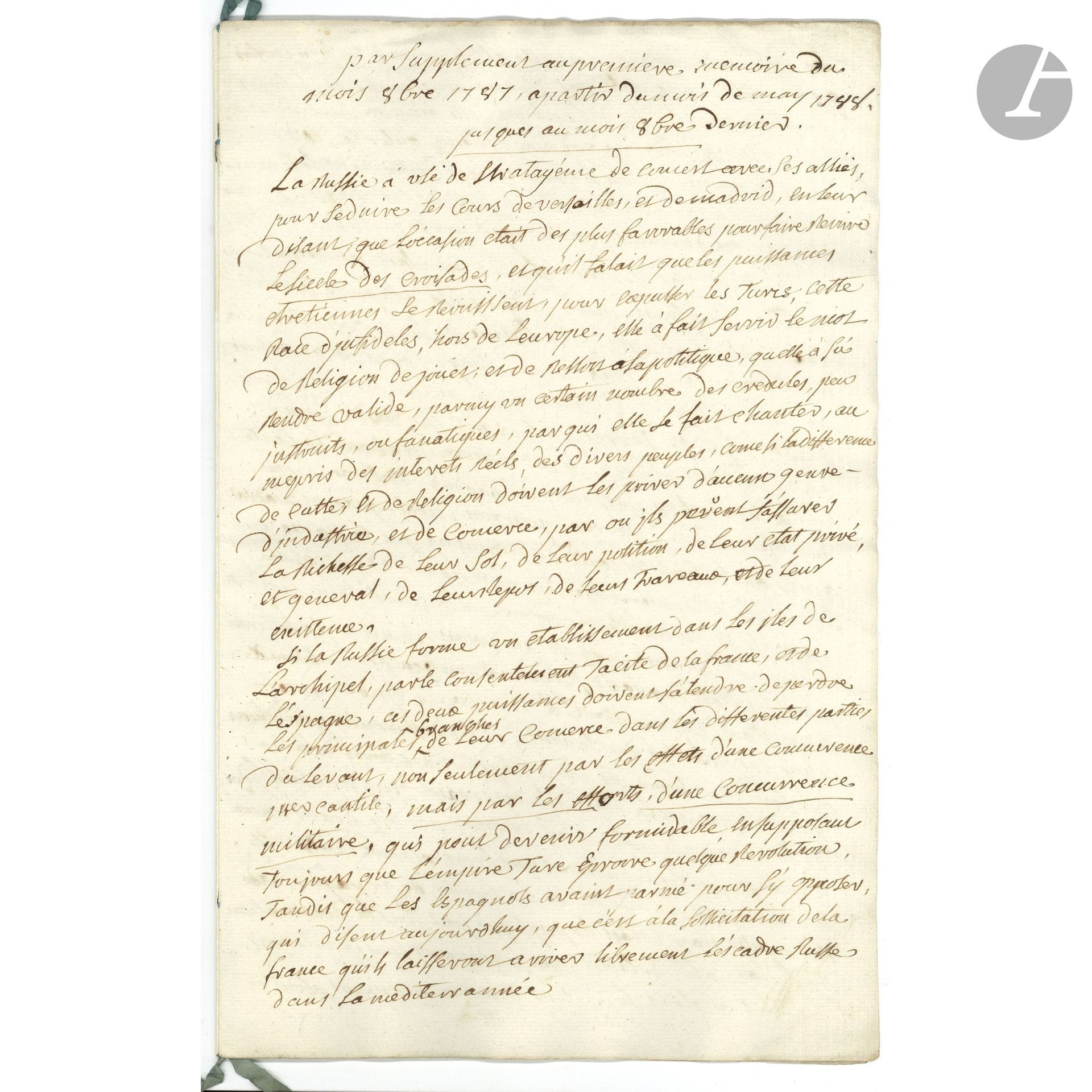
LEVANT. L.A.S. and autograph manuscript by LE BON, Auteuil near Paris, December 30, [1787] and 1788; 3 folio pages and a 7-page folio booklet bound with a blue ribbon. Observations on French trade in the Levant and the attitude of the other European powers. The letter aims to present “a few humble observations regarding our trade in the Levant and some of the consequences that may result from the war currently raging in that region.” In it, Le Bon denounces the joint threat (and military ambitions) of Russia and England—with the tacit complicity of Holland and Norway—to seize control of the Levant trade held by the Turks: “In addition to the squadron that Russia has assembled in the Mediterranean—for which the English have supplied a number of ships built in the ports of Sardinia, Livorno, the Kingdom of Naples, and Trieste by English shipbuilders— and the emperor has supplied part of the artillery, it is preparing to send a considerable fleet there as soon as the weather permits; several of its officers are already in Naples to receive it at the ports where it will call”… The memorandum recounts the events of 1787–1788 concerning the intrigues of Russia and England against the Turks: “Russia employed a stratagem in concert with its allies to win over the courts of Versailles and Madrid, telling them that the opportunity was most favorable for reviving the age of the Crusades and that the Christian powers must unite to expel the Turks [...] from Europe. It used the word ‘religion’ as a tool and a springboard for its politics, which it managed to make credible among a certain number of gullible, uneducated, or fanatical people”... Le Bon then refers to “commercial competition” and “military competition” in the event that Russia were to establish itself on the islands of the Archipelago, with the support of the English and the Austrians, to the detriment of the French and the Spanish. Finally, he explains England’s foreign policy, which seeks by all means to undermine French interests by orchestrating a web of manipulations among European nations: “If Russia were to sail into the North Sea, into the French and Spanish seas all the way to the Mediterranean, with merchant ships, we should welcome it warmly—but not if they were armed for war. The English will always use as a pretext the freedom granted to Russia to send fleets into our seas, in order to use its flag to harass and terrorize our commerce; Russian ships are piloted by English pilots, at least those sailing in the ocean and the Mediterranean. The Sublime Porte, by granting them free passage through the Black Sea and through the Dardanelles into that sea, did not foresee all the various advantages it was granting Russia at the expense of its own immediate interests, especially regarding its possessions in the Archipelago”…
Estimate
€500 - €600
Buyer's premium
31.8%
LEVANT. L.A.S. and autograph manuscript by LE BON, Auteuil near Paris, December 30, [1787] and 1788; 3 folio pages and a 7-page folio booklet bound with a blue ribbon.
Observations on French trade in the Levant and the attitude of the other European powers.
The letter aims to present “a few humble observations regarding our trade in the Levant and some of the consequences that may result from the war currently raging in that region.” In it, Le Bon denounces the joint threat (and military ambitions) of Russia and England—with the tacit complicity of Holland and Norway—to seize control of the Levant trade held by the Turks: “In addition to the squadron that Russia has assembled in the Mediterranean—for which the English have supplied a number of ships built in the ports of Sardinia, Livorno, the Kingdom of Naples, and Trieste by English shipbuilders— and the emperor has supplied part of the artillery, it is preparing to send a considerable fleet there as soon as the weather permits; several of its officers are already in Naples to receive it at the ports where it will call”…
The memorandum recounts the events of 1787–1788 concerning the intrigues of Russia and England against the Turks: “Russia employed a stratagem in concert with its allies to win over the courts of Versailles and Madrid, telling them that the opportunity was most favorable for reviving the age of the Crusades and that the Christian powers must unite to expel the Turks [...] from Europe. It used the word ‘religion’ as a tool and a springboard for its politics, which it managed to make credible among a certain number of gullible, uneducated, or fanatical people”... Le Bon then refers to “commercial competition” and “military competition” in the event that Russia were to establish itself on the islands of the Archipelago, with the support of the English and the Austrians, to the detriment of the French and the Spanish. Finally, he explains England’s foreign policy, which seeks by all means to undermine French interests by orchestrating a web of manipulations among European nations: “If Russia were to sail into the North Sea, into the French and Spanish seas all the way to the Mediterranean, with merchant ships, we should welcome it warmly—but not if they were armed for war. The English will always use as a pretext the freedom granted to Russia to send fleets into our seas, in order to use its flag to harass and terrorize our commerce; Russian ships are piloted by English pilots, at least those sailing in the ocean and the Mediterranean. The Sublime Porte, by granting them free passage through the Black Sea and through the Dardanelles into that sea, did not foresee all the various advantages it was granting Russia at the expense of its own immediate interests, especially regarding its possessions in the Archipelago”…
Sale
Thursday 10 December・14:00 (Europe/Paris)
Sale location coming soon
3, rue Favart
75002 Paris