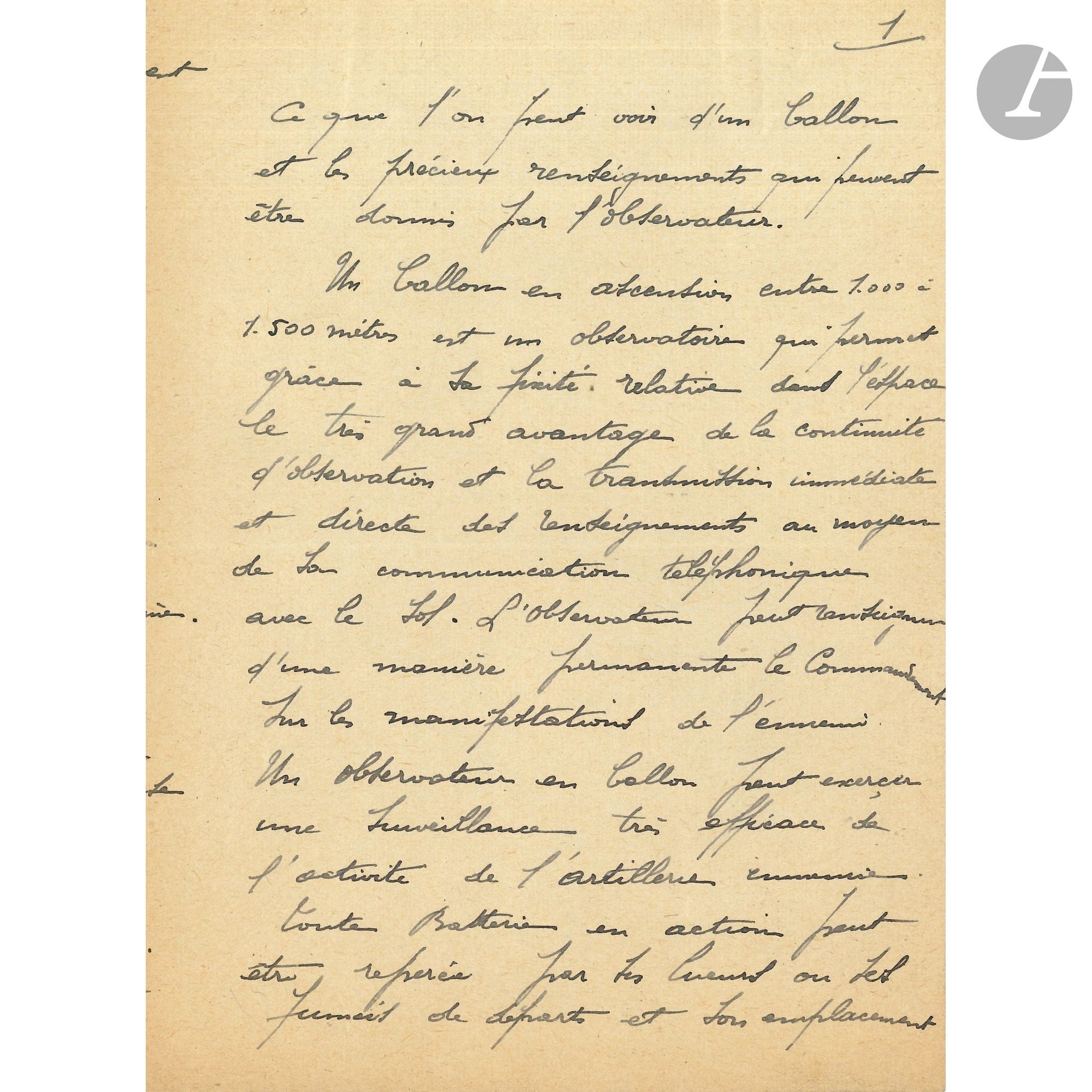
WORLD WAR I, 1914–1918. Joseph MATHIEU (1889–1976?), second lieutenant and balloon observer (Balloon 48, Sector 220). 2 letters and an autograph manuscript, 1918, to Jacques Mortane, editor-in-chief of *La Guerre aérienne*; 5 and 4 pages, in-8 format. An interesting collection on balloon observation during the war. Joseph Mathieu published his *Memoirs of a Balloon Observer, 1914–1918* in 1972 with a preface by General Caquot (Duplication Gaban, 160 copies). Jacques Mortane devoted a special issue of *La Guerre Aérienne illustrée* to “Balloon Observers” (No. 81, May 30, 1918). *Aux Armées*, February 7, 1918. Mathieu invited Mortane to dedicate an issue of his magazine to “those whose thankless yet noble role as balloon observers is all too little known on the home front. […] For my part, I experienced days of true life up there. With that love for the job that makes one enjoy keeping watch all day long in a cramped basket. On those radiant days when nothing moves within 15 kilometers without catching the eye—from where one observes well-aimed shots, spotting the shell craters after every strike because the sky is so clear. You feel proud, and happy too, when the photos provide proof that your shot was on target […] What terrible risks does the balloon observer indeed face; he doesn’t fall from an airplane—alas, he has fallen because of them. At every moment, an attack is to be feared. He does have the parachute as a resource, but even if he reaches the ground safe and sound, he is in danger of being crushed while being dragged along if the wind blows. He faces, against him, the cannon, the airplane, the storm"... – February 22: He confirms his collaboration—and that of his comrades—on the special issue about “balloon observers”... The manuscript consists of two parts: “What Can Be Seen from a Balloon and the Valuable Information That Can Be Provided by the Observer”; followed by “The Risks Faced by the Balloon Observer.” Here is the opening: “A balloon ascending to an altitude of 1,000 to 1,500 meters serves as an observatory; thanks to its relative stillness in space, it offers the great advantage of continuous observation and the immediate and direct transmission of intelligence via telephone communication with the ground. The observer can continuously report to the commander on enemy movements. A balloon observer can conduct highly effective surveillance of enemy artillery activity”… Etc. A note from Jacques Mortane is attached: “Mathieu, a balloon observer—he describes the thankless yet dangerous role, as he is often shot down by enemy aircraft—would remain in the same spot for hours in a cramped gondola, often adjusting fire on distant targets.”
Estimate
€300 - €400
Buyer's premium
31.8%
WORLD WAR I, 1914–1918. Joseph MATHIEU (1889–1976?), second lieutenant and balloon observer (Balloon 48, Sector 220). 2 letters and an autograph manuscript, 1918, to Jacques Mortane, editor-in-chief of *La Guerre aérienne*; 5 and 4 pages, in-8 format.
An interesting collection on balloon observation during the war.
Joseph Mathieu published his *Memoirs of a Balloon Observer, 1914–1918* in 1972 with a preface by General Caquot (Duplication Gaban, 160 copies). Jacques Mortane devoted a special issue of *La Guerre Aérienne illustrée* to “Balloon Observers” (No. 81, May 30, 1918).
*Aux Armées*, February 7, 1918. Mathieu invited Mortane to dedicate an issue of his magazine to “those whose thankless yet noble role as balloon observers is all too little known on the home front. […] For my part, I experienced days of true life up there. With that love for the job that makes one enjoy keeping watch all day long in a cramped basket. On those radiant days when nothing moves within 15 kilometers without catching the eye—from where one observes well-aimed shots, spotting the shell craters after every strike because the sky is so clear. You feel proud, and happy too, when the photos provide proof that your shot was on target […] What terrible risks does the balloon observer indeed face; he doesn’t fall from an airplane—alas, he has fallen because of them. At every moment, an attack is to be feared. He does have the parachute as a resource, but even if he reaches the ground safe and sound, he is in danger of being crushed while being dragged along if the wind blows. He faces, against him, the cannon, the airplane, the storm"... – February 22: He confirms his collaboration—and that of his comrades—on the special issue about “balloon observers”...
The manuscript consists of two parts: “What Can Be Seen from a Balloon and the Valuable Information That Can Be Provided by the Observer”; followed by “The Risks Faced by the Balloon Observer.” Here is the opening: “A balloon ascending to an altitude of 1,000 to 1,500 meters serves as an observatory; thanks to its relative stillness in space, it offers the great advantage of continuous observation and the immediate and direct transmission of intelligence via telephone communication with the ground. The observer can continuously report to the commander on enemy movements. A balloon observer can conduct highly effective surveillance of enemy artillery activity”… Etc.
A note from Jacques Mortane is attached: “Mathieu, a balloon observer—he describes the thankless yet dangerous role, as he is often shot down by enemy aircraft—would remain in the same spot for hours in a cramped gondola, often adjusting fire on distant targets.”
Sale
Thursday 10 December・14:00 (Europe/Paris)
Sale location coming soon
3, rue Favart
75002 Paris