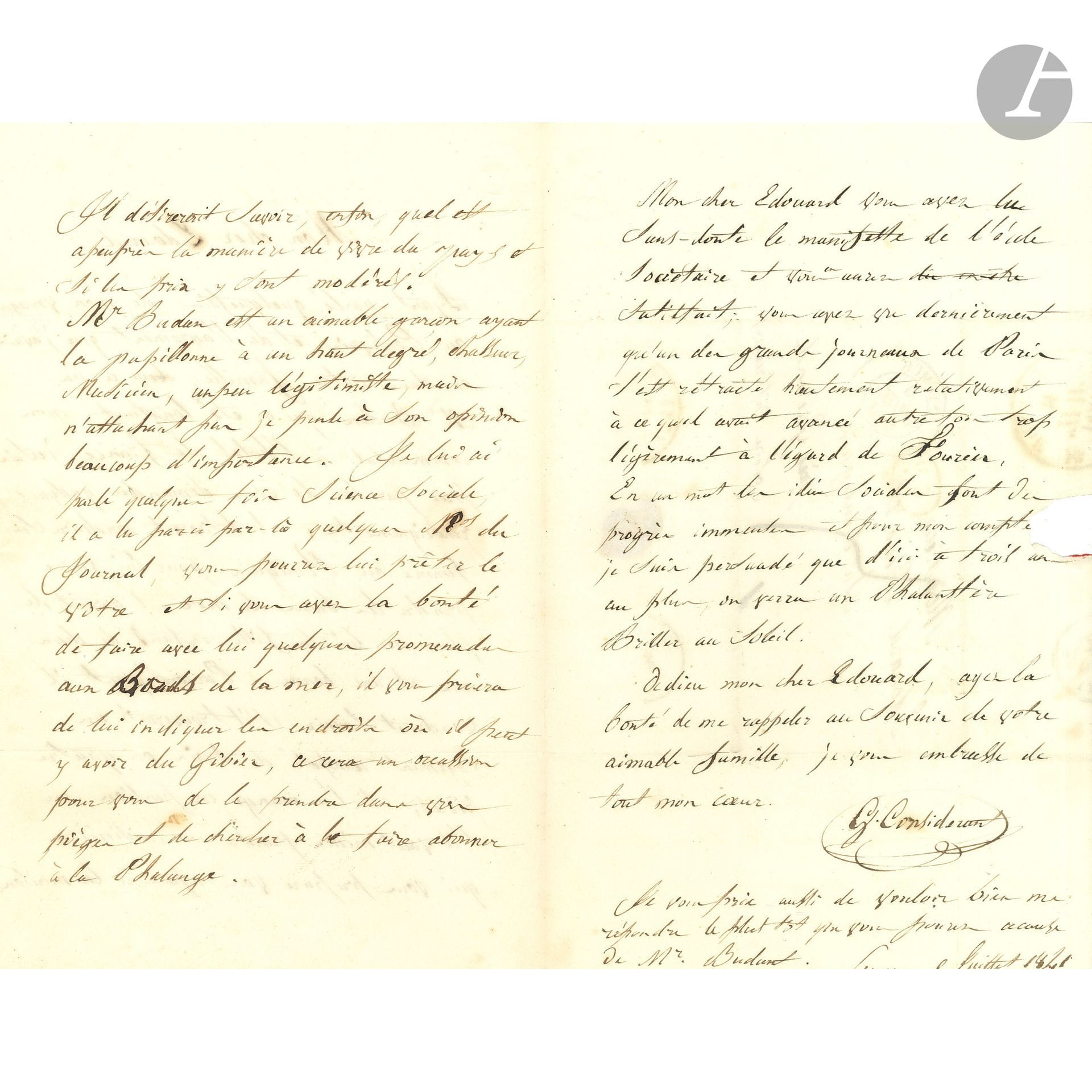
FOURIERISM. Georges CONSIDÉRANT (1800–1885), a Phalansterian and Fourierist, and Victor’s older brother. 7 letters from the sender (L.A.S.), Saumur 1838–1847, to the Fourierist Édouard Benoist (1816–1871) in Le Pouliguen and Le Croisic; 21 pages in-4 and in-8 formats, with addresses. Interesting correspondence, particularly regarding Fourierism, his brother Victor’s activist work, and the establishment of a phalanstery. He justifies Victor’s positions, which surprised many followers. “At first I was distressed because I thought this would be misinterpreted by the newspapers, and my predictions were confirmed; but I understood immediately—and any phalansterian could understand—that Victor was not expressing this opinion as a blind supporter of the government, but out of fear of war, which, at that moment, could be very unfavorable to us. It would have been appropriate to do so in 1830, when the allies were no better off than we were and we had the enthusiasm of much of Europe on our side; now, however, things have changed considerably; our army, which was supposed to number 400,000 men, may not even reach 250,000, even counting those in Africa. […] On the other hand, Victor sees the Phalansterian ideas—which he regards as the salvation of humanity—making rapid enough progress to hope for a first trial in the near future; all of this would be jeopardized by war and postponed to an undetermined time. As you know, his election was unsuccessful, but he stayed for a few days in Colmar and Montbéliard, where he expounded Fourier’s doctrine in a series of lectures and gained many supporters there”… He repeatedly mentions inventions whose patents are expected to generate enough revenue to finance a first phalanstery; he also acts as a proselytizer. “My brother-in-law is very taken with Phalanstère ideas; he has read *Destinée Sociale* and the first volume of Fourier’s great treatise, as well as the newspaper *La Phalange*, and he will contribute a small sum when the time comes. The war, if it takes place, will no doubt harm our air machine—which, incidentally, has been perfected and is a truly fine invention—but the Phalanstery will function nonetheless. […] Social ideas are making immense progress, and for my part, I am convinced that within three years at most, we will see a Phalanstery shining in the sun”… He also reflects on the failures in implementing Fourier’s doctrine. “You feel that Phalanstère affairs are not moving quickly enough; I agree with you. The Phalanstère at Cito [Citeaux Abbey] is, in my view, an unfortunate venture, and were it not for the intrigues of Mr. Gassi de G., the funds allocated to Cito would have gone to Condé. From the very beginning, I regarded the Cito affair as a folly; the idea of turning a former convent into a Phalanstère has always struck me as absurd—the layout and dimensions are completely incompatible, and I am convinced that the influence of the building’s layout must be enormous in such a case”… Etc. Enclosed are a photograph and a calling card of the Fourierist Clarisse Vigoureux, as well as two calling cards from Victor Considérant.
Estimate
€300 - €400
Buyer's premium
31.8%
FOURIERISM. Georges CONSIDÉRANT (1800–1885), a Phalansterian and Fourierist, and Victor’s older brother. 7 letters from the sender (L.A.S.), Saumur 1838–1847, to the Fourierist Édouard Benoist (1816–1871) in Le Pouliguen and Le Croisic; 21 pages in-4 and in-8 formats, with addresses.
Interesting correspondence, particularly regarding Fourierism, his brother Victor’s activist work, and the establishment of a phalanstery. He justifies Victor’s positions, which surprised many followers. “At first I was distressed because I thought this would be misinterpreted by the newspapers, and my predictions were confirmed; but I understood immediately—and any phalansterian could understand—that Victor was not expressing this opinion as a blind supporter of the government, but out of fear of war, which, at that moment, could be very unfavorable to us. It would have been appropriate to do so in 1830, when the allies were no better off than we were and we had the enthusiasm of much of Europe on our side; now, however, things have changed considerably; our army, which was supposed to number 400,000 men, may not even reach 250,000, even counting those in Africa. […] On the other hand, Victor sees the Phalansterian ideas—which he regards as the salvation of humanity—making rapid enough progress to hope for a first trial in the near future; all of this would be jeopardized by war and postponed to an undetermined time. As you know, his election was unsuccessful, but he stayed for a few days in Colmar and Montbéliard, where he expounded Fourier’s doctrine in a series of lectures and gained many supporters there”… He repeatedly mentions inventions whose patents are expected to generate enough revenue to finance a first phalanstery; he also acts as a proselytizer. “My brother-in-law is very taken with Phalanstère ideas; he has read *Destinée Sociale* and the first volume of Fourier’s great treatise, as well as the newspaper *La Phalange*, and he will contribute a small sum when the time comes. The war, if it takes place, will no doubt harm our air machine—which, incidentally, has been perfected and is a truly fine invention—but the Phalanstery will function nonetheless. […] Social ideas are making immense progress, and for my part, I am convinced that within three years at most, we will see a Phalanstery shining in the sun”… He also reflects on the failures in implementing Fourier’s doctrine. “You feel that Phalanstère affairs are not moving quickly enough; I agree with you. The Phalanstère at Cito [Citeaux Abbey] is, in my view, an unfortunate venture, and were it not for the intrigues of Mr. Gassi de G., the funds allocated to Cito would have gone to Condé. From the very beginning, I regarded the Cito affair as a folly; the idea of turning a former convent into a Phalanstère has always struck me as absurd—the layout and dimensions are completely incompatible, and I am convinced that the influence of the building’s layout must be enormous in such a case”… Etc.
Enclosed are a photograph and a calling card of the Fourierist Clarisse Vigoureux, as well as two calling cards from Victor Considérant.
Sale
Thursday 10 December・14:00 (Europe/Paris)
Sale location coming soon
3, rue Favart
75002 Paris