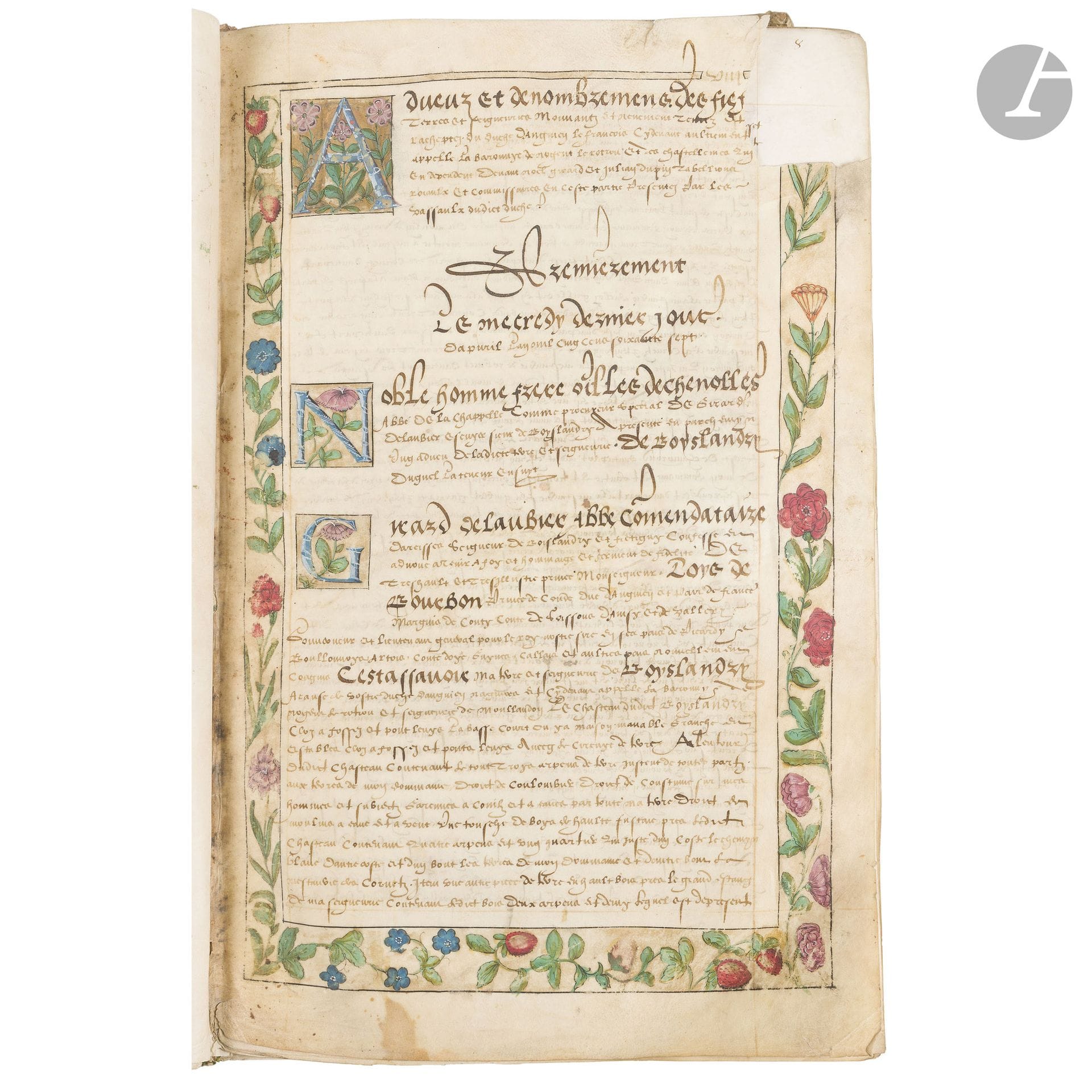
[Louis I of Bourbon, Prince of Condé (1530–1569)]. Manuscript of the Adveux and inventory of the fiefs of the barony of Nogent-le-Rotrou, for Louis de Bourbon, Prince of Condé and Duke of Enghien (1530–1569), 1567–1568. A substantial folio volume (approx. 50 x 32 cm) comprising 417 leaves on ruled parchment, with a 19th-century half-vellum binding with corner pieces and a title label on the spine. An important, richly decorated collection of declarations of allegiance to the Prince of Condé, pertaining to the barony of Nogent-le-Rotrou in the Perche region. Louis de Bourbon, Prince of Condé, succeeded his brother Jean de Bourbon, Count of Soissons and Enghien (1528–1557), as head of the barony of Nogent-le-Rotrou in 1557. An uncle of the future Henry IV, Louis de Bourbon took up residence at the castle of the Counts of Perche and would go on to become the leader of the Protestant faction at the start of the Wars of Religion. The collection comprises 7 parts, with a large painted floral border framing the first page of each part. Numerous signatures by the notaries appear at the end of each day. Numerous painted initials appear throughout, at the beginning of each new act of homage, and then at the start of each new entry regarding a fief, land, or inheritance. The folios are numbered in Roman numerals; for the first two parts, numbering in Arabic numerals (with slight discrepancies) was added later (in the 17th century), along with marginal headings. Headings were added later in the margins of the various fiefs. The “aveu et dénombrement” emerged in the 12th century and became widespread in the 13th century. This is a precise and detailed description by the vassal to his lord of all the tangible and intangible assets constituting the fief at the time of homage—that is, subfiefs, censive rents, annuities, easements, and beneficial and honorary rights. These documents vary in detail depending on the importance of the lordship, providing specifics on the land owned, its type (vineyard, woodland, fallow land), and lands held in censive tenancy, along with all the beneficial or honorary rights pertaining to the holder of the lordship. Decoration: This manuscript is one of the illuminated “aveux et dénombrements,” a style uncommon in documents of this nature but indicative of the deliberate luxury and refinement sought by the lords of Condé. This decoration follows the style adopted under Francis I and thus exhibits a certain archaism: during the reign of Francis I, there were a number of illuminated declarations and inventories, such as that of Lord Philippe d’Harville (Château de Millemont, now the Departmental Archives of Yvelines) or, of course, earlier declarations of allegiance or oaths of fealty owed to suzerain lords such as René d’Anjou, which were richly illuminated (for example, a declaration of allegiance from 1466 rendered to René d’Anjou by Jean de Montespedon, Paris, AN, AE/II/481/A). In the present *Adveux* and inventory of the fiefs of the barony of Nogent-le-Rotrou, for Louis de Bourbon, Prince of Condé, one notes, for example, seven large noble pages with illuminated borders, introducing the major textual divisions relating to the various groups of fiefs discussed. These borders (floral motifs, fruits [strawberries; vines and grapes] on a gold background—a distinctly French version of the Ghent-Bruges trompe l’œil decorations) and the ornate initials (in blue with white highlights, featuring floral or fruit motifs on a gold background) clearly echo the aesthetic of manuscripts produced during the reign of Francis I: for example, the borders of manuscripts such as the Gospel Book of Henry, Duke of Orléans (or of Charles, Count of Angoulême) [Madrid, BN, ms Res.51; reproduced in Bosc and Hermant, *Le siècle de François Ier*, Chantilly, 2015, p. 155] or the initials in manuscripts of translations of classical texts presented to Francis I (for example, the initials in Plutarch’s *Lives of the Noble Men*, French translation, c. 1540 [Chantilly, MS 855]. In the case of the present *Aveux*, copied during the reign of Charles IX, this aesthetic is clearly still appreciated. The other initials that punctuate the manuscript are of a different style, undoubtedly more in keeping with the era, set against colored or reserved backgrounds, executed by a local hand, distinct from the one that painted the borders and initials on the introductory pages of the major textual sections. Below we provide the opening lines of each section, as well as the beginning of the text of the first confession presented therein, each followed by many others. [Duchy of Enghien, Barony of Nogent-le-Rotrou], from April 30, 1567, to October 13, 1568. Opening: “Inventory and enumeration of the fiefs, lands, and seigneuries belonging to and fully held and redeemed from the Duchy ofEnghien the French, formerly known as the Barony of Nogent-le-Rotrou, and of the castellanies dependent thereon, before Noël Girard and Julian Dupin, royal notaries and commissioners in this matter, presented by the vassals of the said duke. ” April 30, 1567 “
Estimate
€20,000 - €25,000
Buyer's premium
31.8%
[Louis I of Bourbon, Prince of Condé (1530–1569)]. Manuscript of the Adveux and inventory of the fiefs of the barony of Nogent-le-Rotrou, for Louis de Bourbon, Prince of Condé and Duke of Enghien (1530–1569), 1567–1568. A substantial folio volume (approx. 50 x 32 cm) comprising 417 leaves on ruled parchment, with a 19th-century half-vellum binding with corner pieces and a title label on the spine.
An important, richly decorated collection of declarations of allegiance to the Prince of Condé, pertaining to the barony of Nogent-le-Rotrou in the Perche region.
Louis de Bourbon, Prince of Condé, succeeded his brother Jean de Bourbon, Count of Soissons and Enghien (1528–1557), as head of the barony of Nogent-le-Rotrou in 1557. An uncle of the future Henry IV, Louis de Bourbon took up residence at the castle of the Counts of Perche and would go on to become the leader of the Protestant faction at the start of the Wars of Religion.
The collection comprises 7 parts, with a large painted floral border framing the first page of each part.
Numerous signatures by the notaries appear at the end of each day.
Numerous painted initials appear throughout, at the beginning of each new act of homage, and then at the start of each new entry regarding a fief, land, or inheritance.
The folios are numbered in Roman numerals; for the first two parts, numbering in Arabic numerals (with slight discrepancies) was added later (in the 17th century), along with marginal headings.
Headings were added later in the margins of the various fiefs.
The “aveu et dénombrement” emerged in the 12th century and became widespread in the 13th century. This is a precise and detailed description by the vassal to his lord of all the tangible and intangible assets constituting the fief at the time of homage—that is, subfiefs, censive rents, annuities, easements, and beneficial and honorary rights. These documents vary in detail depending on the importance of the lordship, providing specifics on the land owned, its type (vineyard, woodland, fallow land), and lands held in censive tenancy, along with all the beneficial or honorary rights pertaining to the holder of the lordship.
Decoration: This manuscript is one of the illuminated “aveux et dénombrements,” a style uncommon in documents of this nature but indicative of the deliberate luxury and refinement sought by the lords of Condé. This decoration follows the style adopted under Francis I and thus exhibits a certain archaism: during the reign of Francis I, there were a number of illuminated declarations and inventories, such as that of Lord Philippe d’Harville (Château de Millemont, now the Departmental Archives of Yvelines) or, of course, earlier declarations of allegiance or oaths of fealty owed to suzerain lords such as René d’Anjou, which were richly illuminated (for example, a declaration of allegiance from 1466 rendered to René d’Anjou by Jean de Montespedon, Paris, AN, AE/II/481/A).
In the present *Adveux* and inventory of the fiefs of the barony of Nogent-le-Rotrou, for Louis de Bourbon, Prince of Condé, one notes, for example, seven large noble pages with illuminated borders, introducing the major textual divisions relating to the various groups of fiefs discussed. These borders (floral motifs, fruits [strawberries; vines and grapes] on a gold background—a distinctly French version of the Ghent-Bruges trompe l’œil decorations) and the ornate initials (in blue with white highlights, featuring floral or fruit motifs on a gold background) clearly echo the aesthetic of manuscripts produced during the reign of Francis I: for example, the borders of manuscripts such as the Gospel Book of Henry, Duke of Orléans (or of Charles, Count of Angoulême) [Madrid, BN, ms Res.51; reproduced in Bosc and Hermant, *Le siècle de François Ier*, Chantilly, 2015, p. 155] or the initials in manuscripts of translations of classical texts presented to Francis I (for example, the initials in Plutarch’s *Lives of the Noble Men*, French translation, c. 1540 [Chantilly, MS 855]. In the case of the present *Aveux*, copied during the reign of Charles IX, this aesthetic is clearly still appreciated. The other initials that punctuate the manuscript are of a different style, undoubtedly more in keeping with the era, set against colored or reserved backgrounds, executed by a local hand, distinct from the one that painted the borders and initials on the introductory pages of the major textual sections.
Below we provide the opening lines of each section, as well as the beginning of the text of the first confession presented therein, each followed by many others.
[Duchy of Enghien, Barony of Nogent-le-Rotrou], from April 30, 1567, to October 13, 1568.
Opening: “Inventory and enumeration of the fiefs, lands, and seigneuries belonging to and fully held and redeemed from the Duchy ofEnghien the French, formerly known as the Barony of Nogent-le-Rotrou, and of the castellanies dependent thereon, before Noël Girard and Julian Dupin, royal notaries and commissioners in this matter, presented by the vassals of the said duke. ”
April 30, 1567
“
Sale
Thursday 10 December・14:00 (Europe/Paris)
Sale location coming soon
3, rue Favart
75002 Paris