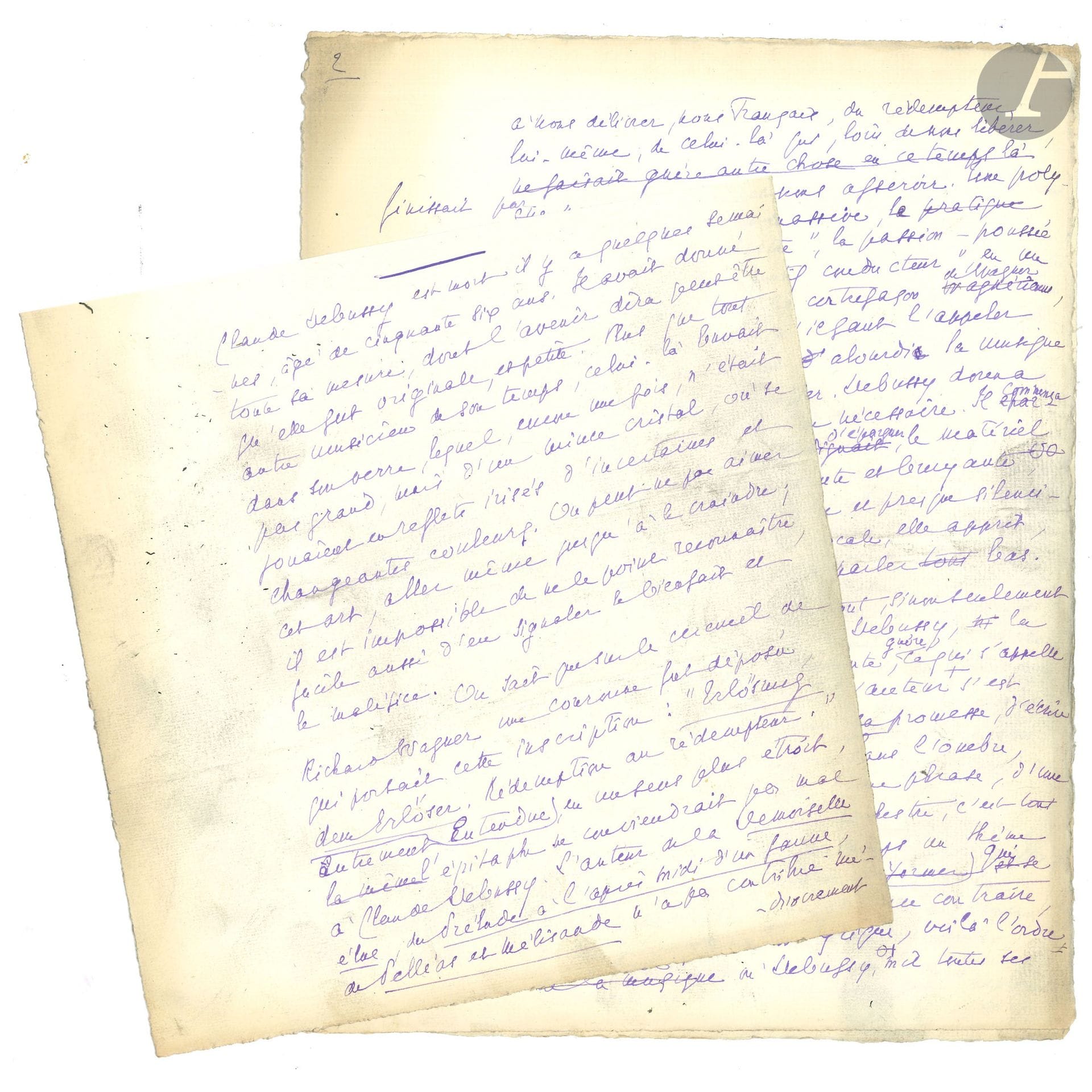
[Claude DEBUSSY]. Camille BELLAIGUE (1858–1930). Signed autograph manuscript, *Revue musicale*, May 15, 1918; 4 pages, in-4 format, with cross-outs and corrections. Pages excerpted from his *Revue musicale* published in the *Revue des Deux Mondes* on May 15, 1918, concerning Claude Debussy, who died on March 25. “Claude Debussy died a few weeks ago, at the age of fifty-six. He had given his all—and perhaps the future will say that his contribution was original, yet modest. More than any other musician of his time, he drank from his own cup—which, once again, was not large, but made of thin crystal, where iridescent reflections of uncertain and shifting colors played across its surface. One may not like this art, may even go so far as to fear it; it is impossible not to recognize it, and it is also easy to point out its benefits and its harms. It is known that a wreath was placed on Richard Wagner’s coffin bearing the inscription: “Erlösung dem Erlöser. Redemption to the Redeemer.” Taken in a different, narrower sense, the epitaph would not be entirely out of place for Claude Debussy. The composer of *La Demoiselle élue*, *Prelude to the Afternoon of a Faun*, and *Pelléas et Mélisande* did more than his fair share to free us, us French people, from the Redeemer himself—the one who, far from liberating us, ended up oppressing and enslaving us”… Etc. And Bellaigue concludes: “Ingenious and subtle, fragile yet finding charm in its very fragility, Debussy’s art makes more room for—and places greater value on—the fleeting impression, the somewhat morbid sensation, than on sound sensibility or clear and strong thought. […] Today more than yesterday, tomorrow more than today, we demand—and will continue to demand—that our music, our own music, instill and leave something else—something more solid and wholesome—in our minds and souls. ” Enclosed: – a business card with three handwritten lines by Bellaigue; – two handwritten lines by Mary Garden; – a printed portrait of Debussy by Georges Villa; – a handwritten letter from Pasteur Vallery-Radot to G. Samazeuilh. Plus a 20-franc note bearing Debussy’s likeness (with a comment by Claude Seignolle: “Glory in… small change!”), and press clippings.
Estimate
€100 - €150
Buyer's premium
31.8%
[Claude DEBUSSY]. Camille BELLAIGUE (1858–1930). Signed autograph manuscript, *Revue musicale*, May 15, 1918; 4 pages, in-4 format, with cross-outs and corrections.
Pages excerpted from his *Revue musicale* published in the *Revue des Deux Mondes* on May 15, 1918, concerning Claude Debussy, who died on March 25.
“Claude Debussy died a few weeks ago, at the age of fifty-six. He had given his all—and perhaps the future will say that his contribution was original, yet modest. More than any other musician of his time, he drank from his own cup—which, once again, was not large, but made of thin crystal, where iridescent reflections of uncertain and shifting colors played across its surface. One may not like this art, may even go so far as to fear it; it is impossible not to recognize it, and it is also easy to point out its benefits and its harms. It is known that a wreath was placed on Richard Wagner’s coffin bearing the inscription: “Erlösung dem Erlöser. Redemption to the Redeemer.” Taken in a different, narrower sense, the epitaph would not be entirely out of place for Claude Debussy. The composer of *La Demoiselle élue*, *Prelude to the Afternoon of a Faun*, and *Pelléas et Mélisande* did more than his fair share to free us, us French people, from the Redeemer himself—the one who, far from liberating us, ended up oppressing and enslaving us”… Etc. And Bellaigue concludes: “Ingenious and subtle, fragile yet finding charm in its very fragility, Debussy’s art makes more room for—and places greater value on—the fleeting impression, the somewhat morbid sensation, than on sound sensibility or clear and strong thought. […] Today more than yesterday, tomorrow more than today, we demand—and will continue to demand—that our music, our own music, instill and leave something else—something more solid and wholesome—in our minds and souls. ”
Enclosed: – a business card with three handwritten lines by Bellaigue; – two handwritten lines by Mary Garden; – a printed portrait of Debussy by Georges Villa; – a handwritten letter from Pasteur Vallery-Radot to G. Samazeuilh. Plus a 20-franc note bearing Debussy’s likeness (with a comment by Claude Seignolle: “Glory in… small change!”), and press clippings.
Sale
Thursday 10 December・14:00 (Europe/Paris)
Sale location coming soon
3, rue Favart
75002 Paris