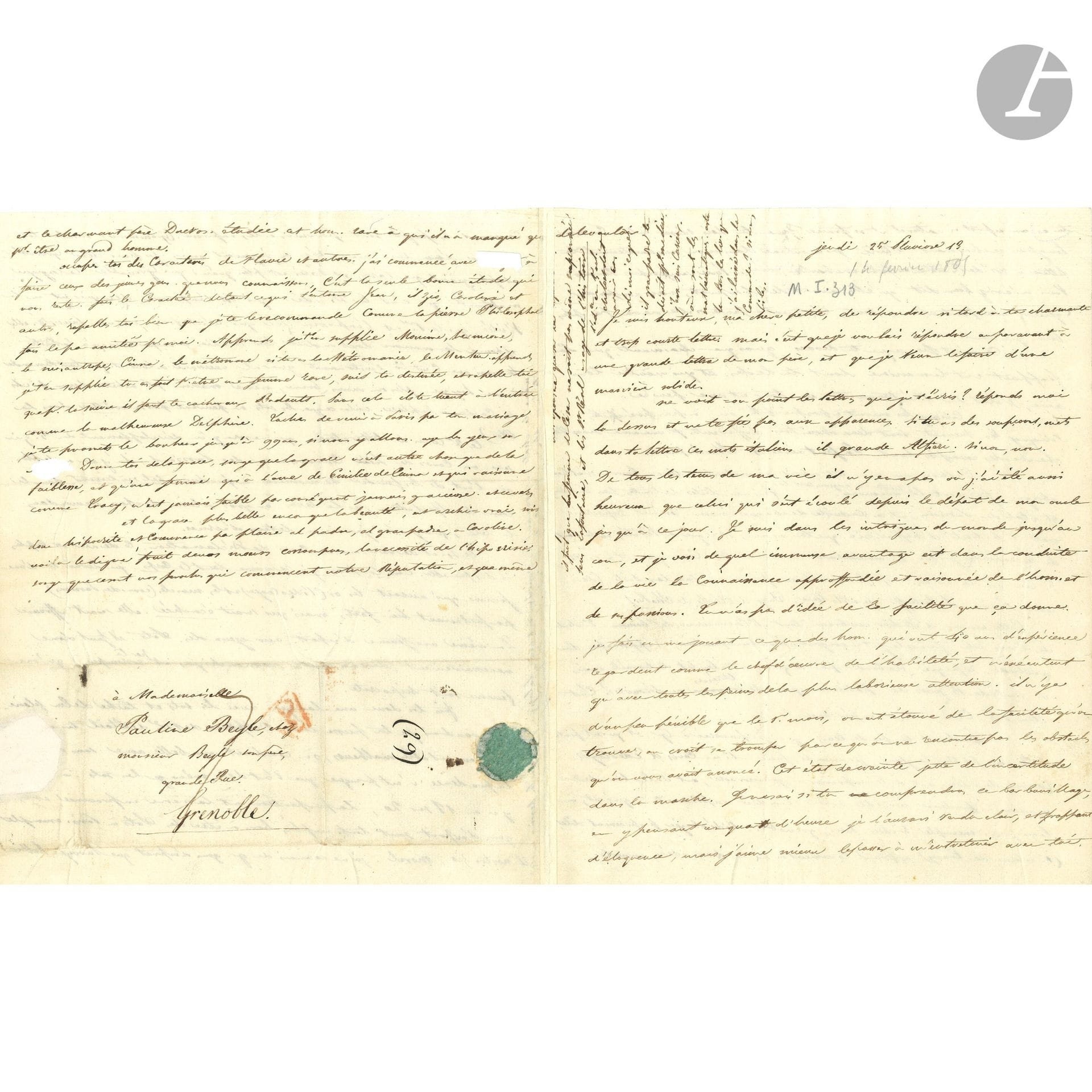
STENDHAL (1783–1842). L.A., [Paris], 25 Pluviôse XIII [February 14, 1805], to Mlle Pauline Beyle in Grenoble; 4 pages, in-4 format, with address (a cut-out name, a small hole, and a small tear caused by a broken seal, which has been repaired). A very beautiful and lengthy letter to his beloved sister. He thanks Pauline for her “charming and all too brief letter” and discusses his life in Paris: “Of all the periods of my life, there has been none in which I have been as happy as the one that has elapsed since my uncle’s [Romain Gagnon] departure until today. I am up to my neck in the intrigues of the world, and I see what an immense advantage a deep and reasoned understanding of man and his passions brings to the conduct of one’s life. You have no idea how much easier it makes things. I accomplish with ease what men with 40 years of experience regard as the pinnacle of skill—and which they execute only with the greatest effort and the most painstaking attention. The only thing that’s a bit difficult is the first month; one is surprised by how easy it turns out to be, and one thinks one must be mistaken because one doesn’t encounter the obstacles one had been warned about. This state of apprehension casts uncertainty into one’s progress”… He encourages Pauline to maintain her “charming style”; Madame de N[ardon] was “enchanted, delighted” by her letter: “It wasn’t what you said—though charming—that struck her; it was the way you said it, which reveals your soul, the state of the instrument, a turn of phrase, and a thought. […] Carefully cultivate this spirit that is so natural. A good method greatly shortens the study by enhancing memory. Make a list of all the Passions and states of the Passions, and following each name—such as ‘hypocrisy’—list 1) the traits of hypocrisy you have observed, the first degree of truth, striving to recount them accurately. 2° Those that have been told to you. 3° Those you have read. 4° The finest portrayals by poets (in this Passion, Molière’s Tartuffe, Iago from Shakespeare’s Othello). This method of study encompasses everything: 1) knowledge of human nature; 2) the study of the fine arts. Do this, I implore you, my dear Pauline. Applying a method may seem unappealing at first because it slows down the work, but after 15 days of patience, what treasures one discovers! It’s astonishing. Trust my experience.” When he comes to Grenoble, he will give Pauline “1. a course in ideology (the science of ideas, the art of expressing them through grammar, the art of linking them in such a way as to produce a true idea—that is, one that expresses what is, or logic”; he gives examples of this, concluding: “Logic, driven by necessity, always exists to a greater or lesser extent in individuals. Those who need everything know more truths and are better at discovering them than those who need nothing.” The second course “on literature” will be merely an expansion of the third, which will be a course on the knowledge of the passions; the only addition will be the art of depicting them in such a way as to evoke a particular feeling in the viewer’s heart. I have a great deal of new material on this subject in my head that I’ve never had time to write down. The fourth and final course will be on declamation. This last one is the most essential. It is the skin that covers the entire body. […] It is therefore necessary (in our monarchical—and thus corrupt—society) for a woman to be a hypocrite. So learn to speak the language of fools and try to please them. I wish you could read *Delphine* by Madame de Staël; you [would see] the terrible misfortunes to which a beautiful soul is led without [...] Prudence is almost entirely the art of dealing with fools”… He urges her to study the characters of all those around her… And he advises her to study “Monime, Hermione, *The Misanthrope*, Cinna, *The Metromane* (if you suffer from metromania), and *The Liar*. Learn, I beg you—you have everything it takes to be a rare woman; follow your destiny, and remember that to follow it, you must hide yourself from the Badauts. Otherwise, they’ll kill you at the very entrance, just like the unfortunate Delphine. […] So be a hypocrite and start by pleasing al padre, al gran padre, and Caroline. Therein lies the worthy fruit of our corrupt morals: the necessity of hypocrisy. Remember that it is our loved ones who establish our reputation, and that even a noble soul will marry you only on the basis of your reputation. “Caesar’s wife must not even be suspected.” And he urges her to read La Fontaine and *Usage de l’Histoire de Saint-Réal*… General Correspondence, vol. I, no. 116.
Estimate
€3,000 - €4,000
Buyer's premium
31.8%
STENDHAL (1783–1842). L.A., [Paris], 25 Pluviôse XIII [February 14, 1805], to Mlle Pauline Beyle in Grenoble; 4 pages, in-4 format, with address (a cut-out name, a small hole, and a small tear caused by a broken seal, which has been repaired).
A very beautiful and lengthy letter to his beloved sister.
He thanks Pauline for her “charming and all too brief letter” and discusses his life in Paris: “Of all the periods of my life, there has been none in which I have been as happy as the one that has elapsed since my uncle’s [Romain Gagnon] departure until today. I am up to my neck in the intrigues of the world, and I see what an immense advantage a deep and reasoned understanding of man and his passions brings to the conduct of one’s life. You have no idea how much easier it makes things. I accomplish with ease what men with 40 years of experience regard as the pinnacle of skill—and which they execute only with the greatest effort and the most painstaking attention. The only thing that’s a bit difficult is the first month; one is surprised by how easy it turns out to be, and one thinks one must be mistaken because one doesn’t encounter the obstacles one had been warned about. This state of apprehension casts uncertainty into one’s progress”…
He encourages Pauline to maintain her “charming style”; Madame de N[ardon] was “enchanted, delighted” by her letter: “It wasn’t what you said—though charming—that struck her; it was the way you said it, which reveals your soul, the state of the instrument, a turn of phrase, and a thought. […] Carefully cultivate this spirit that is so natural. A good method greatly shortens the study by enhancing memory. Make a list of all the Passions and states of the Passions, and following each name—such as ‘hypocrisy’—list 1) the traits of hypocrisy you have observed, the first degree of truth, striving to recount them accurately. 2° Those that have been told to you. 3° Those you have read. 4° The finest portrayals by poets (in this Passion, Molière’s Tartuffe, Iago from Shakespeare’s Othello). This method of study encompasses everything: 1) knowledge of human nature; 2) the study of the fine arts. Do this, I implore you, my dear Pauline. Applying a method may seem unappealing at first because it slows down the work, but after 15 days of patience, what treasures one discovers! It’s astonishing. Trust my experience.”
When he comes to Grenoble, he will give Pauline “1. a course in ideology (the science of ideas, the art of expressing them through grammar, the art of linking them in such a way as to produce a true idea—that is, one that expresses what is, or logic”; he gives examples of this, concluding: “Logic, driven by necessity, always exists to a greater or lesser extent in individuals. Those who need everything know more truths and are better at discovering them than those who need nothing.” The second course “on literature” will be merely an expansion of the third, which will be a course on the knowledge of the passions; the only addition will be the art of depicting them in such a way as to evoke a particular feeling in the viewer’s heart. I have a great deal of new material on this subject in my head that I’ve never had time to write down. The fourth and final course will be on declamation. This last one is the most essential. It is the skin that covers the entire body. […] It is therefore necessary (in our monarchical—and thus corrupt—society) for a woman to be a hypocrite. So learn to speak the language of fools and try to please them. I wish you could read *Delphine* by Madame de Staël; you [would see] the terrible misfortunes to which a beautiful soul is led without [...] Prudence is almost entirely the art of dealing with fools”… He urges her to study the characters of all those around her…
And he advises her to study “Monime, Hermione, *The Misanthrope*, Cinna, *The Metromane* (if you suffer from metromania), and *The Liar*. Learn, I beg you—you have everything it takes to be a rare woman; follow your destiny, and remember that to follow it, you must hide yourself from the Badauts. Otherwise, they’ll kill you at the very entrance, just like the unfortunate Delphine. […] So be a hypocrite and start by pleasing al padre, al gran padre, and Caroline. Therein lies the worthy fruit of our corrupt morals: the necessity of hypocrisy. Remember that it is our loved ones who establish our reputation, and that even a noble soul will marry you only on the basis of your reputation. “Caesar’s wife must not even be suspected.” And he urges her to read La Fontaine and *Usage de l’Histoire de Saint-Réal*…
General Correspondence, vol. I, no. 116.
Sale
Wednesday 9 December・14:00 (Europe/Paris)
Sale location coming soon
3, rue Favart
75002 Paris