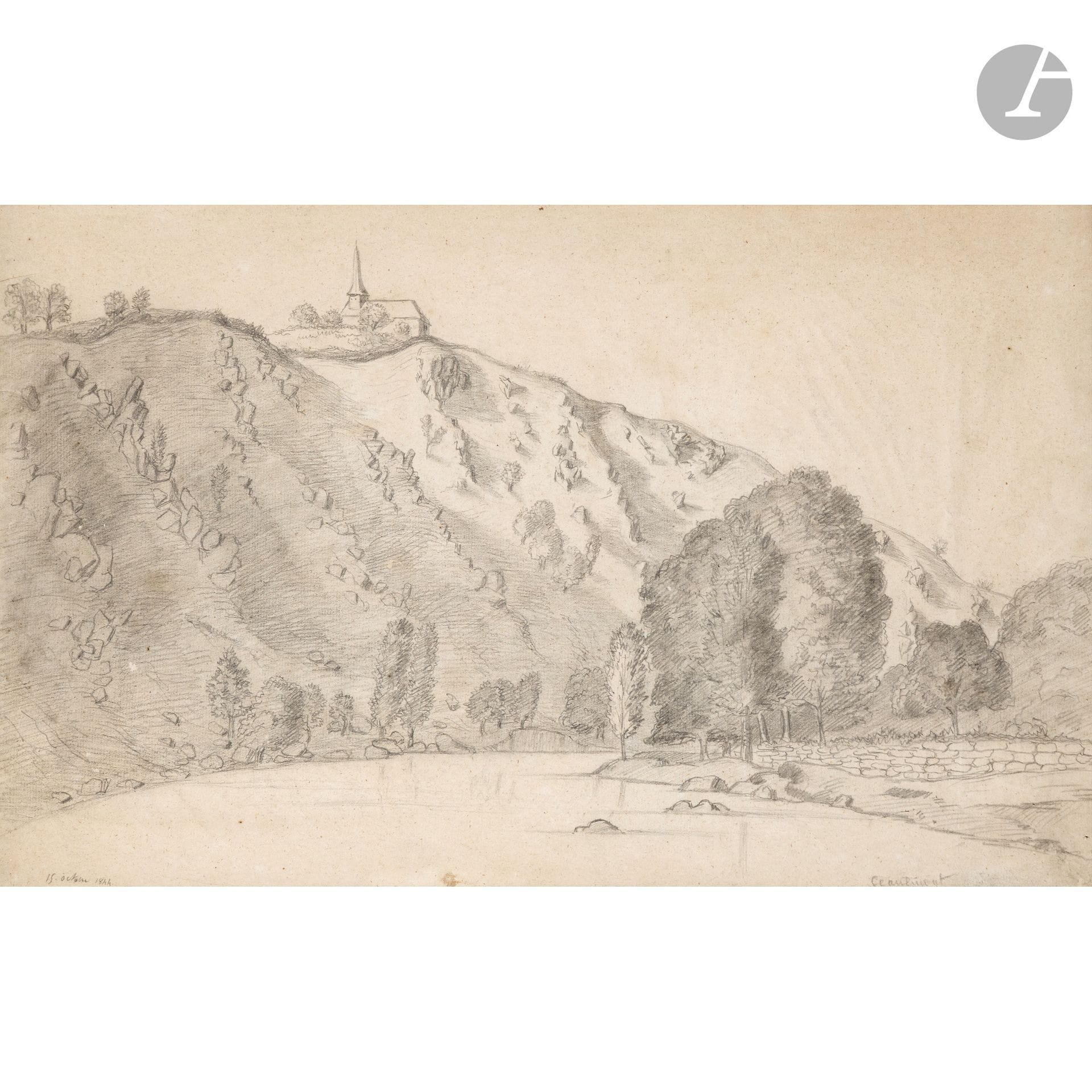
[George SAND]. Eugène GRANDSIRE (1825–1905). Original drawing, Ceaulmont, 1855; graphite, 30 x 47 cm (framed). A beautiful view of the banks of the Creuse. George Sand mentioned this picturesque site in her correspondence (July 19, 1860, XVI, p. 19): “We took a rather long walk in one of the most delightful corners of France. The ravine through which the Creuse flows is bordered here, for several leagues, by high plateaus, supported by schist rising from massive bedrock of gneiss and granite, picturesquely fractured. Lush vegetation springs up around these rugged boulders, and the Creuse—at times turbulent, bubbling among their debris, at other times clear and calm—reflects them like a mirror. From the little church of Ceaulmont, perched at the very top of the rocks, the view plunges into these deep, adorably composed meanders, and stretches over the ravines and across the plateaus all the way to the mountains of the Marche.” This drawing, which was attributed to G. Sand, cannot be hers, for reasons of chronology and style. We attribute it to Eugène Grandsire, who frequently sketched these landscapes of the Creuse, and whose talent G. Sand celebrated in *Promenades autour d’un village* (Chapter XII): “Painters who understand reality are happy poets. They capture everything at once—the whole and the details—and summarize in five minutes what the writer expresses in many pages, what the naturalist can only fathom after many days of observation and toil. They capture the character of things, and, without knowing the names of the trees or the nature of the stones, they paint a portrait of the aspects they sense—a penetrating and intelligent portrait, striking and faithful, without the effort of painstaking investigation. They write about life and translate the realm of nature into a language whose mysterious complexities elude us, so clear and effortless does it seem when they have truly mastered it. Looking at these sketches by Mr. Grandsire, we rediscovered all the gentle emotions of our daydreams during those enchanted walks .” Christian Bernadac, George Sand. Drawings and Watercolors (Belfond, 1992), no. 175 (p. 111).
Estimate
€400 - €500
Buyer's premium
31.8%
[George SAND]. Eugène GRANDSIRE (1825–1905). Original drawing, Ceaulmont, 1855; graphite, 30 x 47 cm (framed).
A beautiful view of the banks of the Creuse.
George Sand mentioned this picturesque site in her correspondence (July 19, 1860, XVI, p. 19): “We took a rather long walk in one of the most delightful corners of France. The ravine through which the Creuse flows is bordered here, for several leagues, by high plateaus, supported by schist rising from massive bedrock of gneiss and granite, picturesquely fractured. Lush vegetation springs up around these rugged boulders, and the Creuse—at times turbulent, bubbling among their debris, at other times clear and calm—reflects them like a mirror. From the little church of Ceaulmont, perched at the very top of the rocks, the view plunges into these deep, adorably composed meanders, and stretches over the ravines and across the plateaus all the way to the mountains of the Marche.”
This drawing, which was attributed to G. Sand, cannot be hers, for reasons of chronology and style. We attribute it to Eugène Grandsire, who frequently sketched these landscapes of the Creuse, and whose talent G. Sand celebrated in *Promenades autour d’un village* (Chapter XII): “Painters who understand reality are happy poets. They capture everything at once—the whole and the details—and summarize in five minutes what the writer expresses in many pages, what the naturalist can only fathom after many days of observation and toil. They capture the character of things, and, without knowing the names of the trees or the nature of the stones, they paint a portrait of the aspects they sense—a penetrating and intelligent portrait, striking and faithful, without the effort of painstaking investigation. They write about life and translate the realm of nature into a language whose mysterious complexities elude us, so clear and effortless does it seem when they have truly mastered it. Looking at these sketches by Mr. Grandsire, we rediscovered all the gentle emotions of our daydreams during those enchanted walks .”
Christian Bernadac, George Sand. Drawings and Watercolors (Belfond, 1992), no. 175 (p. 111).
Sale
Wednesday 9 December・14:00 (Europe/Paris)
Sale location coming soon
3, rue Favart
75002 Paris