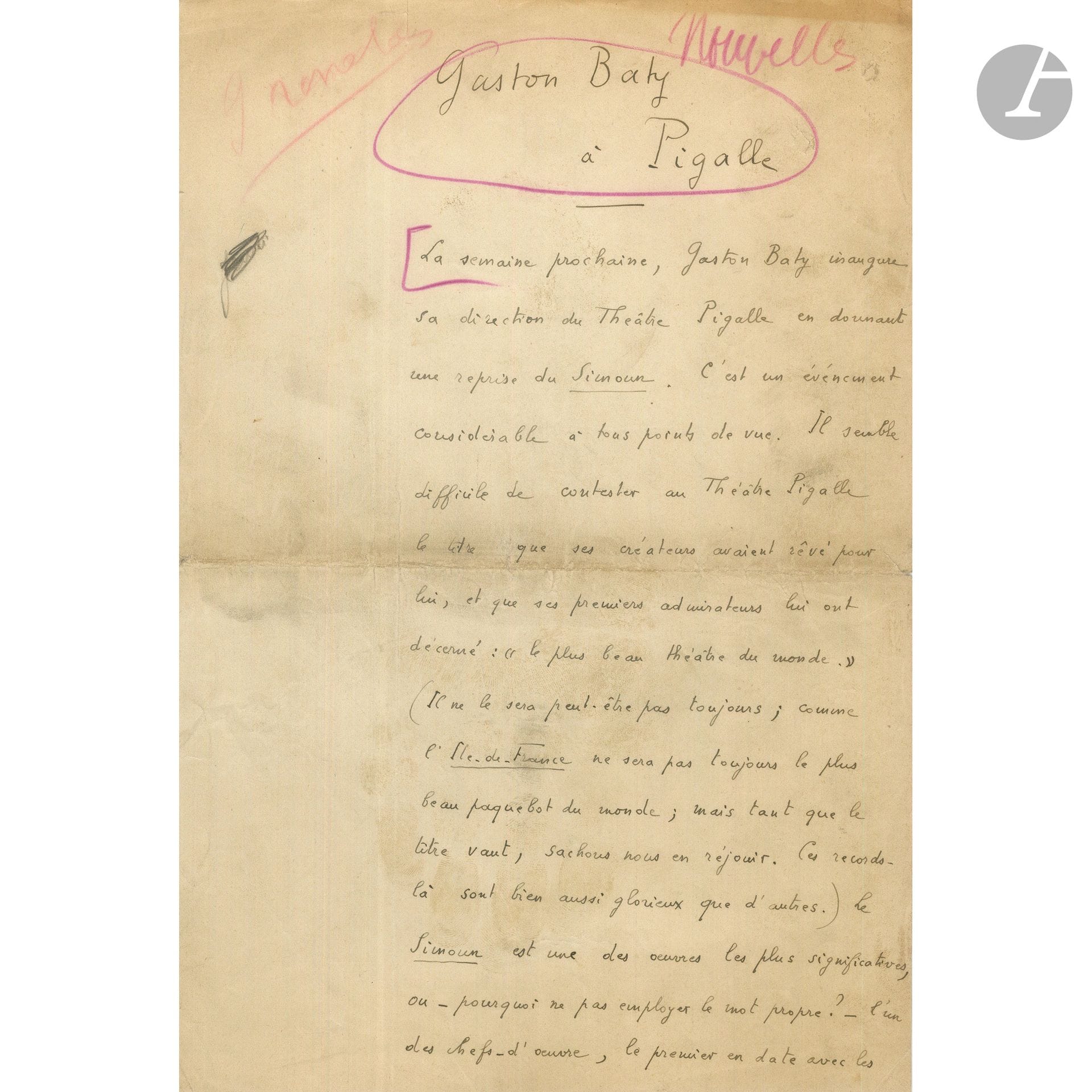
Jules ROMAINS. Signed autograph manuscript, Gaston Baty at Pigalle, [January 1930]; 9 folio-sized pages. On Gaston Baty’s appointment as director of the Théâtre Pigalle (built by Henri de Rothschild and inaugurated in 1929, administered by Gabriel Astruc with André Antoine as artistic director, who left after two months and was replaced by Gaston Baty). Jules Romains’s article appeared in *Les Nouvelles littéraires* on January 18, 1930. “Next week, Gaston Baty will inaugurate his tenure as director of the Théâtre Pigalle with a revival of *Le Simoun* [by Henri-René Lenormand]. This is a significant event in every respect. It seems difficult to dispute the title that the Théâtre Pigalle’s founders had envisioned for it—and that its earliest admirers bestowed upon it: ‘the most beautiful theater in the world.’” *Le Simoun* is “one of the most significant works, […] one of the masterpieces—the first, along with *Les Ratés*, by Lenormand, that is to say, by one of the few French playwrights known and respected throughout the world.” As for Gaston Baty, he is the man who, after struggling for ten years under the harshest conditions, with only meager resources at his disposal, suddenly found himself in possession of an incomparable tool, a set of resources that he could not even reasonably have hoped for”… André Antoine—“whose genius influenced an entire era of European theater”—was not given “the extensive resources that other countries were able to provide to a Reinhardt or a Stanislavsky”; but Baty is not to blame for this. “Nor is there any question of pitting Baty against the directors of his generation or against his predecessors, whose work he directly continues. If Gémier, Copeau, Jouvet, or Dullin had been entrusted with the Théâtre Pigalle, I am quite certain, for my part, that each of them would have handled it with honor. […] By accepting the position, Baty has shown a courage that I greatly admire. […] A marvelous instrument has been placed in hands worthy of it. It will serve the triumph of this French theatrical renaissance that has been underway for ten years—a renaissance that, in the beginning, faced so much indifference, had to make do with such meager resources, and has since never been able to let up on its heroic effort, so tightly have resources of every kind been rationed”... Etc. And Romains concludes: “Baty is far too cultured not to realize that ‘grand spectacle’ devoid of substance spells the ruin of the theater; and that even the most modern machinery is nothing but an expensive compilation when the poetic spirit refuses to inhabit it. In short, Baty’s appointment to a position he deserves based on his track record—and which he is fortunate to assume in the prime of his life and talent—must delight true friends of the theater in France”…
Estimate
€500 - €700
Buyer's premium
31.8%
Jules ROMAINS. Signed autograph manuscript, Gaston Baty at Pigalle, [January 1930]; 9 folio-sized pages.
On Gaston Baty’s appointment as director of the Théâtre Pigalle (built by Henri de Rothschild and inaugurated in 1929, administered by Gabriel Astruc with André Antoine as artistic director, who left after two months and was replaced by Gaston Baty). Jules Romains’s article appeared in *Les Nouvelles littéraires* on January 18, 1930.
“Next week, Gaston Baty will inaugurate his tenure as director of the Théâtre Pigalle with a revival of *Le Simoun* [by Henri-René Lenormand]. This is a significant event in every respect. It seems difficult to dispute the title that the Théâtre Pigalle’s founders had envisioned for it—and that its earliest admirers bestowed upon it: ‘the most beautiful theater in the world.’” *Le Simoun* is “one of the most significant works, […] one of the masterpieces—the first, along with *Les Ratés*, by Lenormand, that is to say, by one of the few French playwrights known and respected throughout the world.” As for Gaston Baty, he is the man who, after struggling for ten years under the harshest conditions, with only meager resources at his disposal, suddenly found himself in possession of an incomparable tool, a set of resources that he could not even reasonably have hoped for”… André Antoine—“whose genius influenced an entire era of European theater”—was not given “the extensive resources that other countries were able to provide to a Reinhardt or a Stanislavsky”; but Baty is not to blame for this. “Nor is there any question of pitting Baty against the directors of his generation or against his predecessors, whose work he directly continues. If Gémier, Copeau, Jouvet, or Dullin had been entrusted with the Théâtre Pigalle, I am quite certain, for my part, that each of them would have handled it with honor. […] By accepting the position, Baty has shown a courage that I greatly admire. […] A marvelous instrument has been placed in hands worthy of it. It will serve the triumph of this French theatrical renaissance that has been underway for ten years—a renaissance that, in the beginning, faced so much indifference, had to make do with such meager resources, and has since never been able to let up on its heroic effort, so tightly have resources of every kind been rationed”... Etc.
And Romains concludes: “Baty is far too cultured not to realize that ‘grand spectacle’ devoid of substance spells the ruin of the theater; and that even the most modern machinery is nothing but an expensive compilation when the poetic spirit refuses to inhabit it. In short, Baty’s appointment to a position he deserves based on his track record—and which he is fortunate to assume in the prime of his life and talent—must delight true friends of the theater in France”…
Sale
Wednesday 9 December・14:00 (Europe/Paris)
Sale location coming soon
3, rue Favart
75002 Paris