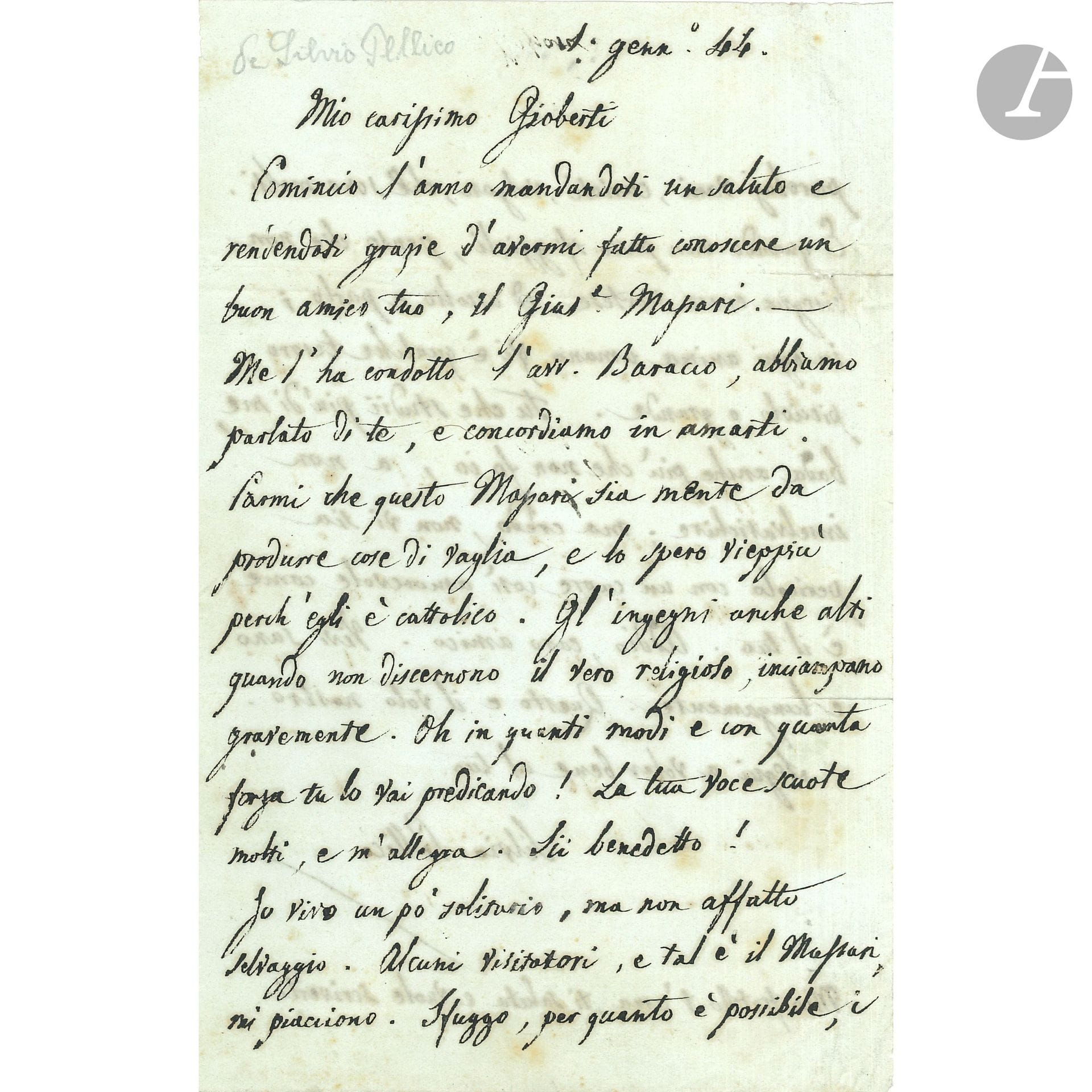
Silvio PELLICO (1789–1854). Autograph letter, January 1, 1844, to Vincenzo Gioberti; 2 pages, in-8 format, with address; in Italian. A lovely, friendly letter. [Vincenzo Gioberti (1801–1852) had just published his *Primato morale e civile degli Italiani*, proposing a confederation of Italian states under the Pope’s authority, a work that would have a major influence on the Risorgimento.] Pellico sends his best wishes to Gioberti, thanking him for introducing him to Giuseppe Massari (1821–1884), whom he believes is capable of great things, all the more so because he is a Catholic. Even the greatest minds, when they fail to discern the true religious truth, stumble gravely. (“This Massari is a mind capable of producing things of value, and I hope all the more so because he is a Catholic. Even the highest minds, when they fail to discern the true religious truth, stumble gravely.” Pellico lived as a recluse, but not as a hermit. He avoided, as much as possible, vain, curious, or vulgar talk; and when he could not escape it, he listened and spoke, for in every human soul lies some treasure, small or great: “I live somewhat in solitude, but by no means like a wild man. […] I avoid, as much as possible, vain, curious, and vulgar chatter—of which there is much. And when I cannot avoid it, I think one must not be rude, so I listen and speak; in every human soul there is some treasure, small or great”… Enclosed are: 3 handwritten letters from Pellico’s translator, Antoine de Latour, dated 1872–1875, concerning, in particular, André Chénier; and a letter from Alexandre Andryane, Pellico’s fellow prisoner, to the publisher Ladvocat, regarding the reprint of his *Memoirs of a Prisoner* (1859).
Estimate
€400 - €500
Buyer's premium
31.8%
Silvio PELLICO (1789–1854). Autograph letter, January 1, 1844, to Vincenzo Gioberti; 2 pages, in-8 format, with address; in Italian.
A lovely, friendly letter. [Vincenzo Gioberti (1801–1852) had just published his *Primato morale e civile degli Italiani*, proposing a confederation of Italian states under the Pope’s authority, a work that would have a major influence on the Risorgimento.]
Pellico sends his best wishes to Gioberti, thanking him for introducing him to Giuseppe Massari (1821–1884), whom he believes is capable of great things, all the more so because he is a Catholic. Even the greatest minds, when they fail to discern the true religious truth, stumble gravely. (“This Massari is a mind capable of producing things of value, and I hope all the more so because he is a Catholic. Even the highest minds, when they fail to discern the true religious truth, stumble gravely.” Pellico lived as a recluse, but not as a hermit. He avoided, as much as possible, vain, curious, or vulgar talk; and when he could not escape it, he listened and spoke, for in every human soul lies some treasure, small or great: “I live somewhat in solitude, but by no means like a wild man. […] I avoid, as much as possible, vain, curious, and vulgar chatter—of which there is much. And when I cannot avoid it, I think one must not be rude, so I listen and speak; in every human soul there is some treasure, small or great”…
Enclosed are: 3 handwritten letters from Pellico’s translator, Antoine de Latour, dated 1872–1875, concerning, in particular, André Chénier; and a letter from Alexandre Andryane, Pellico’s fellow prisoner, to the publisher Ladvocat, regarding the reprint of his *Memoirs of a Prisoner* (1859).
Sale
Wednesday 9 December・14:00 (Europe/Paris)
Sale location coming soon
3, rue Favart
75002 Paris