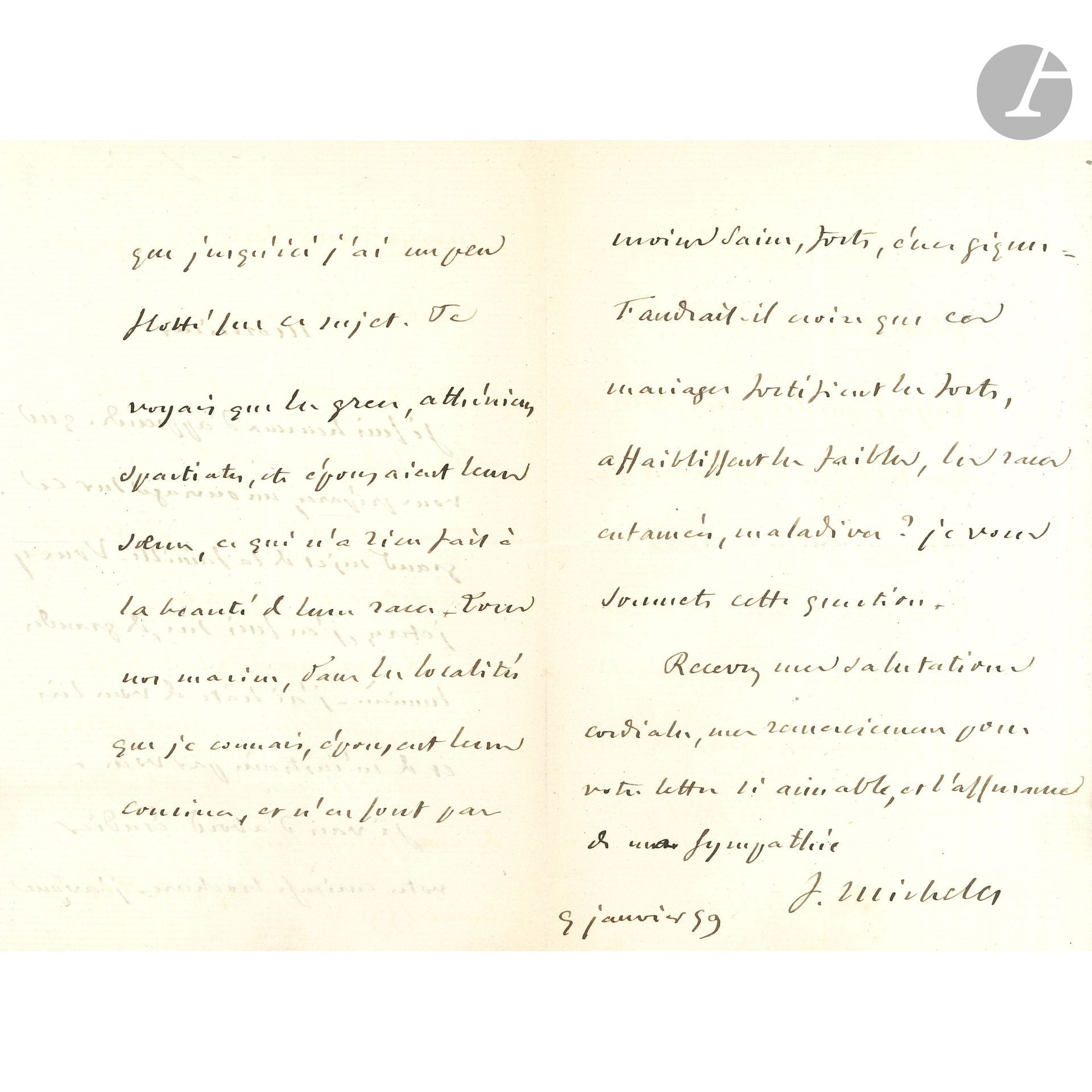
Jules MICHELET (1798–1874). 6 letters, 1859–1868; 17 pages, in-8. 1859. January 5, regarding family and marriage: the Greeks “married their sisters, which did nothing to diminish the beauty of their races. All our sailors, in the areas I know, marry their cousins, and are no less healthy, strong, and energetic for it. Should we conclude that such marriages strengthen the strong and weaken the weak, as well as those races that are already compromised or sickly?”… – January 7, thanking him for an article on *La Femme*: “It is above all a book of tenderness and pity for a very unhappy half of the human race. I would have had no impact whatsoever if I had not highlighted the painful, tragic, and bloody side of the issue”… January 23, 1865, [to Théodore de Banville]. He had never read anything more dazzling: “You have surpassed all the masters of melody, those who claimed to possess the great treasure—rhythm—of which you are the master and absolute owner”… Hyères, 1868 [to Gustave Vapereau]. – April 2. He wants to defend the university, “so cruelly attacked by some, so poorly defended by others,” which has “produced immensely in literature, from 1830 to 1868 ”… – April 9: “Do not think that I wish to set myself up as a blind defender of the university—I know the pros and cons”… – April 11, on Carlyle: “a very superficial dreamer when it comes to the Revolution—a pitiful work—no research, and nothing but false glimmers. The future will judge me. People will see how much time and effort I put into writing the history of the Revolution over eight years, with what rigorous precision, taking into account the hours and minutes of those days when everything depended on the quarter-hour needed to send a message from the Cordeliers to the Jacobins. […] Through alternating details (sometimes spiritualist, sometimes materialist), I have taken my analysis to such a degree—one that no one else has reached—that I have penetrated to the very core of individuality”…
Estimate
€400 - €500
Buyer's premium
31.8%
Jules MICHELET (1798–1874). 6 letters, 1859–1868; 17 pages, in-8.
1859. January 5, regarding family and marriage: the Greeks “married their sisters, which did nothing to diminish the beauty of their races. All our sailors, in the areas I know, marry their cousins, and are no less healthy, strong, and energetic for it. Should we conclude that such marriages strengthen the strong and weaken the weak, as well as those races that are already compromised or sickly?”… – January 7, thanking him for an article on *La Femme*: “It is above all a book of tenderness and pity for a very unhappy half of the human race. I would have had no impact whatsoever if I had not highlighted the painful, tragic, and bloody side of the issue”…
January 23, 1865, [to Théodore de Banville]. He had never read anything more dazzling: “You have surpassed all the masters of melody, those who claimed to possess the great treasure—rhythm—of which you are the master and absolute owner”…
Hyères, 1868 [to Gustave Vapereau]. – April 2. He wants to defend the university, “so cruelly attacked by some, so poorly defended by others,” which has “produced immensely in literature, from 1830 to 1868 ”… – April 9: “Do not think that I wish to set myself up as a blind defender of the university—I know the pros and cons”… – April 11, on Carlyle: “a very superficial dreamer when it comes to the Revolution—a pitiful work—no research, and nothing but false glimmers. The future will judge me. People will see how much time and effort I put into writing the history of the Revolution over eight years, with what rigorous precision, taking into account the hours and minutes of those days when everything depended on the quarter-hour needed to send a message from the Cordeliers to the Jacobins. […] Through alternating details (sometimes spiritualist, sometimes materialist), I have taken my analysis to such a degree—one that no one else has reached—that I have penetrated to the very core of individuality”…
Sale
Wednesday 9 December・14:00 (Europe/Paris)
Sale location coming soon
3, rue Favart
75002 Paris