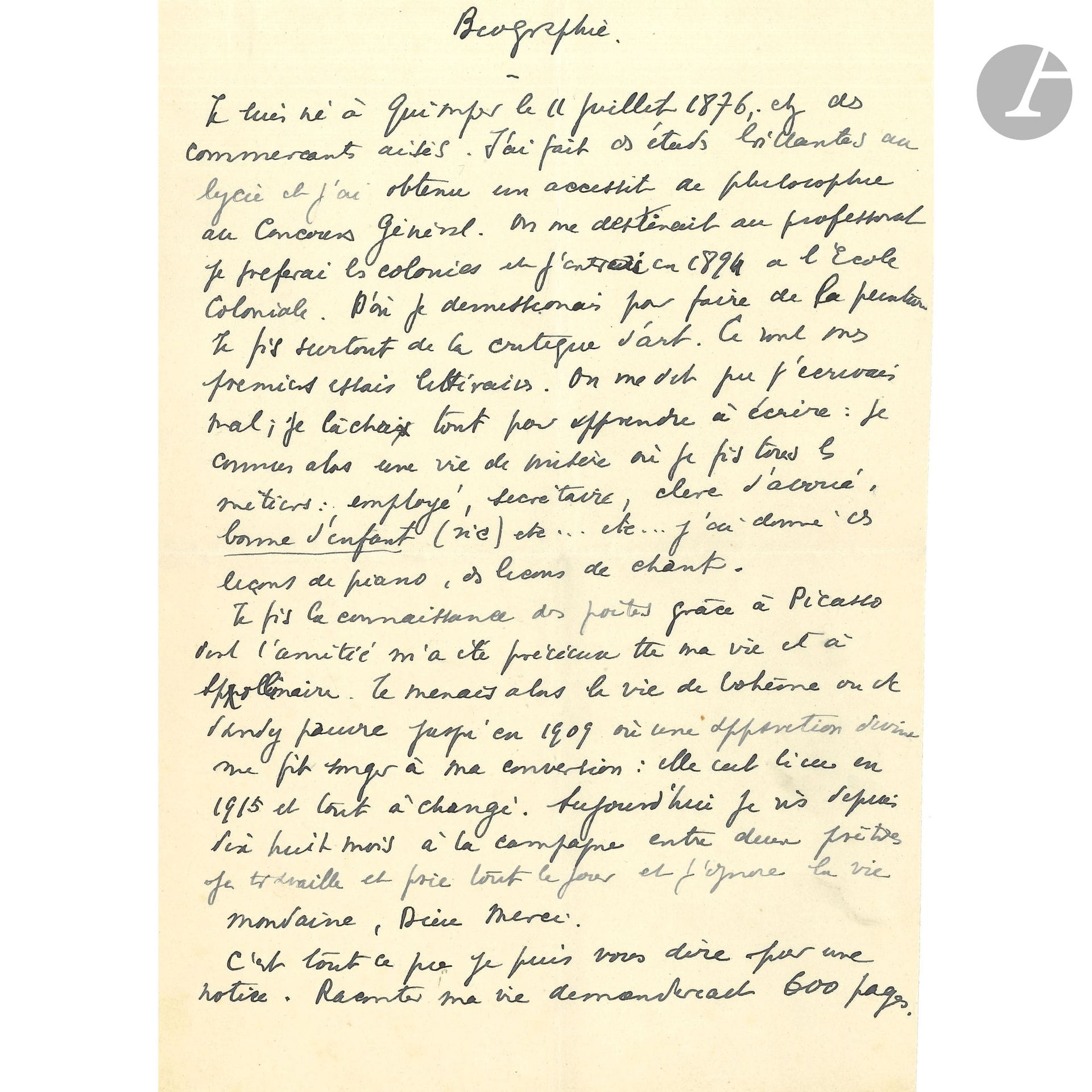
Max JACOB. 2 letters and an autograph manuscript, 1918–1922, to Robert de La Vaissière; 1 page, in-12 format, with an address on the back (postcard), and 2 pages, small in-4 format, with an envelope. 17 rue Gabrielle [July 24, 1918]. He thanks him for his “charming response” to *Le Cornet à dés*: “It was certainly worth more than the poems, which lack its clever turn of phrase, its grace, and its finesse. But goodness! Do you really think I’m that smart? You’re scaring me! Well, anyway! I’ll try to become that smart”… Saint-Benoît-sur-Loire, November 3, 1922. “You’ll find my verses in *Le Laboratoire central*, in *Le Sans Pareil* […] They’ll give you a copy if you go on my behalf, on the grounds of good publicity.” He’ll find Frère Matorel’s Œuvres burlesques et mystiques at Kahnweiler’s or the National Library. There are also poems in *La Défense de Tartuffe*, 12 rue de l’Odéon. “I don’t think any of these publishers will object to their reproduction.” He encloses his biography… Biography. Autobiographical note: “I was born in Quimper on July 11, 1876, to a well-to-do merchant family. I excelled in my studies […] and in 1894 I entered the École Coloniale. I resigned from there to pursue painting. I worked primarily as an art critic. These were my first literary attempts. People told me I wrote poorly; I gave it all up to learn how to write: I then lived a life of poverty, doing all sorts of jobs […] I met the poets thanks to Picasso—whose friendship has been precious to me all my life—and Apollinaire. I led the life of a bohemian—or a poor dandy—until 1909, when a divine apparition led me to contemplate my conversion: it took place in 1915, and everything changed. “Today I have been living in the countryside for eighteen months, between two priests. I work and pray all day, and I know nothing of worldly life”…
Estimate
€600 - €800
Buyer's premium
31.8%
Max JACOB. 2 letters and an autograph manuscript, 1918–1922, to Robert de La Vaissière; 1 page, in-12 format, with an address on the back (postcard), and 2 pages, small in-4 format, with an envelope.
17 rue Gabrielle [July 24, 1918]. He thanks him for his “charming response” to *Le Cornet à dés*: “It was certainly worth more than the poems, which lack its clever turn of phrase, its grace, and its finesse. But goodness! Do you really think I’m that smart? You’re scaring me! Well, anyway! I’ll try to become that smart”…
Saint-Benoît-sur-Loire, November 3, 1922. “You’ll find my verses in *Le Laboratoire central*, in *Le Sans Pareil* […] They’ll give you a copy if you go on my behalf, on the grounds of good publicity.” He’ll find Frère Matorel’s Œuvres burlesques et mystiques at Kahnweiler’s or the National Library. There are also poems in *La Défense de Tartuffe*, 12 rue de l’Odéon. “I don’t think any of these publishers will object to their reproduction.” He encloses his biography…
Biography. Autobiographical note: “I was born in Quimper on July 11, 1876, to a well-to-do merchant family. I excelled in my studies […] and in 1894 I entered the École Coloniale. I resigned from there to pursue painting. I worked primarily as an art critic. These were my first literary attempts. People told me I wrote poorly; I gave it all up to learn how to write: I then lived a life of poverty, doing all sorts of jobs […] I met the poets thanks to Picasso—whose friendship has been precious to me all my life—and Apollinaire. I led the life of a bohemian—or a poor dandy—until 1909, when a divine apparition led me to contemplate my conversion: it took place in 1915, and everything changed. “Today I have been living in the countryside for eighteen months, between two priests. I work and pray all day, and I know nothing of worldly life”…
Sale
Wednesday 9 December・14:00 (Europe/Paris)
Sale location coming soon
3, rue Favart
75002 Paris