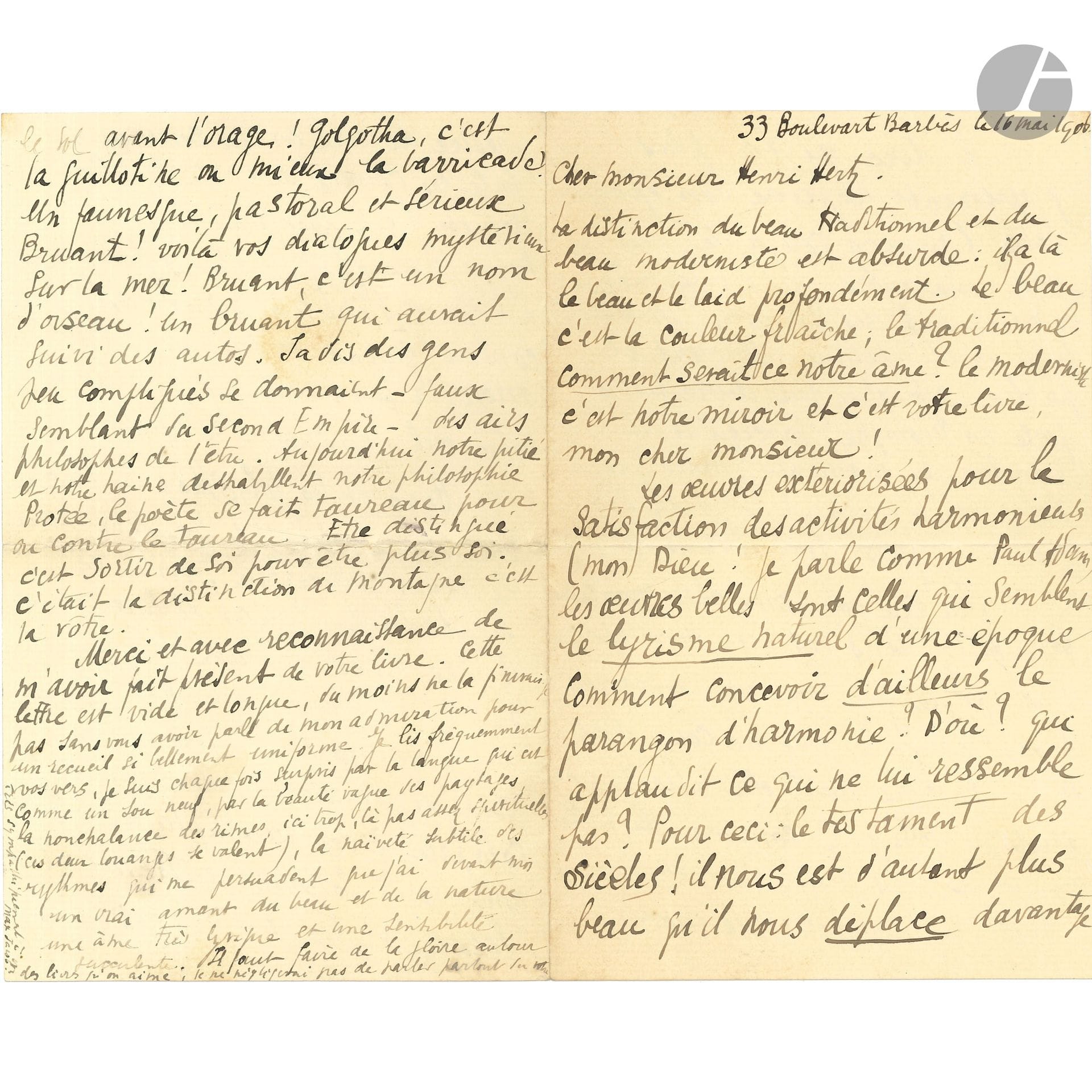
Max JACOB (1876–1944). Autograph letter, “33 Boulevard Barbès,” May 16, 1906, to Henri Hertz; 4 pages, in-8. A very fine literary letter on poetry and modernity. [Henri Hertz (1875–1966) had just published *Quelques vers* with L. Vanier.] “The distinction between traditional beauty and modernist beauty is absurd: at its core lies beauty and ugliness. Beauty is fresh color […] modernity is our mirror […] beautiful works are those that seem to embody the natural lyricism of an era”… He saw in Hertz’s verses his own era, “an era that wavers, resigned yet not resigned, with a glance and a smile from which it draws a lesson; intelligent as the struggle (don’t try to fool us, huh?) and, all things considered, more believing than not, eager to express itself in a single word, potent with chemistry, so that it calls every question into question […] Hugo and his theatrical Golgothas, Baudelaire shopping for earrings at Gautier’s—that’s the Second Empire: a luxurious setting, and laughter itself is a luxury! (Those who laugh are sad; see the Englishman). Corbière was on the boulevard, and Laforgue was in middle school. “People compare you to those two hecklers! But no! We’re shaken in a different way”… And Jacob evokes Bruant… “Like Proteus, the poet turns himself into a bull—for or against the bull. To be distinguished is to step outside oneself in order to be more oneself”…
Estimate
€500 - €700
Buyer's premium
31.8%
Max JACOB (1876–1944). Autograph letter, “33 Boulevard Barbès,” May 16, 1906, to Henri Hertz; 4 pages, in-8.
A very fine literary letter on poetry and modernity. [Henri Hertz (1875–1966) had just published *Quelques vers* with L. Vanier.]
“The distinction between traditional beauty and modernist beauty is absurd: at its core lies beauty and ugliness. Beauty is fresh color […] modernity is our mirror […] beautiful works are those that seem to embody the natural lyricism of an era”… He saw in Hertz’s verses his own era, “an era that wavers, resigned yet not resigned, with a glance and a smile from which it draws a lesson; intelligent as the struggle (don’t try to fool us, huh?) and, all things considered, more believing than not, eager to express itself in a single word, potent with chemistry, so that it calls every question into question […] Hugo and his theatrical Golgothas, Baudelaire shopping for earrings at Gautier’s—that’s the Second Empire: a luxurious setting, and laughter itself is a luxury! (Those who laugh are sad; see the Englishman). Corbière was on the boulevard, and Laforgue was in middle school. “People compare you to those two hecklers! But no! We’re shaken in a different way”… And Jacob evokes Bruant… “Like Proteus, the poet turns himself into a bull—for or against the bull. To be distinguished is to step outside oneself in order to be more oneself”…
Sale
Wednesday 9 December・14:00 (Europe/Paris)
Sale location coming soon
3, rue Favart
75002 Paris