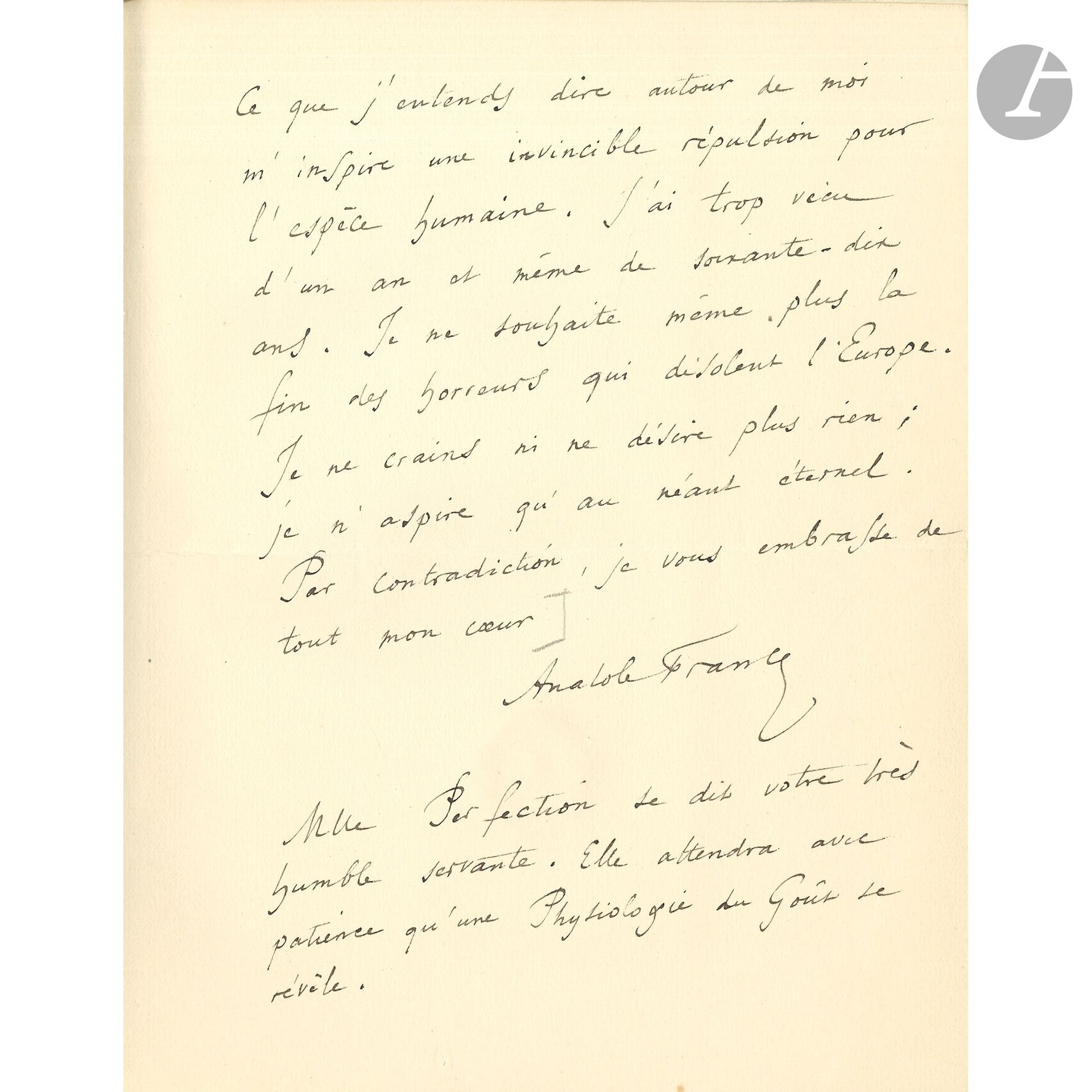
Anatole FRANCE. 10 personal letters, La Béchellerie and Antibes, 1915–1922, to his friends Léopold Kahn and Jules Couët; 21 pages in-8 and small in-4 format, 5 on La Béchellerie letterhead, 2 from the Hôtel du Cap d’Antibes, 5 envelopes addressed to Jules Couët, mounted on tabs in a single small in-4 volume, bound in red half-maroquin. From his retreat in Tours, Anatole France follows the developments of the war with anxiety and sadness. He gives news of his partner Emma (Tyco) and allows himself to be overcome by discouragement. To Léopold Kahn. He recounts a conversation between Albert Thomas and Joffre, who never said that the war would end in late July: “He simply said that there would be news in July. At a time when we are inundated with lies and nonsense, an honest and reasonable word is a welcome relief”… He asks that *Les Dieux ont soif* be sent to Jacques Barnathon and to Dr. Borgey, who describes to him the misfortunes of Verdun; “I receive only letters from the front that exude courage and devotion, but I have been shown some that betray discouragement—and worse than discouragement. “The Dardanelles campaign is being conducted ineptly”… He has no doubt about victory, but “we must redouble our efforts and all work together—military, civilians, men, and women—with harmony and absolute devotion”… He heats his home with green wood and has replaced bread with potatoes; he regrets Ribot’s refusal to negotiate with Germany, which “will cost the world many disasters and much misery”… He is concerned about the domestic situation: “There are fears that Parliament will collapse under the weight of scandals and popular unrest. No one foresees peace coming soon”… March 12, 1921: he leaves Antibes, where he was “horribly bored”; he is worried about the future, foresees an inevitable catastrophe, and is convinced “that the industrialists who govern France have imposed unacceptable conditions on the Germans to bring about a rupture that would allow them to occupy the Ruhr”… To Jules Couët. May 9 [1915]: Italy’s entry into the war gives him some hope; he protested the bombing of a cathedral but sees no end to the war in sight and extrapolates: “The war against China, Japan, and the United States is finally giving our planet a pleasant appearance”… January 6, 1916: “I love you—a rare exception. For I am horrified by men, and I would be quite at a loss to tell you what I hate most about them—their stupidity or their wickedness”… June 21, 1917: he never opens a newspaper; “apart from *Le Canard enchaîné*, I read Euripides and thus manage to endure life”… Antibes, January 30, 1918: “I sought distraction in the most useless, frivolous, and futile occupation I could possibly choose—I wrote two short stories to add to the tales of Little Pierre”… Antibes, January 28, 1921: He found a 1647 edition of *Selected Letters of Sieur de Balzac* at a bookstore in Cannes: “This book is invaluable for the history of the language”; He was overcome by boredom and could not bring himself to “get seriously to work on Volume 2 of *Le Petit Pierre*, which Calmann is demanding of me. But to console myself, I say with Ecclesiastes: ‘What profit does a man gain from all his labor?’”… A letter of tribute to a lady (facsimile) has been bound in following this; and an autograph letter from Valérie France (Anatole’s ex-wife) has been included, in which she announces to a friend her upcoming marriage to René Dussaud (July 7, 1902).
Estimate
€500 - €700
Buyer's premium
31.8%
Anatole FRANCE. 10 personal letters, La Béchellerie and Antibes, 1915–1922, to his friends Léopold Kahn and Jules Couët; 21 pages in-8 and small in-4 format, 5 on La Béchellerie letterhead, 2 from the Hôtel du Cap d’Antibes, 5 envelopes addressed to Jules Couët, mounted on tabs in a single small in-4 volume, bound in red half-maroquin.
From his retreat in Tours, Anatole France follows the developments of the war with anxiety and sadness. He gives news of his partner Emma (Tyco) and allows himself to be overcome by discouragement.
To Léopold Kahn. He recounts a conversation between Albert Thomas and Joffre, who never said that the war would end in late July: “He simply said that there would be news in July. At a time when we are inundated with lies and nonsense, an honest and reasonable word is a welcome relief”… He asks that *Les Dieux ont soif* be sent to Jacques Barnathon and to Dr. Borgey, who describes to him the misfortunes of Verdun; “I receive only letters from the front that exude courage and devotion, but I have been shown some that betray discouragement—and worse than discouragement. “The Dardanelles campaign is being conducted ineptly”… He has no doubt about victory, but “we must redouble our efforts and all work together—military, civilians, men, and women—with harmony and absolute devotion”… He heats his home with green wood and has replaced bread with potatoes; he regrets Ribot’s refusal to negotiate with Germany, which “will cost the world many disasters and much misery”… He is concerned about the domestic situation: “There are fears that Parliament will collapse under the weight of scandals and popular unrest. No one foresees peace coming soon”… March 12, 1921: he leaves Antibes, where he was “horribly bored”; he is worried about the future, foresees an inevitable catastrophe, and is convinced “that the industrialists who govern France have imposed unacceptable conditions on the Germans to bring about a rupture that would allow them to occupy the Ruhr”…
To Jules Couët. May 9 [1915]: Italy’s entry into the war gives him some hope; he protested the bombing of a cathedral but sees no end to the war in sight and extrapolates: “The war against China, Japan, and the United States is finally giving our planet a pleasant appearance”… January 6, 1916: “I love you—a rare exception. For I am horrified by men, and I would be quite at a loss to tell you what I hate most about them—their stupidity or their wickedness”… June 21, 1917: he never opens a newspaper; “apart from *Le Canard enchaîné*, I read Euripides and thus manage to endure life”… Antibes, January 30, 1918: “I sought distraction in the most useless, frivolous, and futile occupation I could possibly choose—I wrote two short stories to add to the tales of Little Pierre”… Antibes, January 28, 1921: He found a 1647 edition of *Selected Letters of Sieur de Balzac* at a bookstore in Cannes: “This book is invaluable for the history of the language”; He was overcome by boredom and could not bring himself to “get seriously to work on Volume 2 of *Le Petit Pierre*, which Calmann is demanding of me. But to console myself, I say with Ecclesiastes: ‘What profit does a man gain from all his labor?’”…
A letter of tribute to a lady (facsimile) has been bound in following this; and an autograph letter from Valérie France (Anatole’s ex-wife) has been included, in which she announces to a friend her upcoming marriage to René Dussaud (July 7, 1902).
Sale
Wednesday 9 December・14:00 (Europe/Paris)
Sale location coming soon
3, rue Favart
75002 Paris