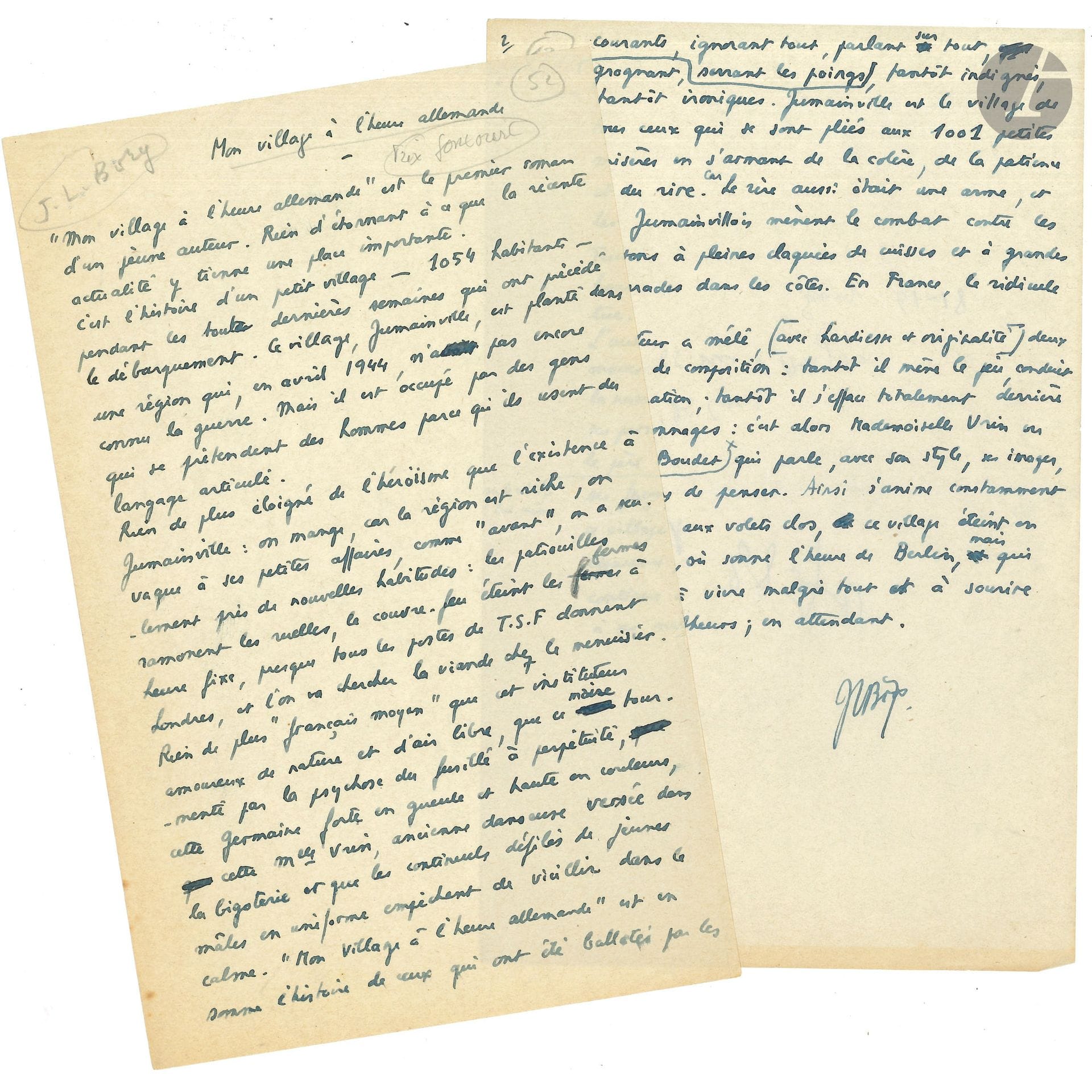
Jean-Louis BORY (1919–1979). 2 signed autograph manuscripts, *Mon village à l’heure allemande…*, and responses to a questionnaire, [1945]; 2 and 5½ pages, in-8. Introduction to his novel (1945 Prix Goncourt): “Mon village à l’heure allemande is the first novel by a young author. It is no surprise that recent current events play a significant role in it. It is the story of a small village—1,054 inhabitants—during the very last weeks leading up to the D-Day landings. […] Nothing could be further from heroism than life in Jumainville”… Answers to an 8-point questionnaire (typed copy attached). Bory discusses his upcoming novel *Chère Aglaé* and his other novel projects: *Fragile* and *La Halle aux houblons*... “The theater appeals to me, but I won’t tackle it for a few years; one must be exceptionally well-prepared to succeed there.” Among his mentors, he cites Aragon, Faulkner, Aymé, Laclos, and Balzac, “the undisputed master of the novel.” This is followed by interesting observations and predictions about the postwar novel, “the future of the novel”; finally, he reflects on the critics’ reactions to *Mon village à l’heure allemande*… Enclosed: *Mon village à l’heure allemande* (Flammarion, 1945), bound in havana-colored half-maroquin with corner caps, along with a newspaper clipping announcing the 1945 Goncourt Prize awarded to Bory.
Estimate
€300 - €400
Buyer's premium
31.8%
Jean-Louis BORY (1919–1979). 2 signed autograph manuscripts, *Mon village à l’heure allemande…*, and responses to a questionnaire, [1945]; 2 and 5½ pages, in-8.
Introduction to his novel (1945 Prix Goncourt): “Mon village à l’heure allemande is the first novel by a young author. It is no surprise that recent current events play a significant role in it. It is the story of a small village—1,054 inhabitants—during the very last weeks leading up to the D-Day landings. […] Nothing could be further from heroism than life in Jumainville”…
Answers to an 8-point questionnaire (typed copy attached). Bory discusses his upcoming novel *Chère Aglaé* and his other novel projects: *Fragile* and *La Halle aux houblons*... “The theater appeals to me, but I won’t tackle it for a few years; one must be exceptionally well-prepared to succeed there.” Among his mentors, he cites Aragon, Faulkner, Aymé, Laclos, and Balzac, “the undisputed master of the novel.” This is followed by interesting observations and predictions about the postwar novel, “the future of the novel”; finally, he reflects on the critics’ reactions to *Mon village à l’heure allemande*…
Enclosed: *Mon village à l’heure allemande* (Flammarion, 1945), bound in havana-colored half-maroquin with corner caps, along with a newspaper clipping announcing the 1945 Goncourt Prize awarded to Bory.
Sale
Wednesday 9 December・14:00 (Europe/Paris)
Sale location coming soon
3, rue Favart
75002 Paris