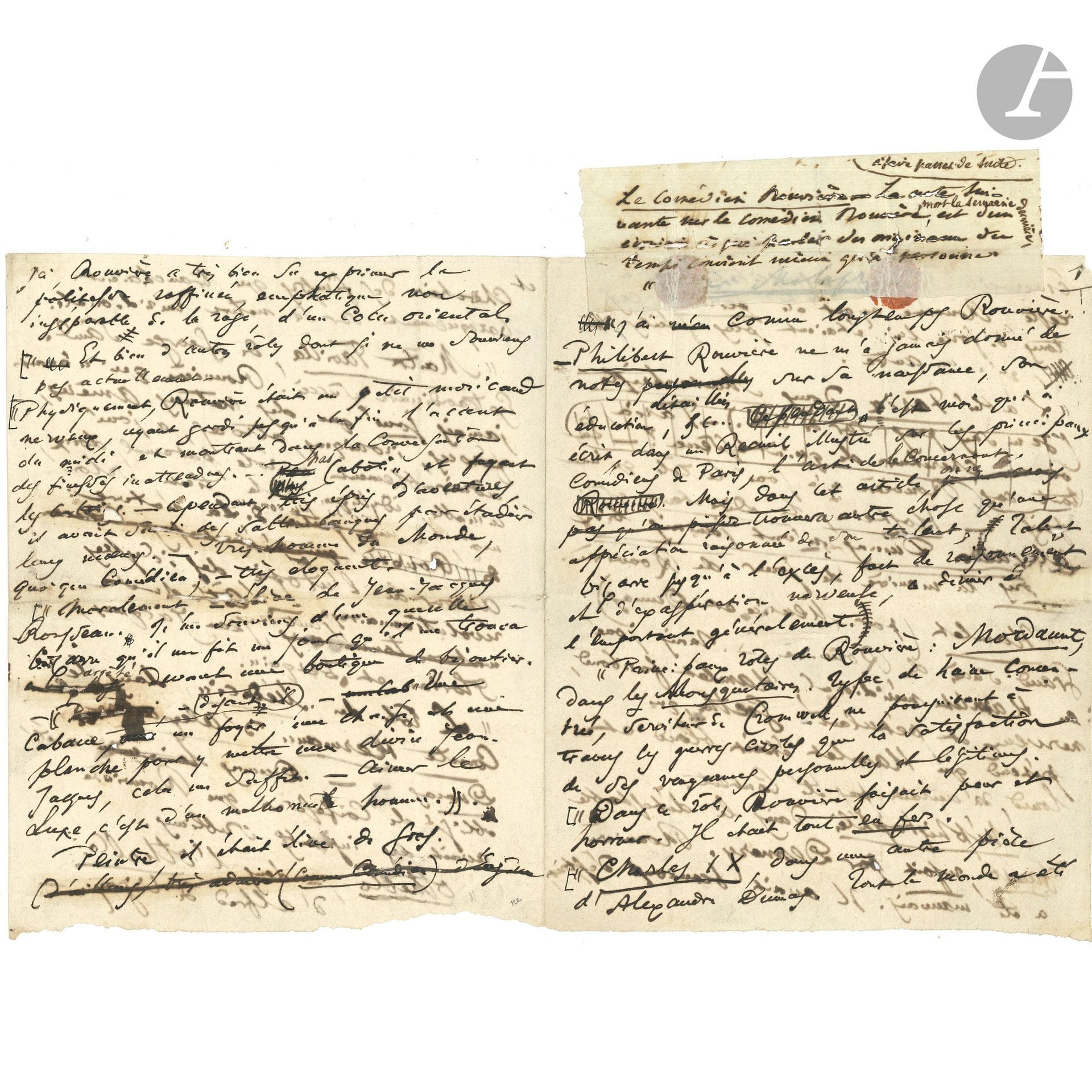
Charles BAUDELAIRE. Autograph manuscript, “Le Comédien Rouvière,” [1865]; 5 pages, small in-4 (slight cracks caused by ink corrosion, minor repair). Working manuscript of an article. This article appeared in *La Petite Revue* on October 28, 1865. The actor Philibert Rouvière (1805–1865) had just died on October 19. For this obituary, Baudelaire reused part of the entry he had written about Rouvière in 1856 for the *Nouvelle Galerie des artistes dramatiques vivants*, which was reprinted with a few variations in *L’Artiste* on December 1, 1859. The manuscript, which remained unknown to Baudelaire’s editors in the *Pléiade* series, contains numerous and significant cross-outs and corrections. At the top of Baudelaire’s manuscript, Auguste Poulet-Malassis wrote a short introductory text on a slip of paper: “The Actor Rouvière. The following note on the actor Rouvière, who died last week, is by a writer who is better suited than anyone else to speak of the originals of the time.” Baudelaire begins as follows: “I knew Rouvière for a long time. – Philibert Rouvière never gave me detailed notes about his birth, his upbringing, etc. It was I who wrote the article about him in an Illustrated Collection on the Principal Actors of Paris. But in that article, one will find nothing but a reasoned assessment of his talent—a talent bizarre to the extreme, composed of reasoning and nervous exaggeration, the latter generally prevailing.” He lists Rouvière’s major roles: “Mordaunt, in *The Three Musketeers*. A paragon of concentrated hatred, a servant of Cromwell, pursuing through the civil wars nothing but the satisfaction of his personal and legitimate vengeance. In this role, Rouvière inspired fear and horror. He was all steel”; as Charles IX in Alexandre Dumas’s *La Reine Margot*, audiences were “amazed by this resurrection”; Abbé Faria in *The Count of Monte Cristo*; Hamlet, “A great success for Rouvière. – But played as a southern Hamlet; a furious, nervous, and petulant Hamlet”…; “Mephistopheles, in the detestable *Faust*, remade by Dennery. Rouvière was poor. He had a great deal of wit and sought subtleties that stood out in a baroque way against his southern nature”; Maître Favilla, by George Sand: “An extraordinary success! Rouvière, who had never before played anything but bitter, ferocious, ironic, or atrocious characters, gave an admirable performance in a paternal, gentle, amiable, and idyllic role. This, in my opinion, stems from a little-known aspect of his nature: a love of utopia and revolutionary idylls;—a reverence for Jean-Jacques, Florian, and Berquin”; the Doctor, in Alexandre Dumas’s *The Count of Hermann*, who “was forced to admit that Rouvière had moments of sublime brilliance”; Othello, from Alfred de Vigny’s *The Moor of Venice*: “Rouvière was very skilled at expressing the refined, emphatic politeness that is inseparable from the rage of an Eastern cuckold”; and many other roles as well. “Physically, Rouvière was a small, nervous, dark-skinned man who retained his Southern accent until the end and displayed unexpected subtleties in conversation…—not a ham and one who shunned hams. – However, with a great love of adventure, he had traveled with traveling theater troupes to study their ways. – A man of the world, though an actor, and very eloquent. Morally, a disciple of Jean-Jacques Rousseau”; and Baudelaire recounts a “bizarre quarrel” that Rouvière picked with him while he was looking at a jeweler’s storefront. Rouvière had been a painter and “a pupil of Gros. A few months ago, when Rouvière fell ill and was very poor, some friends came up with the idea of holding a sale of his paintings,” but to no avail. “As a painter, he was, in some respects, what he was as an actor—bizarre, ingenious, and incomplete. I do, however, recall a charming painting depicting Hamlet forcing his mother to gaze at the portrait of the late king. – An ultra-Romantic painting.” A painting of the Girondins in prison was offered for sale as a Géricault, “which I immediately recognized as a Rouvière… A grand composition, wild and clumsy, even childlike, but full of passion.” The last lines, on the back of the final page, are in Poulet-Malassis’s hand, as is the signature “Ch. B.”: “As an actor, Rouvière was greatly admired by Eugène Delacroix. Mr. Champfleury wrote a curious study of him in the form of a short story: *The Trianon Actor*.”
Estimate
€3,000 - €4,000
Buyer's premium
31.8%
Charles BAUDELAIRE. Autograph manuscript, “Le Comédien Rouvière,” [1865]; 5 pages, small in-4 (slight cracks caused by ink corrosion, minor repair).
Working manuscript of an article.
This article appeared in *La Petite Revue* on October 28, 1865. The actor Philibert Rouvière (1805–1865) had just died on October 19. For this obituary, Baudelaire reused part of the entry he had written about Rouvière in 1856 for the *Nouvelle Galerie des artistes dramatiques vivants*, which was reprinted with a few variations in *L’Artiste* on December 1, 1859.
The manuscript, which remained unknown to Baudelaire’s editors in the *Pléiade* series, contains numerous and significant cross-outs and corrections. At the top of Baudelaire’s manuscript, Auguste Poulet-Malassis wrote a short introductory text on a slip of paper: “The Actor Rouvière. The following note on the actor Rouvière, who died last week, is by a writer who is better suited than anyone else to speak of the originals of the time.”
Baudelaire begins as follows: “I knew Rouvière for a long time. – Philibert Rouvière never gave me detailed notes about his birth, his upbringing, etc. It was I who wrote the article about him in an Illustrated Collection on the Principal Actors of Paris. But in that article, one will find nothing but a reasoned assessment of his talent—a talent bizarre to the extreme, composed of reasoning and nervous exaggeration, the latter generally prevailing.”
He lists Rouvière’s major roles: “Mordaunt, in *The Three Musketeers*. A paragon of concentrated hatred, a servant of Cromwell, pursuing through the civil wars nothing but the satisfaction of his personal and legitimate vengeance. In this role, Rouvière inspired fear and horror. He was all steel”; as Charles IX in Alexandre Dumas’s *La Reine Margot*, audiences were “amazed by this resurrection”; Abbé Faria in *The Count of Monte Cristo*; Hamlet, “A great success for Rouvière. – But played as a southern Hamlet; a furious, nervous, and petulant Hamlet”…; “Mephistopheles, in the detestable *Faust*, remade by Dennery. Rouvière was poor. He had a great deal of wit and sought subtleties that stood out in a baroque way against his southern nature”; Maître Favilla, by George Sand: “An extraordinary success! Rouvière, who had never before played anything but bitter, ferocious, ironic, or atrocious characters, gave an admirable performance in a paternal, gentle, amiable, and idyllic role. This, in my opinion, stems from a little-known aspect of his nature: a love of utopia and revolutionary idylls;—a reverence for Jean-Jacques, Florian, and Berquin”; the Doctor, in Alexandre Dumas’s *The Count of Hermann*, who “was forced to admit that Rouvière had moments of sublime brilliance”; Othello, from Alfred de Vigny’s *The Moor of Venice*: “Rouvière was very skilled at expressing the refined, emphatic politeness that is inseparable from the rage of an Eastern cuckold”; and many other roles as well.
“Physically, Rouvière was a small, nervous, dark-skinned man who retained his Southern accent until the end and displayed unexpected subtleties in conversation…—not a ham and one who shunned hams. – However, with a great love of adventure, he had traveled with traveling theater troupes to study their ways. – A man of the world, though an actor, and very eloquent. Morally, a disciple of Jean-Jacques Rousseau”; and Baudelaire recounts a “bizarre quarrel” that Rouvière picked with him while he was looking at a jeweler’s storefront.
Rouvière had been a painter and “a pupil of Gros. A few months ago, when Rouvière fell ill and was very poor, some friends came up with the idea of holding a sale of his paintings,” but to no avail. “As a painter, he was, in some respects, what he was as an actor—bizarre, ingenious, and incomplete. I do, however, recall a charming painting depicting Hamlet forcing his mother to gaze at the portrait of the late king. – An ultra-Romantic painting.” A painting of the Girondins in prison was offered for sale as a Géricault, “which I immediately recognized as a Rouvière… A grand composition, wild and clumsy, even childlike, but full of passion.”
The last lines, on the back of the final page, are in Poulet-Malassis’s hand, as is the signature “Ch. B.”: “As an actor, Rouvière was greatly admired by Eugène Delacroix. Mr. Champfleury wrote a curious study of him in the form of a short story: *The Trianon Actor*.”
Sale
Wednesday 9 December・14:00 (Europe/Paris)
Sale location coming soon
3, rue Favart
75002 Paris