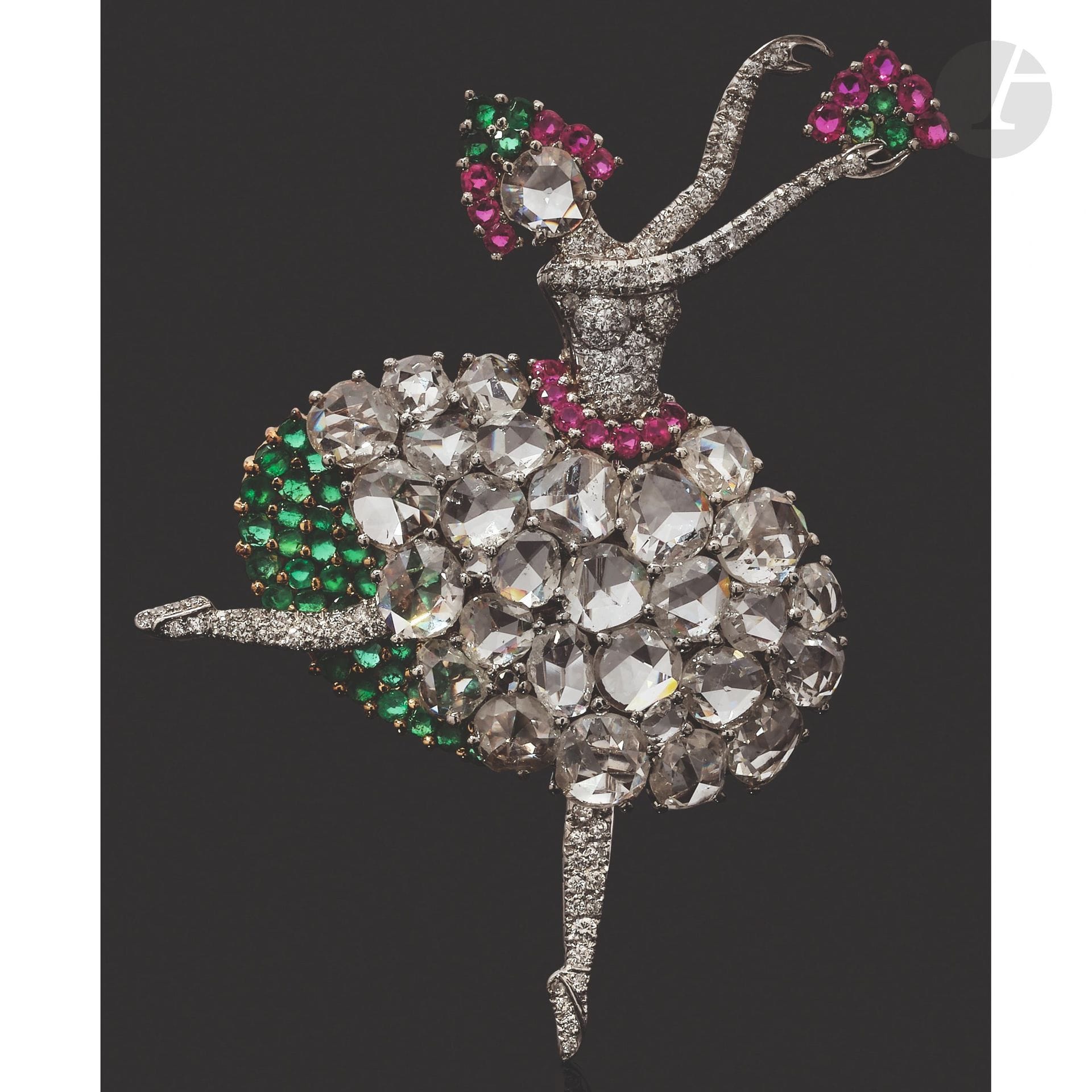
JOHN RUBEL A clip brooch in platinum and 18K gold (750) depicting a ballerina, with the bust, arms, and legs set with round brilliant-cut diamonds; the face and tutu adorned with rose-cut diamonds; the headdress and bouquet set with rubies and emeralds; and the petticoat accented with emeralds. Signed, traces of a number. Dated to the 1940s. Height: approximately 6.7 cm. Gross weight: 19.4 g (impacts with material loss) The history of Maison Rubel began in Hungary, where Jean and Robert Rubel ran a jewelry store with their parents at the dawn of the 20th century. The two brothers emigrated to Paris and opened their first workshop in 1915 on Rue Vivienne. The quality of their work quickly became renowned throughout Paris, leading them to expand and relocate to Avenue de l’Opéra. The most prestigious houses on the Place commissioned their work. It was with Van Cleef & Arpels that the Rubel workshop reached the pinnacle of its creative genius and absolute mastery of jewelry craftsmanship, creating exceptional pieces for the 1925 International Exhibition of Decorative Arts in Paris. They were invited by Van Cleef & Arpels to New York in the late 1930s to oversee the production of American jewelry. Their collaboration with Van Cleef & Arpels ended in 1943, and the Rubels opened their own boutique on Fifth Avenue, where they enjoyed immense success. Jean Americanized his first name to John. But World War II took a heavy toll on their family and intensified their desire to return home. After closing their workshop, they returned to France and devoted themselves to diamonds. The house was reborn in 2015 under the leadership of Sophie Mizrahi-Rubel. The clip brooch we are presenting here depicts a ballerina performing an arabesque; the movements of her arms and legs, the position of her torso in relation to her tutu—all these details are rendered with remarkable precision and attention to detail. It seems that the idea for this brooch depicting a ballerina came from Robert Rubel, who reportedly sketched the dancer performing before him during a show on a paper tablecloth. The next day, he reportedly brought this sketch to his designer, Maurice Duvalet (who also worked for Van Cleef & Arpels), and the brilliant designer transformed it into a piece of jewelry. Numerous designs were created featuring different costumes, evoking in turn flamenco, classical ballet, and more… The dancer in a white tutu that we are presenting here, designed by John Rubel, is comparable to a piece reproduced in the Van Cleef & Arpels Collection (The Van Cleef & Arpels Collection 1906–1953, Paris 2023, p. 399) dated 1941.
Estimate
€40,000 - €50,000
Buyer's premium
30%
JOHN RUBEL
A clip brooch in platinum and 18K gold (750) depicting a ballerina, with the bust, arms, and legs set with round brilliant-cut diamonds; the face and tutu adorned with rose-cut diamonds; the headdress and bouquet set with rubies and emeralds; and the petticoat accented with emeralds. Signed, traces of a number. Dated to the 1940s. Height: approximately 6.7 cm. Gross weight: 19.4 g (impacts with material loss)
The history of Maison Rubel began in Hungary, where Jean and Robert Rubel ran a jewelry store with their parents at the dawn of the 20th century. The two brothers emigrated to Paris and opened their first workshop in 1915 on Rue Vivienne. The quality of their work quickly became renowned throughout Paris, leading them to expand and relocate to Avenue de l’Opéra. The most prestigious houses on the Place commissioned their work. It was with Van Cleef & Arpels that the Rubel workshop reached the pinnacle of its creative genius and absolute mastery of jewelry craftsmanship, creating exceptional pieces for the 1925 International Exhibition of Decorative Arts in Paris. They were invited by Van Cleef & Arpels to New York in the late 1930s to oversee the production of American jewelry. Their collaboration with Van Cleef & Arpels ended in 1943, and the Rubels opened their own boutique on Fifth Avenue, where they enjoyed immense success. Jean Americanized his first name to John. But World War II took a heavy toll on their family and intensified their desire to return home. After closing their workshop, they returned to France and devoted themselves to diamonds. The house was reborn in 2015 under the leadership of Sophie Mizrahi-Rubel.
The clip brooch we are presenting here depicts a ballerina performing an arabesque; the movements of her arms and legs, the position of her torso in relation to her tutu—all these details are rendered with remarkable precision and attention to detail.
It seems that the idea for this brooch depicting a ballerina came from Robert Rubel, who reportedly sketched the dancer performing before him during a show on a paper tablecloth. The next day, he reportedly brought this sketch to his designer, Maurice Duvalet (who also worked for Van Cleef & Arpels), and the brilliant designer transformed it into a piece of jewelry. Numerous designs were created featuring different costumes, evoking in turn flamenco, classical ballet, and more…
The dancer in a white tutu that we are presenting here, designed by John Rubel, is comparable to a piece reproduced in the Van Cleef & Arpels Collection (The Van Cleef & Arpels Collection 1906–1953, Paris 2023, p. 399) dated 1941.
Sale
Tuesday 8 December・11:00 (Europe/Paris)
Salle 3 - Hôtel Drouot
9, rue Drouot
75009 Paris