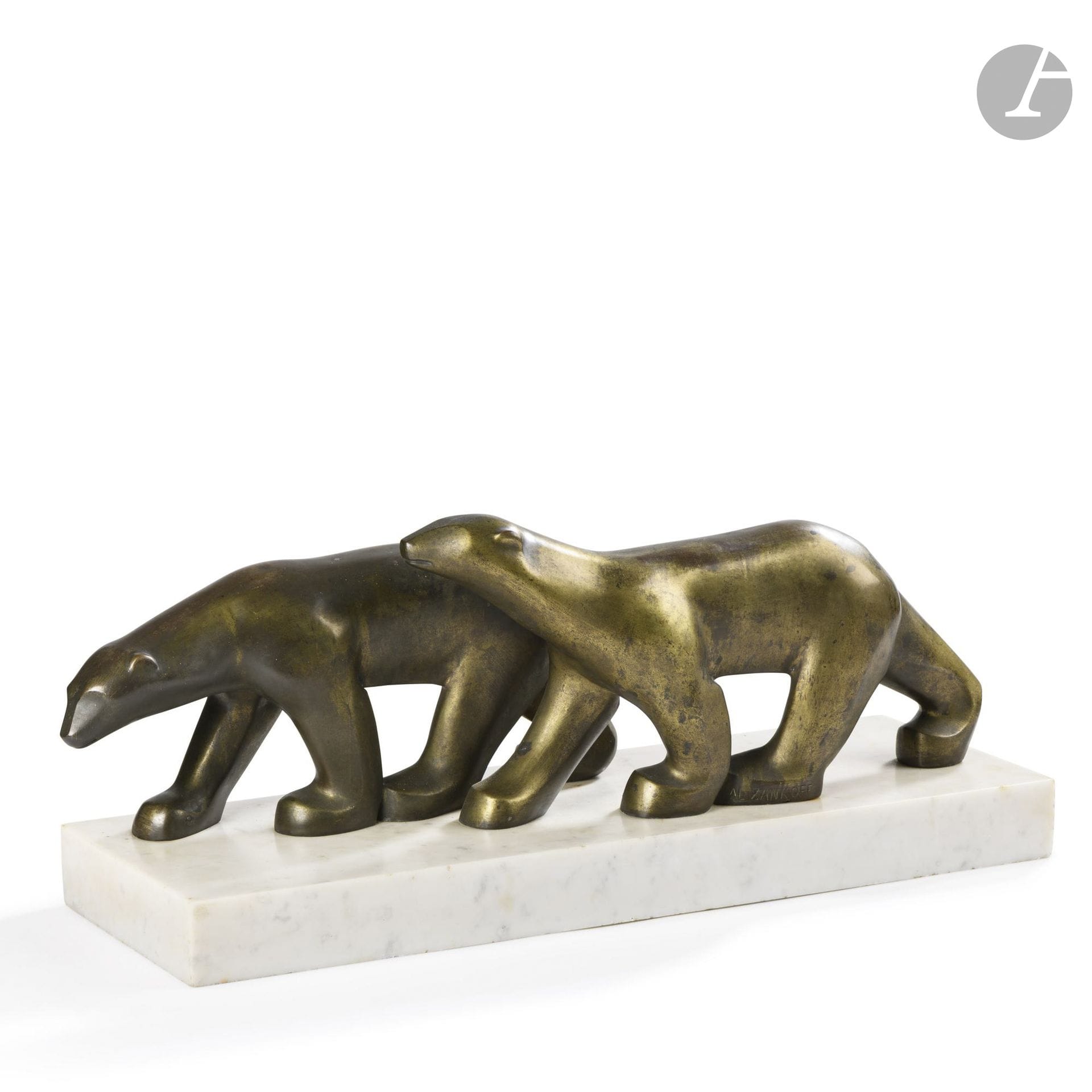
ALEXANDRE ZANKOFF (1900–1982) (ALEXANDER ZANKOV OR ALEKSANDER TZANKOV OR ALEXANDER ZANKHOV, ALSO KNOWN AS) – АЛЕКСАНДЪР ЗАНКОВ Pair of walking polar bears, circa 1930 Animal group sculpture. Bronze cast with a nuanced gold-brown patina. Marble base. Early edition from the 1930s, most likely by Guillemard. Signed “Al. ZANKOFF” and numbered 10 on the left hind paw of the bear with its head raised. Including base: Height: 25 cm – Length: 58 cm – Depth: 19.5 cm Alexander ZANKOFF Son of politician Kristo Zankov and brother of revolutionary Georges Zankov, Alexander Zankov, a sculptor and painter, was born in Sofia in 1900 and died there in 1982. He trained at the Academy of Arts in Florence, then at the Academy in Rome, completing his studies in 1927. In 1929, his passion for sculpture led him to further his training under Émile-Antoine Bourdelle. He returned to Bulgaria, likely for good, in 1934. Some of his works are housed at the National Gallery in Sofia, while others are in museums in Kazanlak (Bulgaria) and Moscow. He created several monuments in Bulgaria, including one in Kardjali (1939), on the façade of the Military Academy in Sofia (1941), and many others commissioned for the Bulgarian capital after the 1946 revolution.
Estimate
€8,000 - €12,000
Buyer's premium
31.8%
ALEXANDRE ZANKOFF (1900–1982) (ALEXANDER ZANKOV OR ALEKSANDER TZANKOV OR ALEXANDER ZANKHOV, ALSO KNOWN AS) – АЛЕКСАНДЪР ЗАНКОВ
Pair of walking polar bears, circa 1930
Animal group sculpture.
Bronze cast with a nuanced gold-brown patina.
Marble base.
Early edition from the 1930s, most likely by Guillemard.
Signed “Al. ZANKOFF” and numbered 10 on the left hind paw of the bear with its head raised.
Including base: Height: 25 cm – Length: 58 cm – Depth: 19.5 cm
Alexander ZANKOFF
Son of politician Kristo Zankov and brother of revolutionary Georges Zankov, Alexander Zankov, a sculptor and painter, was born in Sofia in 1900 and died there in 1982. He trained at the Academy of Arts in Florence, then at the Academy in Rome, completing his studies in 1927. In 1929, his passion for sculpture led him to further his training under Émile-Antoine Bourdelle. He returned to Bulgaria, likely for good, in 1934. Some of his works are housed at the National Gallery in Sofia, while others are in museums in Kazanlak (Bulgaria) and Moscow. He created several monuments in Bulgaria, including one in Kardjali (1939), on the façade of the Military Academy in Sofia (1941), and many others commissioned for the Bulgarian capital after the 1946 revolution.
Sale
Friday 27 November・14:00 (Europe/Paris)
Salle 5-6 - Hôtel Drouot
9, rue Drouot
75009 Paris