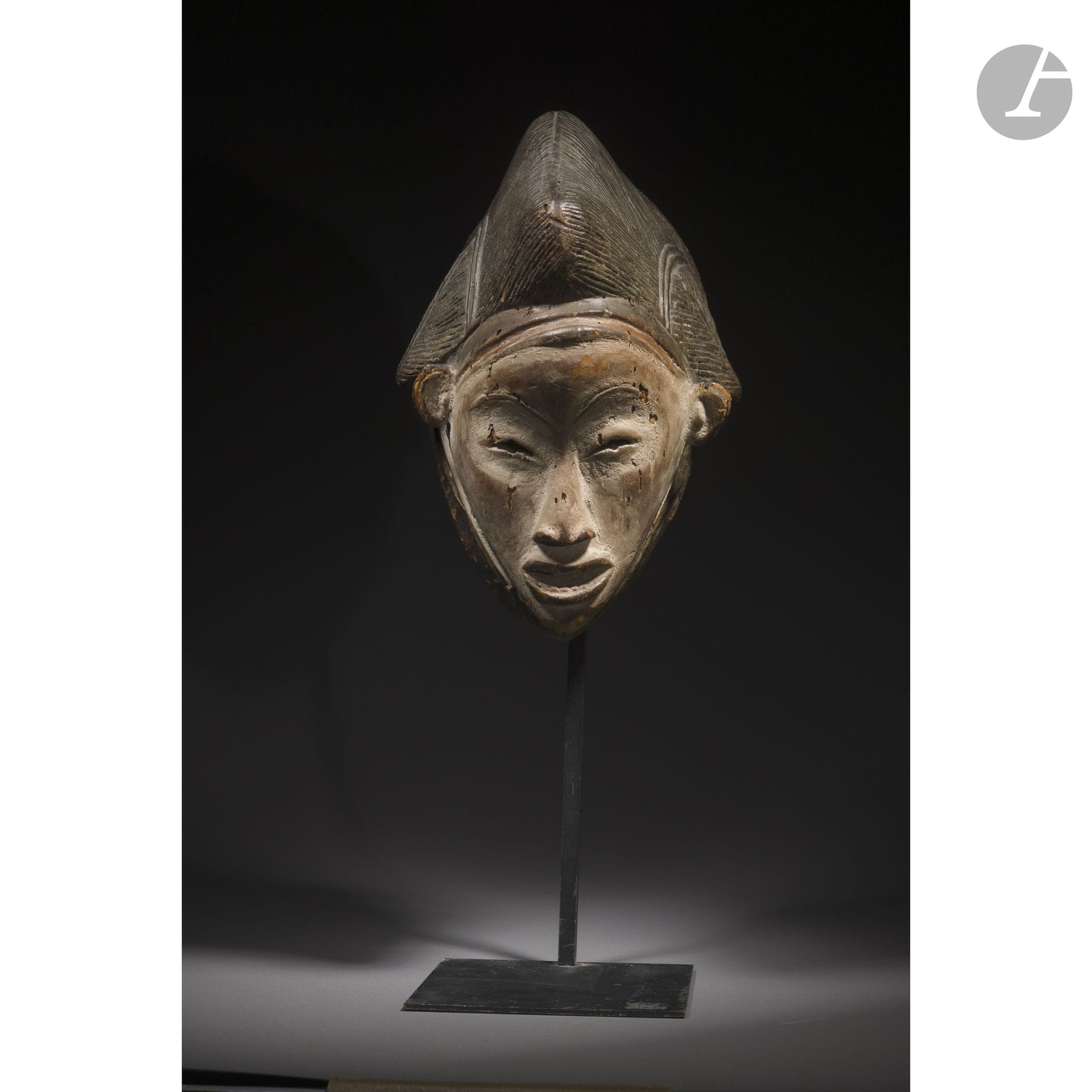
A beautiful, ancient Okuyi mask of superb style, part of the great sculptural tradition of southern Gabon, shared in particular by the Punu, Lumbu, Shira, and Nzebi peoples. Recognizable by their faces coated in white kaolin, their lips highlighted in red, their arched eyebrows, and their half-closed eyes, these masks played an essential role in the ritual and ceremonial life of the region’s communities. They were notably featured in the Mukudj dances—also known as Mukuyi or Okuyi—during which the mask bearer, perched on high stilts, performed spectacular moves. Associated with the initiation of young boys, these events also accompanied major occasions in community life. The delicacy of the features and the whiteness of the face evoke the idealized figure of an ancestor, whose benevolent powers serve as a link between the world of the living and that of the spirits. The symbolism of the colors plays a key role in this spiritual dimension: the white of the kaolin refers to the world of the ancestors, while the red of the lips—traditionally obtained from padouk wood—evokes life and vitality. Through the harmony of their proportions, the purity of their lines, and the extreme refinement of their modeling, the Okuyi masks—particularly those attributed to the Punu—rank among the most iconic expressions of Central African art. Discovered and admired in Europe as early as the late 19th century, they have left a profound impression on modern artists and collectors, who are drawn to their sculptural power and the balance of their forms. Added to this is the depth of the kaolin inlays, which attest to the work’s archaic character. Punu, Gabon Wood, kaolin, wooden tenons, ancient damage (particularly on the chin), numerous visible signs of wear and insect holes, significant oxidation due to age, a very beautiful and ancient patina from use; on the reverse, an old label bearing the number “58.” Height: 29 cm
Estimate
€6,000 - €8,000
Buyer's premium
31.8%
A beautiful, ancient Okuyi mask of superb style, part of the great sculptural tradition of southern Gabon, shared in particular by the Punu, Lumbu, Shira, and Nzebi peoples. Recognizable by their faces coated in white kaolin, their lips highlighted in red, their arched eyebrows, and their half-closed eyes, these masks played an essential role in the ritual and ceremonial life of the region’s communities.
They were notably featured in the Mukudj dances—also known as Mukuyi or Okuyi—during which the mask bearer, perched on high stilts, performed spectacular moves. Associated with the initiation of young boys, these events also accompanied major occasions in community life.
The delicacy of the features and the whiteness of the face evoke the idealized figure of an ancestor, whose benevolent powers serve as a link between the world of the living and that of the spirits. The symbolism of the colors plays a key role in this spiritual dimension: the white of the kaolin refers to the world of the ancestors, while the red of the lips—traditionally obtained from padouk wood—evokes life and vitality.
Through the harmony of their proportions, the purity of their lines, and the extreme refinement of their modeling, the Okuyi masks—particularly those attributed to the Punu—rank among the most iconic expressions of Central African art. Discovered and admired in Europe as early as the late 19th century, they have left a profound impression on modern artists and collectors, who are drawn to their sculptural power and the balance of their forms. Added to this is the depth of the kaolin inlays, which attest to the work’s archaic character.
Punu, Gabon
Wood, kaolin, wooden tenons, ancient damage (particularly on the chin), numerous visible signs of wear and insect holes, significant oxidation due to age, a very beautiful and ancient patina from use; on the reverse, an old label bearing the number “58.”
Height: 29 cm
Sale
Thursday 26 November・14:00 (Europe/Paris)
Sale location coming soon
3, rue Favart
75002 Paris