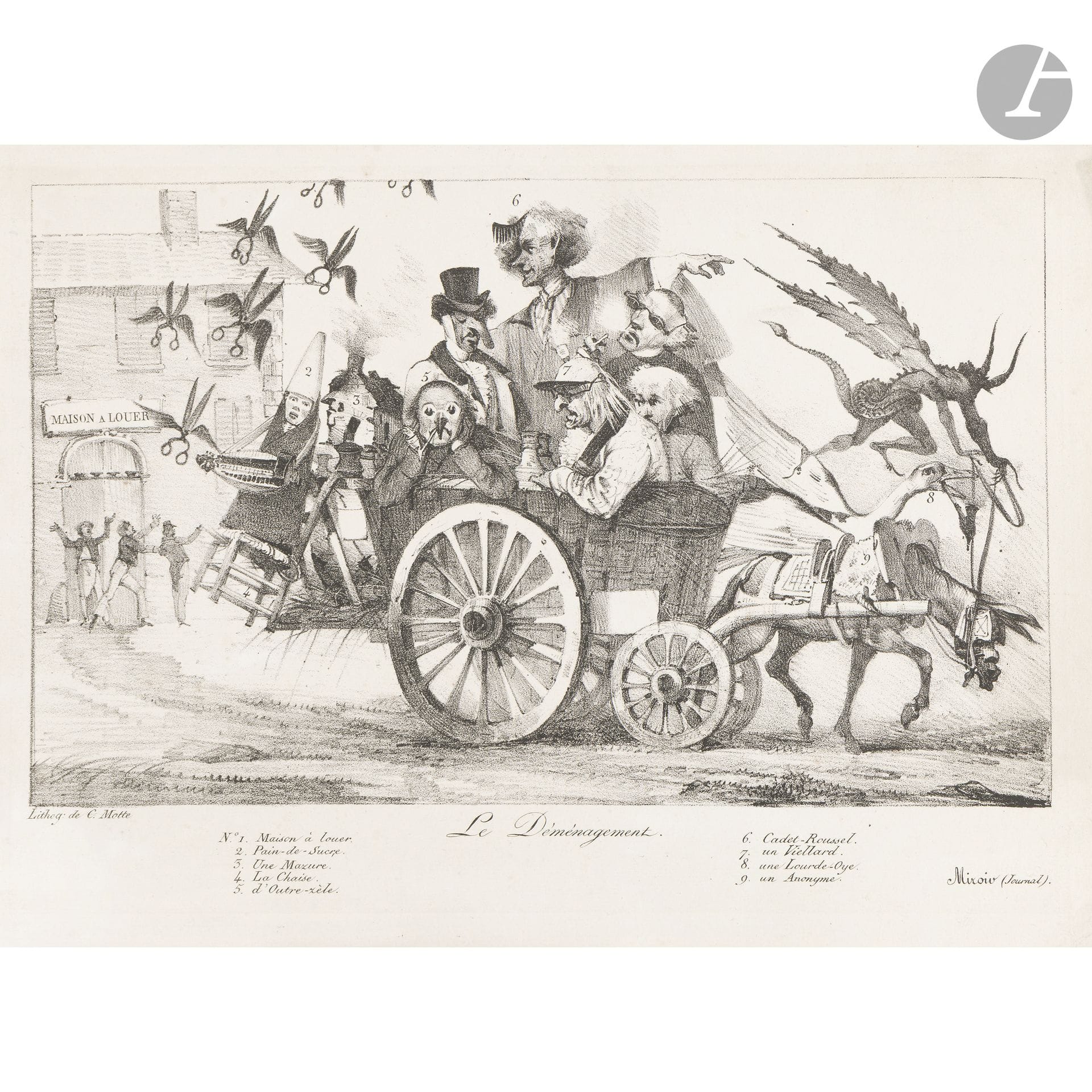
Eugène Delacroix (1798–1863) The Removal of Censorship. 1822. Lithograph. 312 x 190 [337 x 250 mm]. Delteil, Strauber 35. Very fine print on cream-colored laid paper. Full margins. AABM stamp (Lugt 3075). Plate published in the newspaper *Le Miroir*, February 11, 1822. "While *La Silhouette* established illustration and caricature in the press of the 1830s, other publications had already paved the way in the preceding years. This was the case with *Le Miroir*, to which the young Delacroix contributed, as well as the counterrevolutionary *Actes des apôtres* (1789–1792), the Bonapartist *Nain jaune* (1815), and the royalist *Annales du ridicule* or *Scènes et caricatures parisiennes* (1815). In 1822, at the same time that the government ostensibly abolished censorship and the various committees overseeing theaters, books, and periodicals, it passed a highly restrictive press law in March. Perhaps ironically, Delacroix depicts here censorship being driven from its home (a “house for rent” sign is already hanging there). As a swarm of winged scissors (the quintessential symbol of censorship) flies away, the censors leave their now-useless offices on Rue des Saints-Pères. Among them are Mazure (3), author of educational textbooks, depicted as an old house (“masure”); Abbé Picon d’Andrezel (5), inspector general of the University; Academician Rousselle (6); the poet Vieillard (7), a literary censor, and finally Jacques Honoré de Lourdoueix, a journalist at *La Gazette de France* and president of the Paris censorship board.” (BnF essentiels).
Estimate
€300 - €400
Buyer's premium
31.8%
Eugène Delacroix (1798–1863)
The Removal of Censorship. 1822. Lithograph. 312 x 190 [337 x 250 mm]. Delteil, Strauber 35. Very fine print on cream-colored laid paper. Full margins. AABM stamp (Lugt 3075).
Plate published in the newspaper *Le Miroir*, February 11, 1822.
"While *La Silhouette* established illustration and caricature in the press of the 1830s, other publications had already paved the way in the preceding years. This was the case with *Le Miroir*, to which the young Delacroix contributed, as well as the counterrevolutionary *Actes des apôtres* (1789–1792), the Bonapartist *Nain jaune* (1815), and the royalist *Annales du ridicule* or *Scènes et caricatures parisiennes* (1815).
In 1822, at the same time that the government ostensibly abolished censorship and the various committees overseeing theaters, books, and periodicals, it passed a highly restrictive press law in March.
Perhaps ironically, Delacroix depicts here censorship being driven from its home (a “house for rent” sign is already hanging there). As a swarm of winged scissors (the quintessential symbol of censorship) flies away, the censors leave their now-useless offices on Rue des Saints-Pères. Among them are Mazure (3), author of educational textbooks, depicted as an old house (“masure”); Abbé Picon d’Andrezel (5), inspector general of the University; Academician Rousselle (6); the poet Vieillard (7), a literary censor, and finally Jacques Honoré de Lourdoueix, a journalist at *La Gazette de France* and president of the Paris censorship board.” (BnF essentiels).
Sale
Tuesday 24 November・14:00 (Europe/Paris)
Sale location coming soon
3, rue Favart
75002 Paris