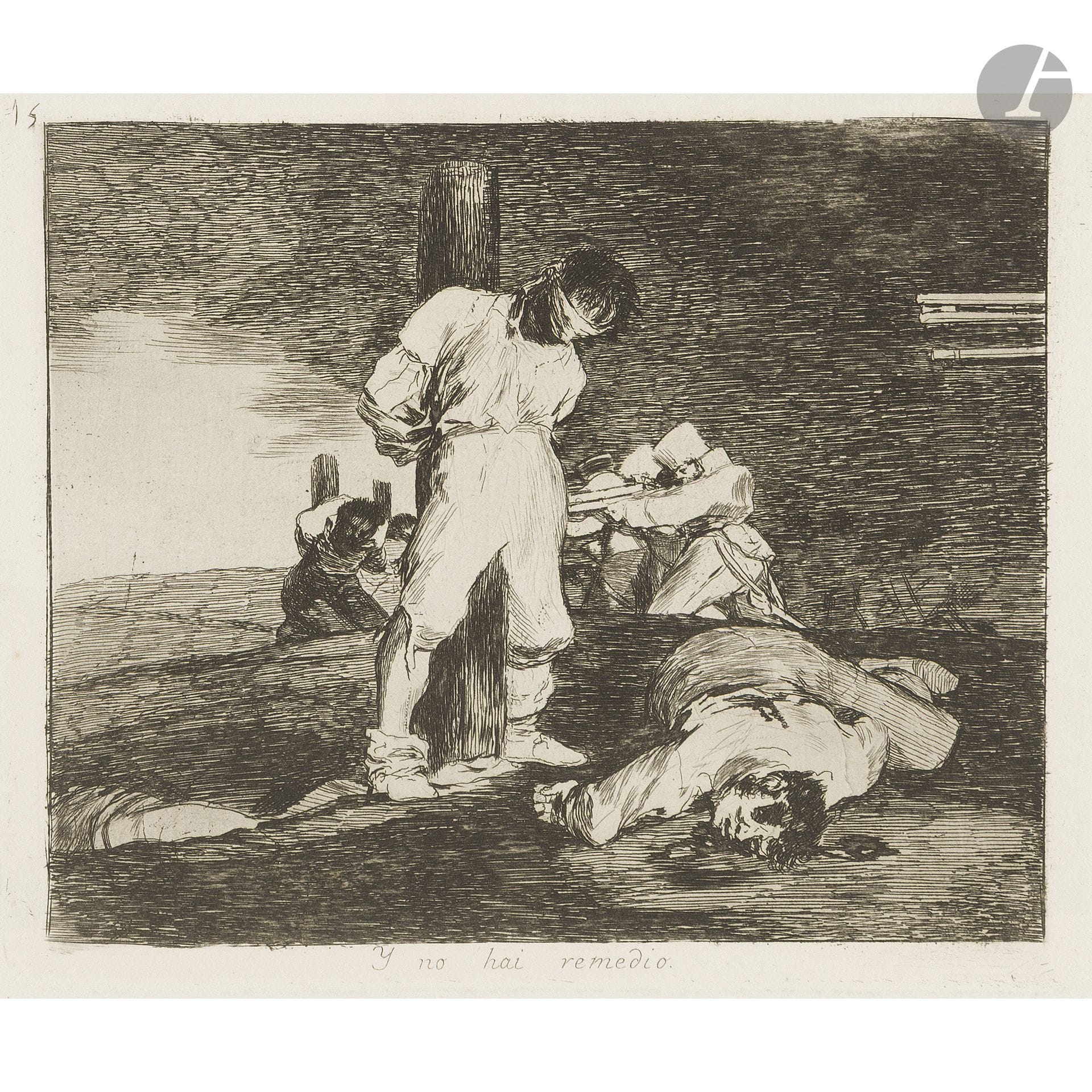
Francisco de Goya y Lucientes (1746–1828) The Disasters of War. 1810–1820. An oblong album [340 x 245 mm] containing the complete series of 80 plates. Etching, aquatint, drypoint, and engraving. Delteil 120–199; Harris 121–200. Very fine prints in bistre on deep cream-colored vellum with a JGO or palmette watermark, from the rare first edition published by the Real Academia de Nobles Artes de San Fernando, Madrid (1863), referenced by Harris as I a (on b), prior to the corrections made to the lettering on plates 9, 32, 33, 34, 35, 36 (the letter “m” added in pencil), 39, and 47, preceded by the lithographed title page and the printed text leaf. A few scattered light foxing spots, mainly in the margins. Very slight oxidation at the very edges of the leaves. Original red percaline binding, gilt title on the upper cover, spine with four raised bands and gilt title (slightly rubbed). AABM stamp (Lugt 3075). Included: Fiero Monstruo! Circa 1820. Etching, drypoint, and burin. 220 x 175 [273 x 195 mm]. Delteil 200; Harris 201. A fine proof of this rare, extra plate not included in the series, on laid paper, from a posthumous print run made around 1870 for Lefort, before the bevels were added, with the number 81 in the upper left corner. Large, light foxing spots. Stains on the reverse. Full margins, the bottom margin irregular. Stamp by Henri Guérard (Lugt 1157)—who may have been the printer of this plate. AABM stamp (Lugt 3075). "In 1808, Napoleon installed his brother Joseph on the Spanish throne. The population immediately rebelled, and a guerrilla war broke out against the French. As an eyewitness, Goya chronicled the atrocities of this six-year war—which ended with a tragic return to a feudal regime under the reign of Ferdinand VII—in a series of eighty-two prints. Abandoning traditional battle scenes and military depictions, the artist portrays with uncompromising realism the often horrific episodes of repression that he witnessed firsthand. He also occasionally adopts a more universal perspective, through references to classical painting or allegorical figures. " (BnF Essentials). Due to the repressive political climate under the absolutist reign of Ferdinand VII, Goya was never able to publish these engravings during his lifetime for fear of economic and political reprisals. It was the Real Academia de San Fernando that produced the first edition, much later, in 1863. A total of seven print runs are known, the last dating from 1937.
Estimate
€30,000 - €40,000
Buyer's premium
31.8%
Francisco de Goya y Lucientes (1746–1828)
The Disasters of War. 1810–1820. An oblong album [340 x 245 mm] containing the complete series of 80 plates. Etching, aquatint, drypoint, and engraving. Delteil 120–199; Harris 121–200. Very fine prints in bistre on deep cream-colored vellum with a JGO or palmette watermark, from the rare first edition published by the Real Academia de Nobles Artes de San Fernando, Madrid (1863), referenced by Harris as I a (on b), prior to the corrections made to the lettering on plates 9, 32, 33, 34, 35, 36 (the letter “m” added in pencil), 39, and 47, preceded by the lithographed title page and the printed text leaf. A few scattered light foxing spots, mainly in the margins. Very slight oxidation at the very edges of the leaves. Original red percaline binding, gilt title on the upper cover, spine with four raised bands and gilt title (slightly rubbed). AABM stamp (Lugt 3075).
Included: Fiero Monstruo! Circa 1820. Etching, drypoint, and burin. 220 x 175 [273 x 195 mm]. Delteil 200; Harris 201. A fine proof of this rare, extra plate not included in the series, on laid paper, from a posthumous print run made around 1870 for Lefort, before the bevels were added, with the number 81 in the upper left corner. Large, light foxing spots. Stains on the reverse. Full margins, the bottom margin irregular. Stamp by Henri Guérard (Lugt 1157)—who may have been the printer of this plate. AABM stamp (Lugt 3075).
"In 1808, Napoleon installed his brother Joseph on the Spanish throne. The population immediately rebelled, and a guerrilla war broke out against the French. As an eyewitness, Goya chronicled the atrocities of this six-year war—which ended with a tragic return to a feudal regime under the reign of Ferdinand VII—in a series of eighty-two prints.
Abandoning traditional battle scenes and military depictions, the artist portrays with uncompromising realism the often horrific episodes of repression that he witnessed firsthand. He also occasionally adopts a more universal perspective, through references to classical painting or allegorical figures. " (BnF Essentials).
Due to the repressive political climate under the absolutist reign of Ferdinand VII, Goya was never able to publish these engravings during his lifetime for fear of economic and political reprisals. It was the Real Academia de San Fernando that produced the first edition, much later, in 1863. A total of seven print runs are known, the last dating from 1937.
Sale
Tuesday 24 November・14:00 (Europe/Paris)
Sale location coming soon
3, rue Favart
75002 Paris