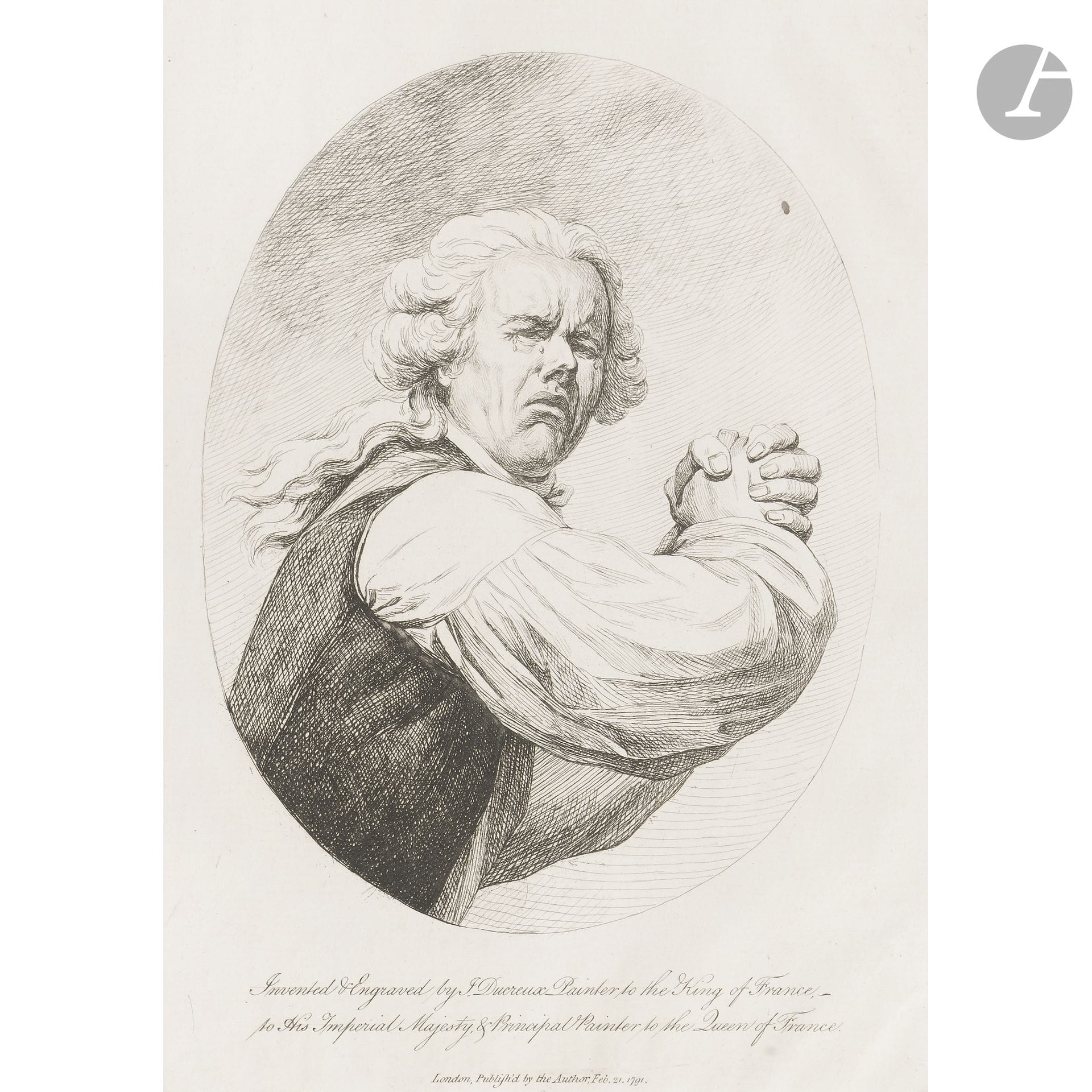
Joseph Ducreux (1735–1802) Self-Portrait of the Artist in Tears, Wringing His Hands (Ducreux in Tears or The Gambler in Tears). 1791. Etching. 212 x 293 [284 x 404 mm]. Baudicour 1; I.F.F. 1; V. Carlson et al., *Regency to Empire: French Printmaking 1715–1814*, The Baltimore Museum of Art and The Minneapolis Institute of Arts, 1984, no. 106. A very fine print on laid paper. A small splatter of sepia ink within the oval on the right margin. Small traces of glue on the left margin on the reverse. Generous margins. Very rare. AABM stamp (Lugt 3075). Ducreux created this work as part of a series of physiognomic prints published in London in the late 18th century. A great devotee of physiognomy (the study of facial form and features to identify character, based on the writings of Lavater), he sought to capture the extreme variety of human emotions. In this same series, he also depicted himself as a laughing man or a reserved man. The BnF lists only three subjects engraved by him: “In a moment of good humor, he etched three humorous images of himself onto copper with a nimble burin.” (Inventory of the French Collection, 18th Century, vol. 7, p. 490). “During the French Revolution, Ducreux emigrated to London, leaving Paris on January 12, 1791. While there, he exhibited five works at the Royal Academy, including portraits titled *Surprise* and *Surprise Mixed with Terror*. But he found little favor in the English capital and soon returned to France on August 15. His only three plates, however, were etched during his stay in England. [...] It may be that Ducreux hoped to capitalize on the English taste for caricature, well established in the work of such artists as William Hogarth, James Gillray, and Thomas Rowlandson. " (V. Carlson, in V. I. Carlson and J. W. Ittmann, eds., *Regency to Empire: French Printmaking 1715–1814*, The Minneapolis Institute of Arts, 1984, p. 296).
Estimate
€1,200 - €1,500
Buyer's premium
31.8%
Joseph Ducreux (1735–1802)
Self-Portrait of the Artist in Tears, Wringing His Hands (Ducreux in Tears or The Gambler in Tears). 1791. Etching. 212 x 293 [284 x 404 mm]. Baudicour 1; I.F.F. 1; V. Carlson et al., *Regency to Empire: French Printmaking 1715–1814*, The Baltimore Museum of Art and The Minneapolis Institute of Arts, 1984, no. 106. A very fine print on laid paper. A small splatter of sepia ink within the oval on the right margin. Small traces of glue on the left margin on the reverse. Generous margins. Very rare. AABM stamp (Lugt 3075).
Ducreux created this work as part of a series of physiognomic prints published in London in the late 18th century. A great devotee of physiognomy (the study of facial form and features to identify character, based on the writings of Lavater), he sought to capture the extreme variety of human emotions. In this same series, he also depicted himself as a laughing man or a reserved man. The BnF lists only three subjects engraved by him: “In a moment of good humor, he etched three humorous images of himself onto copper with a nimble burin.” (Inventory of the French Collection, 18th Century, vol. 7, p. 490).
“During the French Revolution, Ducreux emigrated to London, leaving Paris on January 12, 1791. While there, he exhibited five works at the Royal Academy, including portraits titled *Surprise* and *Surprise Mixed with Terror*. But he found little favor in the English capital and soon returned to France on August 15. His only three plates, however, were etched during his stay in England. [...] It may be that Ducreux hoped to capitalize on the English taste for caricature, well established in the work of such artists as William Hogarth, James Gillray, and Thomas Rowlandson. " (V. Carlson, in V. I. Carlson and J. W. Ittmann, eds., *Regency to Empire: French Printmaking 1715–1814*, The Minneapolis Institute of Arts, 1984, p. 296).
Sale
Tuesday 24 November・14:00 (Europe/Paris)
Sale location coming soon
3, rue Favart
75002 Paris