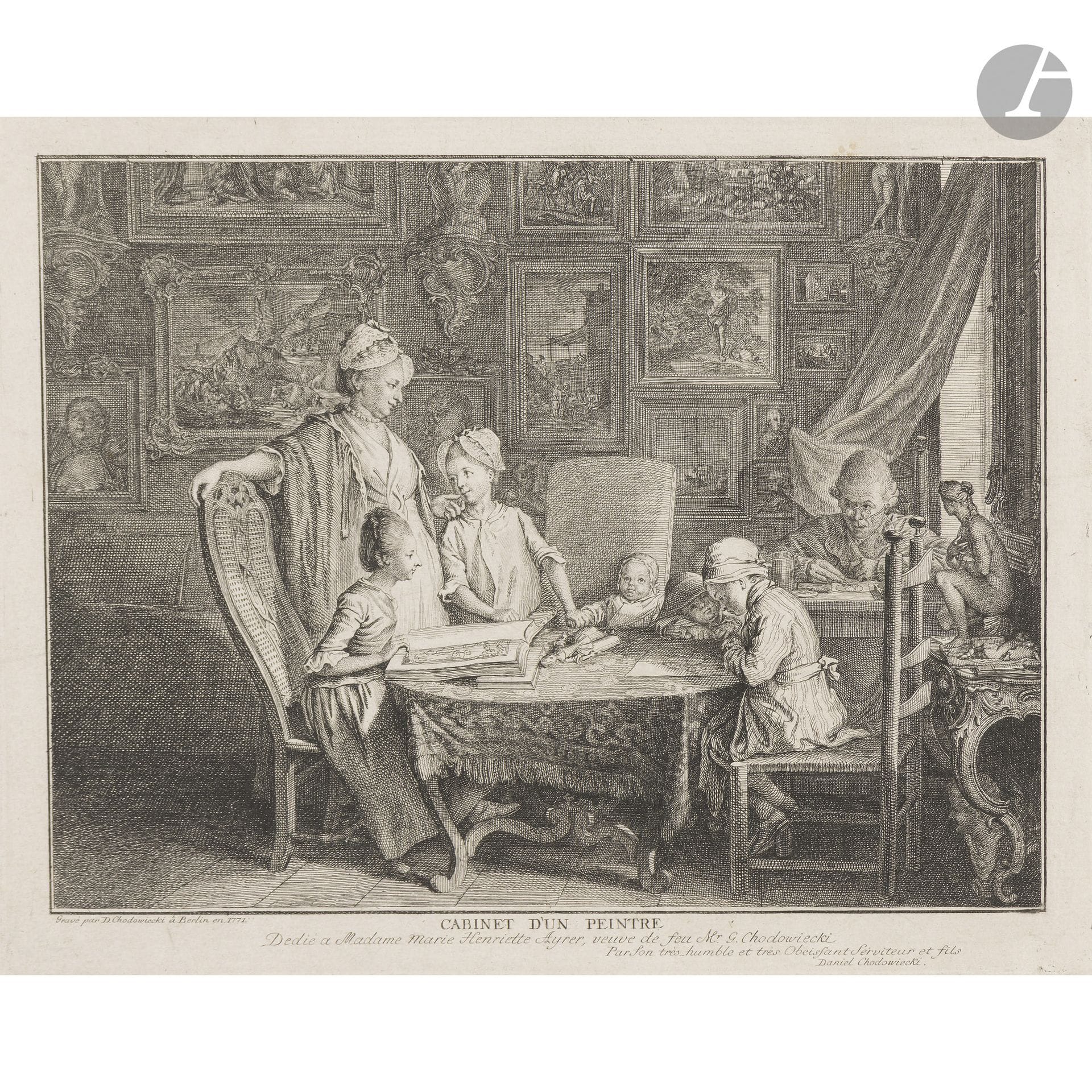
Daniel Chodowiecki (1726–1781) A Painter’s Studio. Circa 1771. Etching and engraving. 227 x 176 [233 x 183 mm]. Engelmann 75. A very fine print on laid paper. A fine, long, oblique fold across the sheet (visible only on the reverse). Narrow margins. AABM stamp (Lugt 3075). "The explanatory dedication on this print is to Madame Henriette Ayrer, Chodowiecki’s mother in Danzig, whom he had not seen for thirty years after leaving his native city in 1743. Her request for a drawing of her son’s family—whom she did not know at all—was the ostensible reason for the composition, in which Chodowiecki depicts himself as both artist and observer of his wife, Jeanne Barez, and his children: Jeanne, Susette, Henriette, Isac Heinrich, and Wilhelm—the eldest son who followed in his father’s footsteps to become a printmaker (1765–1805). Beyond this purely private purpose, the work held an almost iconic significance as an exemplification of the virtues of bourgeois family life in the latter half of the eighteenth century, drawing its inspiration from works such as Philippe Le Bas’s engravings based on Chardin’s domestic interiors. From the outset, it was an image intended for public consumption that was immediately in demand among those who valued his work, such as the Augsburg artist, J. E. Haid (1739–1809), who in 1774 expressed his regret to Chodowiecki that he could no longer obtain a good print of the subject... " (Antony Griffiths and Frances Carey, *German Printmaking in the Age of Goethe*, London, British Museum, 1994, no. 18).
Estimate
€400 - €500
Buyer's premium
31.8%
Daniel Chodowiecki (1726–1781)
A Painter’s Studio. Circa 1771. Etching and engraving. 227 x 176 [233 x 183 mm]. Engelmann 75. A very fine print on laid paper. A fine, long, oblique fold across the sheet (visible only on the reverse). Narrow margins. AABM stamp (Lugt 3075).
"The explanatory dedication on this print is to Madame Henriette Ayrer, Chodowiecki’s mother in Danzig, whom he had not seen for thirty years after leaving his native city in 1743. Her request for a drawing of her son’s family—whom she did not know at all—was the ostensible reason for the composition, in which Chodowiecki depicts himself as both artist and observer of his wife, Jeanne Barez, and his children: Jeanne, Susette, Henriette, Isac Heinrich, and Wilhelm—the eldest son who followed in his father’s footsteps to become a printmaker (1765–1805). Beyond this purely private purpose, the work held an almost iconic significance as an exemplification of the virtues of bourgeois family life in the latter half of the eighteenth century, drawing its inspiration from works such as Philippe Le Bas’s engravings based on Chardin’s domestic interiors. From the outset, it was an image intended for public consumption that was immediately in demand among those who valued his work, such as the Augsburg artist, J. E. Haid (1739–1809), who in 1774 expressed his regret to Chodowiecki that he could no longer obtain a good print of the subject... " (Antony Griffiths and Frances Carey, *German Printmaking in the Age of Goethe*, London, British Museum, 1994, no. 18).
Sale
Tuesday 24 November・14:00 (Europe/Paris)
Sale location coming soon
3, rue Favart
75002 Paris