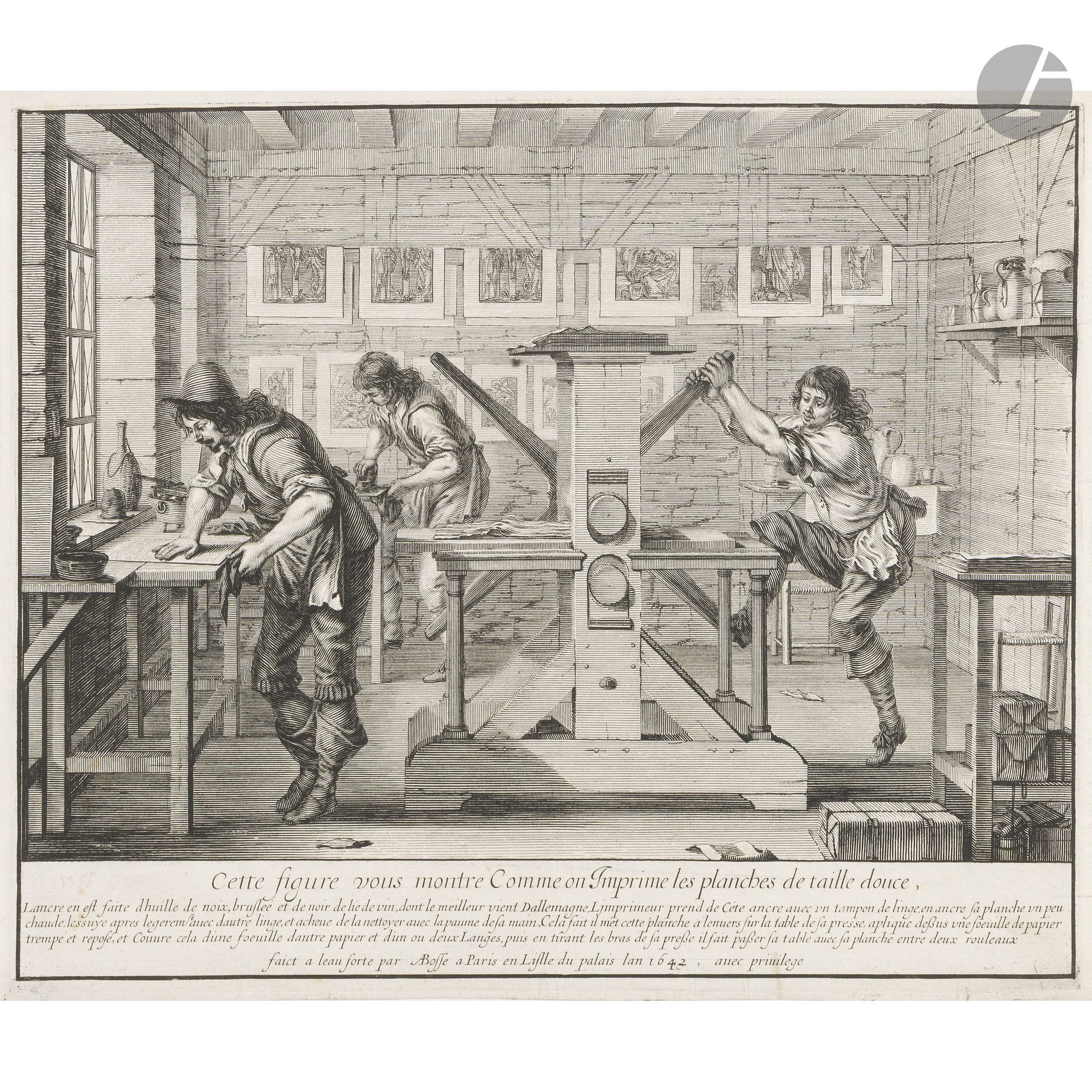
Abraham Bosse (1602–1676) The Engraver (This illustration shows how intaglio plates are printed). 1642. Etching and burin. 315 x 253 [328 x 263 mm]. Duplessis 1388; Lothe 254; Sophie Join-Lambert and Maxime Préaud (eds.), Abraham Bosse, savant graveur, Paris and Tours, BnF, 2004, no. 204. A very fine print on thin laid paper; the letter placement marks are clearly visible (indicating that this is one of the earliest proofs printed). A small, oblique reddish stain across the word “privilege.” Narrow margins. AABM stamp (Lugt 3075). In his exhibition catalog, *Abraham Bosse, Savant Graveur* (op. cit.), Maxime Préaud offers this modernized version of the caption: "This illustration shows you how intaglio plates are printed / The ink is made from burnt walnut oil and wine lees black, the best of which comes from Germany. The printer takes some of this ink with a cloth pad, inks his slightly warm plate [in the background toward the left], wipes it lightly afterward with one or more other cloths, and finishes cleaning it with the palm of his hand [on the left]. Once this is done, he places the plate upside down on the table of his press, lays a sheet of paper—which has been soaked and allowed to dry—on top of it, and covers it with another sheet of paper and one or two cloths; then, by pulling the arms of his press, he passes the table with the board between two rollers.” (Préaud, p. 226).
Estimate
€1,500 - €1,800
Buyer's premium
31.8%
Abraham Bosse (1602–1676)
The Engraver (This illustration shows how intaglio plates are printed). 1642. Etching and burin. 315 x 253 [328 x 263 mm]. Duplessis 1388; Lothe 254; Sophie Join-Lambert and Maxime Préaud (eds.), Abraham Bosse, savant graveur, Paris and Tours, BnF, 2004, no. 204. A very fine print on thin laid paper; the letter placement marks are clearly visible (indicating that this is one of the earliest proofs printed). A small, oblique reddish stain across the word “privilege.” Narrow margins. AABM stamp (Lugt 3075).
In his exhibition catalog, *Abraham Bosse, Savant Graveur* (op. cit.), Maxime Préaud offers this modernized version of the caption: "This illustration shows you how intaglio plates are printed / The ink is made from burnt walnut oil and wine lees black, the best of which comes from Germany. The printer takes some of this ink with a cloth pad, inks his slightly warm plate [in the background toward the left], wipes it lightly afterward with one or more other cloths, and finishes cleaning it with the palm of his hand [on the left]. Once this is done, he places the plate upside down on the table of his press, lays a sheet of paper—which has been soaked and allowed to dry—on top of it, and covers it with another sheet of paper and one or two cloths; then, by pulling the arms of his press, he passes the table with the board between two rollers.” (Préaud, p. 226).
Sale
Tuesday 24 November・14:00 (Europe/Paris)
Sale location coming soon
3, rue Favart
75002 Paris