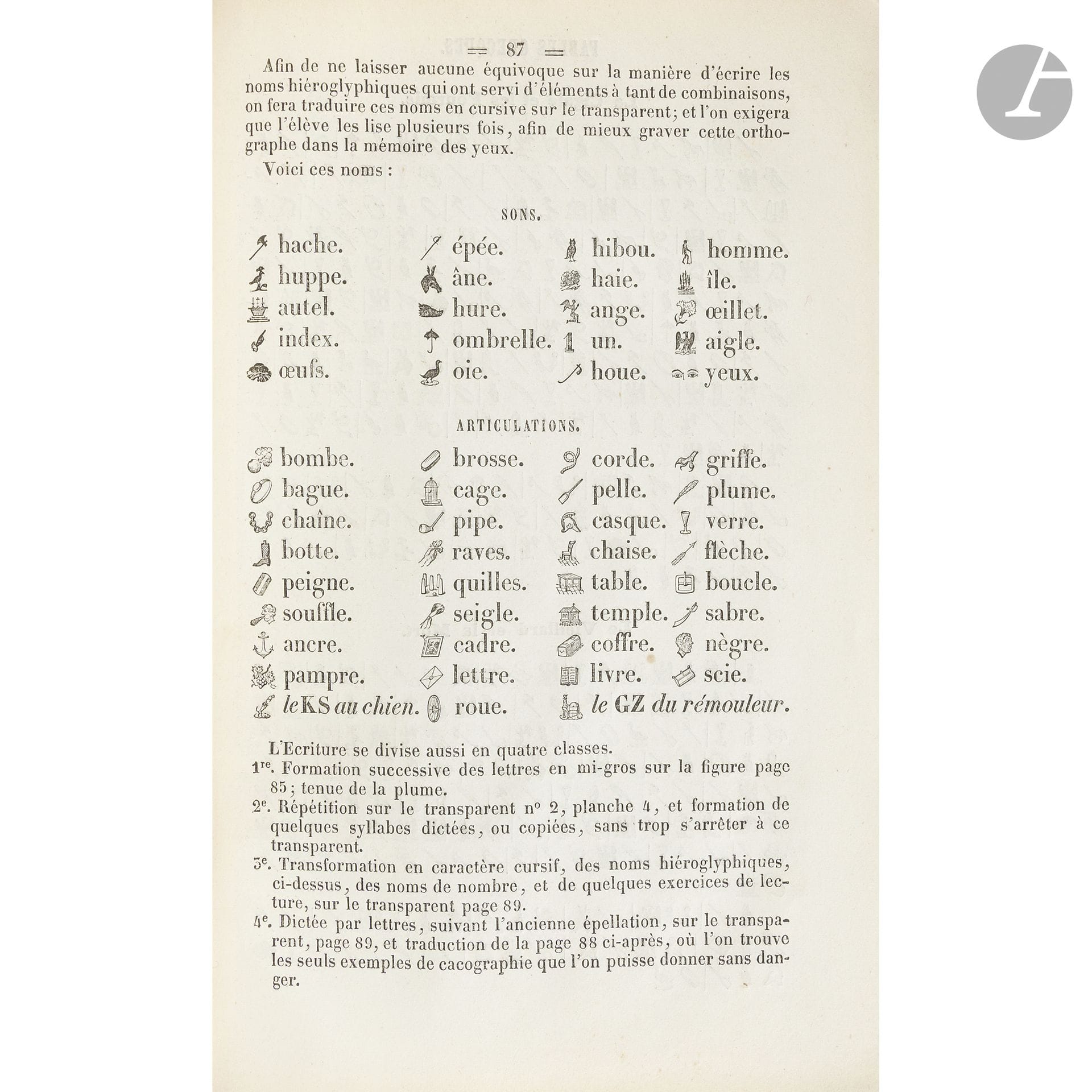
CHESNIER-DUCHESNE (Camille). French Hieroglyphs, or a Figurative Method Applied to Elementary Education; also containing: 1) an Essay on the Pronunciation of Foreign Languages; 2) the simplest form of shorthand; 3. a new system of heraldry; 4. the art of writing with dots, and of conveying thought through the mere indication of a few hieroglyphs. [Included]: Hieroglyphic Method Applied to Elementary Education and to All Teaching Methods—Mutual, Simultaneous, and Individual; the only system that represents French pronunciation with unambiguous signs, and with the help of which one can learn to read, write, and count on one’s own after just a few hours of instruction. Paris: Librairie encyclopédique de Roret, 1843–1844. — 2 volumes, in-8, 238 x 155: XVIII, 134 pp., (2 ff.), 11 plates (out of 12), illustrated cover; (1 folio), 96 pp., (1 folio), 4 plates, illustrated cover. Paperback, untrimmed. Caillet, 2326. First edition of *French Hieroglyphs*, composed by Camille Chesnier-Duchesne, an officer and “literary eccentric,” in which he presents and describes a French substitute writing system based on the “transfer rebus”—where each image is valued for its name—applied to the teaching of reading, shorthand, the pronunciation of languages, heraldry, and the project for a universal alphabet. According to Caillet, it is a “very curious work in which one finds everything, even intelligent things… Secret scripts, shorthand, etc… ” An illustrated copy featuring 11 of the 12 plates. The fold-out plate and the dedication page to Charles Nodier are missing. It includes the tracing (p. 89). The second volume is a reissue of the same book, published under a new title but truncated to the first 96 pages: the introduction, the demonstration text, and the final chapters (foreign languages, coats of arms, etc.) have been omitted. It now includes only plates 3 through 6 and the tracing on page 89. Paperback copies. Tears with missing sections on the cover of the first volume; the front cover and title page are partially detached. Tears and missing sections on the spine of the second volume.
Estimate
€300 - €400
Buyer's premium
28.1%
CHESNIER-DUCHESNE (Camille).
French Hieroglyphs, or a Figurative Method Applied to Elementary Education; also containing: 1) an Essay on the Pronunciation of Foreign Languages; 2) the simplest form of shorthand; 3. a new system of heraldry; 4. the art of writing with dots, and of conveying thought through the mere indication of a few hieroglyphs.
[Included]: Hieroglyphic Method Applied to Elementary Education and to All Teaching Methods—Mutual, Simultaneous, and Individual; the only system that represents French pronunciation with unambiguous signs, and with the help of which one can learn to read, write, and count on one’s own after just a few hours of instruction.
Paris: Librairie encyclopédique de Roret, 1843–1844. — 2 volumes, in-8, 238 x 155: XVIII, 134 pp., (2 ff.), 11 plates (out of 12), illustrated cover; (1 folio), 96 pp., (1 folio), 4 plates, illustrated cover. Paperback, untrimmed.
Caillet, 2326.
First edition of *French Hieroglyphs*, composed by Camille Chesnier-Duchesne, an officer and “literary eccentric,” in which he presents and describes a French substitute writing system based on the “transfer rebus”—where each image is valued for its name—applied to the teaching of reading, shorthand, the pronunciation of languages, heraldry, and the project for a universal alphabet.
According to Caillet, it is a “very curious work in which one finds everything, even intelligent things… Secret scripts, shorthand, etc… ”
An illustrated copy featuring 11 of the 12 plates. The fold-out plate and the dedication page to Charles Nodier are missing. It includes the tracing (p. 89).
The second volume is a reissue of the same book, published under a new title but truncated to the first 96 pages: the introduction, the demonstration text, and the final chapters (foreign languages, coats of arms, etc.) have been omitted. It now includes only plates 3 through 6 and the tracing on page 89.
Paperback copies.
Tears with missing sections on the cover of the first volume; the front cover and title page are partially detached. Tears and missing sections on the spine of the second volume.
Sale
Wednesday 25 November・14:00 (Europe/Paris)
Sale location coming soon
3, rue Favart
75002 Paris