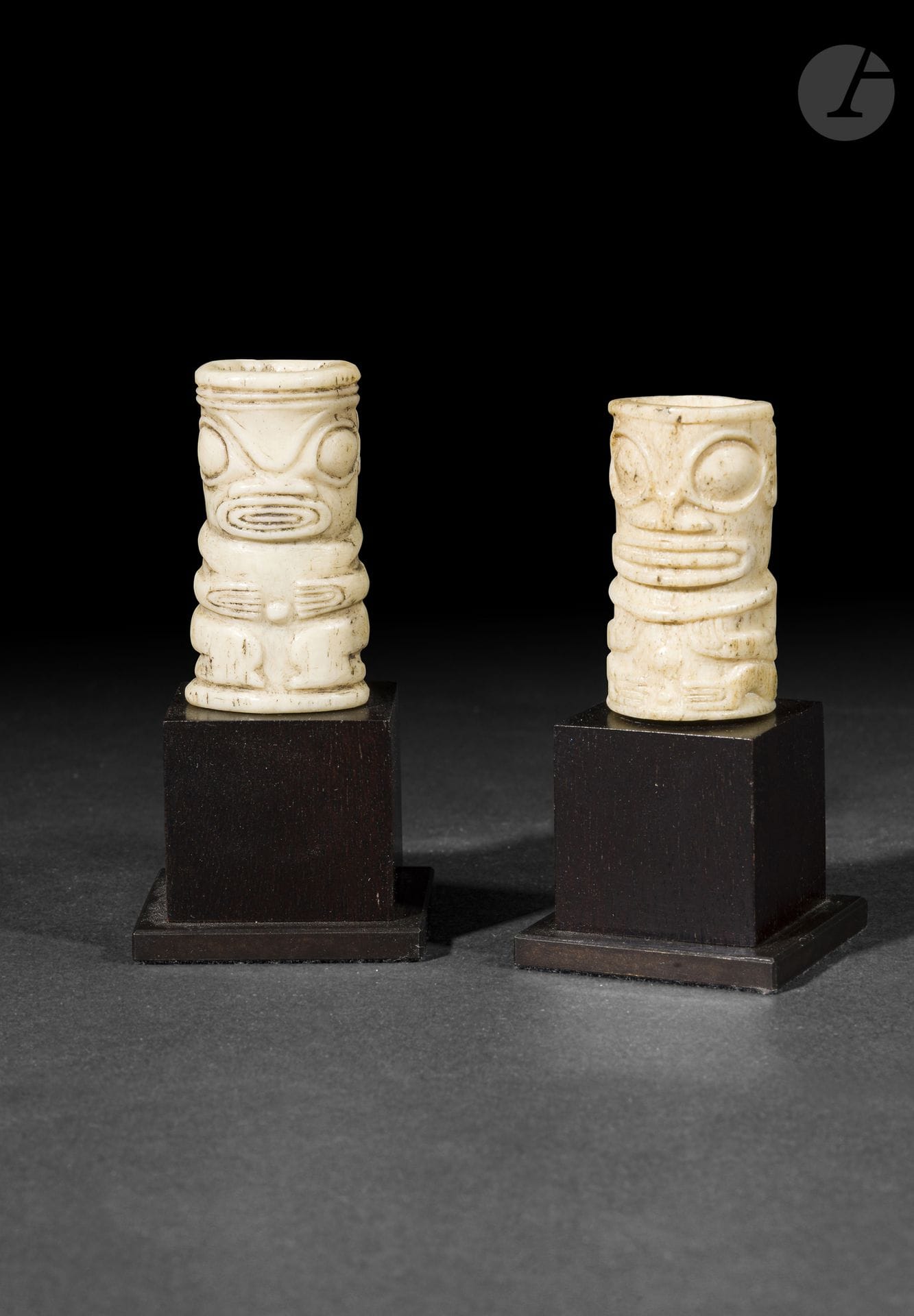
Two anthropomorphic pendants (ivi po’o), Marquesas Islands, French Polynesia Height: 4 and 4.5 cm Bone. These anthropomorphic pendants, traditionally known as ivi po’o, depict a stylized figure with folded limbs in the traditional style of Marquesan art. Associated with ancestor worship and the concept of mana, these representations were worn as ornaments symbolizing prestige and protection. The expressive power of their forms—characterized by a disproportionately large head, a compact body, and a composition of remarkable simplicity—makes them one of the most iconic expressions of Marquesan art. Beyond their ornamental function, these pendants served as a reminder of the spiritual bond uniting their wearer with their ancestors and helped affirm their status within the community. Provenance: Franck Marcelin, Aix-en-Provence.
Complete my bid
Place your absentee bid
An absentee bid is a confidential instruction given to the auctioneer. You only pay if you win the lot, and never more than your maximum amount.
Estimate
€3,000 - €5,000
Buyer's premium
32%
Two anthropomorphic pendants (ivi po’o), Marquesas Islands, French Polynesia
Height: 4 and 4.5 cm
Bone.
These anthropomorphic pendants, traditionally known as ivi po’o, depict a stylized figure with folded limbs in the traditional style of Marquesan art. Associated with ancestor worship and the concept of mana, these representations were worn as ornaments symbolizing prestige and protection. The expressive power of their forms—characterized by a disproportionately large head, a compact body, and a composition of remarkable simplicity—makes them one of the most iconic expressions of Marquesan art. Beyond their ornamental function, these pendants served as a reminder of the spiritual bond uniting their wearer with their ancestors and helped affirm their status within the community.
Provenance:
Franck Marcelin, Aix-en-Provence.
Sale
Thursday 26 November・14:00 (Europe/Paris)
Salle 15 - Hôtel Drouot
9, rue Drouot
75009 Paris