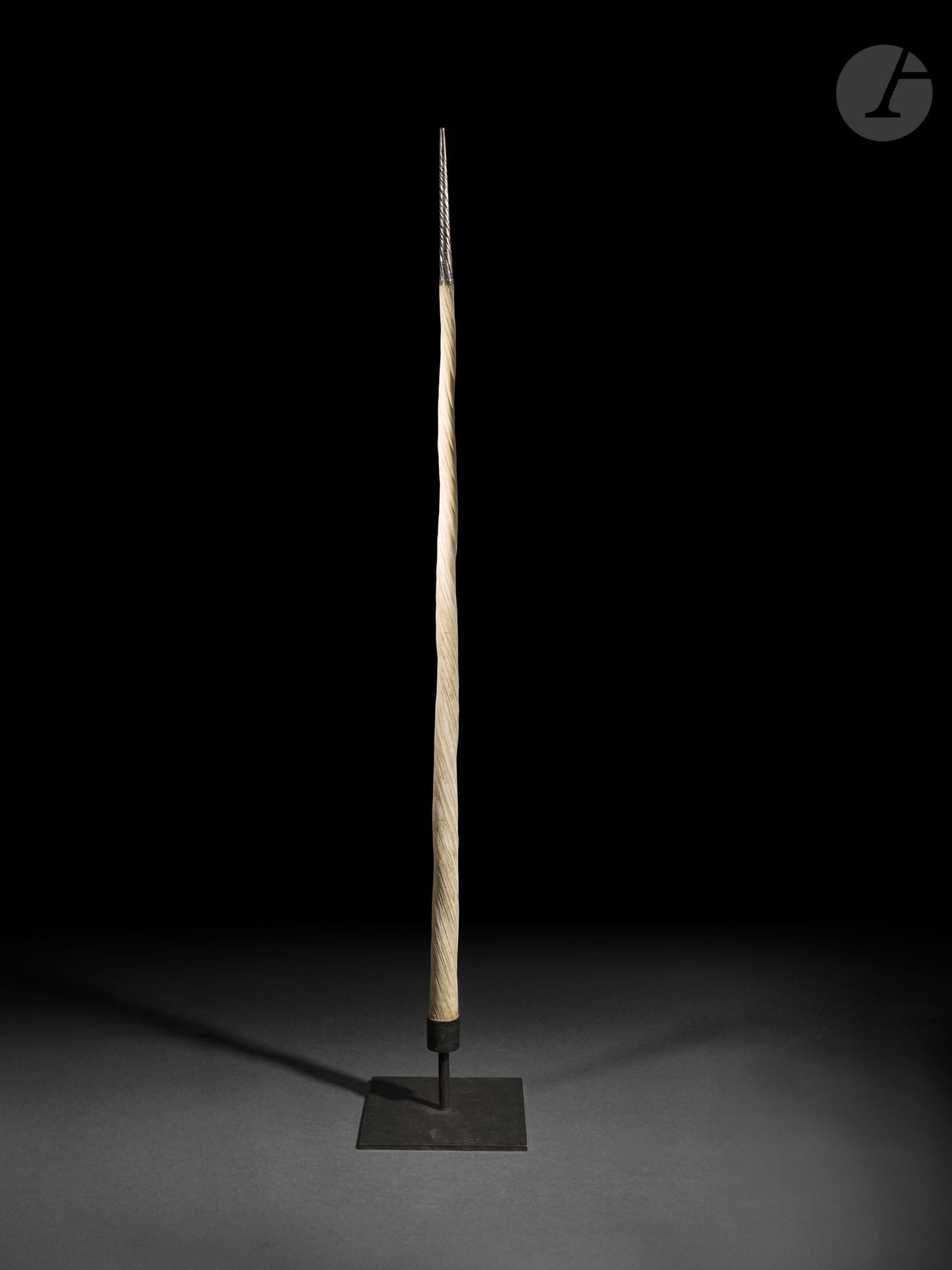
Narwhal tooth or rostrum (Monodon monoceros) Small in size, with a beautiful antique patina that clearly reveals the striations on the surface of the tusk. The upper part of the object is covered with a silver plate (heavily patinated) that perfectly follows the shape (including the details of the striations). English work, mid-19th century. Total height: 181 cm; gross weight (with base): 11 kg The tusk is intact and mounted on a modern black-lacquered iron base. A few small cracks and fissures are present, attesting to the object’s age. The narwhal is a marine mammal found in the Arctic. It owes its fame to its two tusks: the right one (which rarely breaks through the gum and is often invisible) and the left one (which takes the form of a helical tusk that can reach up to 270 cm in length). In the Middle Ages, this tooth or rostrum was considered a unicorn’s “horn”—a symbol of virginity and purity. Because of the magical and therapeutic powers attributed to this tooth, its value was equivalent to that of gold. Emperor Charles V settled a huge debt he owed to the Margrave of Bayreuth by giving him two narwhal “horns.” Classification II/A under the CITES (Washington Convention) codes and European Union Regulation 338/97 of December 9, 1996. CIC issued on October 21, 2026. For export outside the EU, a re-export document will be required and must be obtained at the buyer’s expense.
Complete my bid
Place your absentee bid
An absentee bid is a confidential instruction given to the auctioneer. You only pay if you win the lot, and never more than your maximum amount.
Estimate
€4,000 - €6,000
Buyer's premium
32%
Narwhal tooth or rostrum (Monodon monoceros)
Small in size, with a beautiful antique patina that clearly reveals the striations on the surface of the tusk. The upper part of the object is covered with a silver plate (heavily patinated) that perfectly follows the shape (including the details of the striations).
English work, mid-19th century.
Total height: 181 cm; gross weight (with base): 11 kg
The tusk is intact and mounted on a modern black-lacquered iron base. A few small cracks and fissures are present, attesting to the object’s age.
The narwhal is a marine mammal found in the Arctic. It owes its fame to its two tusks: the right one (which rarely breaks through the gum and is often invisible) and the left one (which takes the form of a helical tusk that can reach up to 270 cm in length). In the Middle Ages, this tooth or rostrum was considered a unicorn’s “horn”—a symbol of virginity and purity. Because of the magical and therapeutic powers attributed to this tooth, its value was equivalent to that of gold. Emperor Charles V settled a huge debt he owed to the Margrave of Bayreuth by giving him two narwhal “horns.”
Classification II/A under the CITES (Washington Convention) codes and European Union Regulation 338/97 of December 9, 1996. CIC issued on October 21, 2026. For export outside the EU, a re-export document will be required and must be obtained at the buyer’s expense.
Sale
Thursday 26 November・14:00 (Europe/Paris)
Salle 15 - Hôtel Drouot
9, rue Drouot
75009 Paris