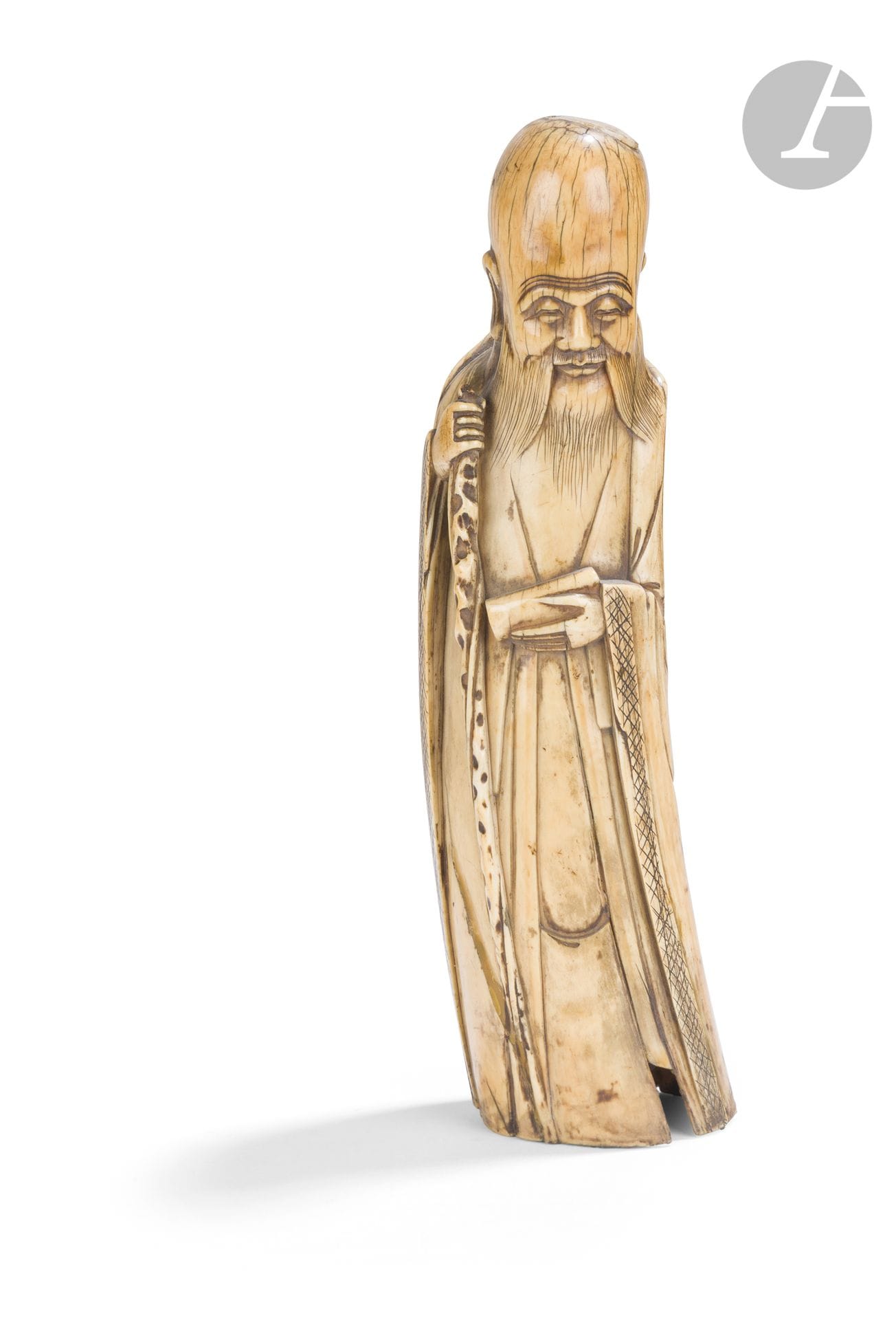
Ivory statuette of a Taoist immortal, China, Ming Dynasty (1368–1644) Carved in the round, this figure depicts the immortal Shoulao (Shouxing - 壽星), the Taoist god of longevity, standing in a serene pose. He is recognizable by his disproportionately rounded forehead—a symbol of wisdom and longevity—his smiling face framed by a long mustache and a finely incised beard, as well as the gnarled staff he holds in his right hand, carved in high relief and reminiscent of a pilgrim’s staff. His left hand holds a scroll pressed against his chest. His robe, with its ample, flowing folds, features borders engraved with geometric patterns. The reverse side, deliberately understated, highlights the volume of the drapery and the natural polish of the ivory, whose cracks and honey-colored patina attest to the material’s age. The sculpture, executed with great restraint, is representative of late Ming-era works intended for scholars’ study rooms, where depictions of Taoist immortals were particularly prized as symbols of happiness, longevity, and prosperity. Height: 21.5 cm; weight: 236 g Antique patina, natural cracks in the ivory, wear and minor signs of use consistent with its age, restorations.
Complete my bid
Place your absentee bid
An absentee bid is a confidential instruction given to the auctioneer. You only pay if you win the lot, and never more than your maximum amount.
Estimate
€1,000 - €1,500
Buyer's premium
32%
Ivory statuette of a Taoist immortal, China, Ming Dynasty (1368–1644)
Carved in the round, this figure depicts the immortal Shoulao (Shouxing - 壽星), the Taoist god of longevity, standing in a serene pose. He is recognizable by his disproportionately rounded forehead—a symbol of wisdom and longevity—his smiling face framed by a long mustache and a finely incised beard, as well as the gnarled staff he holds in his right hand, carved in high relief and reminiscent of a pilgrim’s staff. His left hand holds a scroll pressed against his chest. His robe, with its ample, flowing folds, features borders engraved with geometric patterns. The reverse side, deliberately understated, highlights the volume of the drapery and the natural polish of the ivory, whose cracks and honey-colored patina attest to the material’s age. The sculpture, executed with great restraint, is representative of late Ming-era works intended for scholars’ study rooms, where depictions of Taoist immortals were particularly prized as symbols of happiness, longevity, and prosperity.
Height: 21.5 cm; weight: 236 g
Antique patina, natural cracks in the ivory, wear and minor signs of use consistent with its age, restorations.
Sale
Tuesday 10 November・14:00 (Europe/Paris)
Salle 4 - Hôtel Drouot
9, rue Drouot
75009 Paris