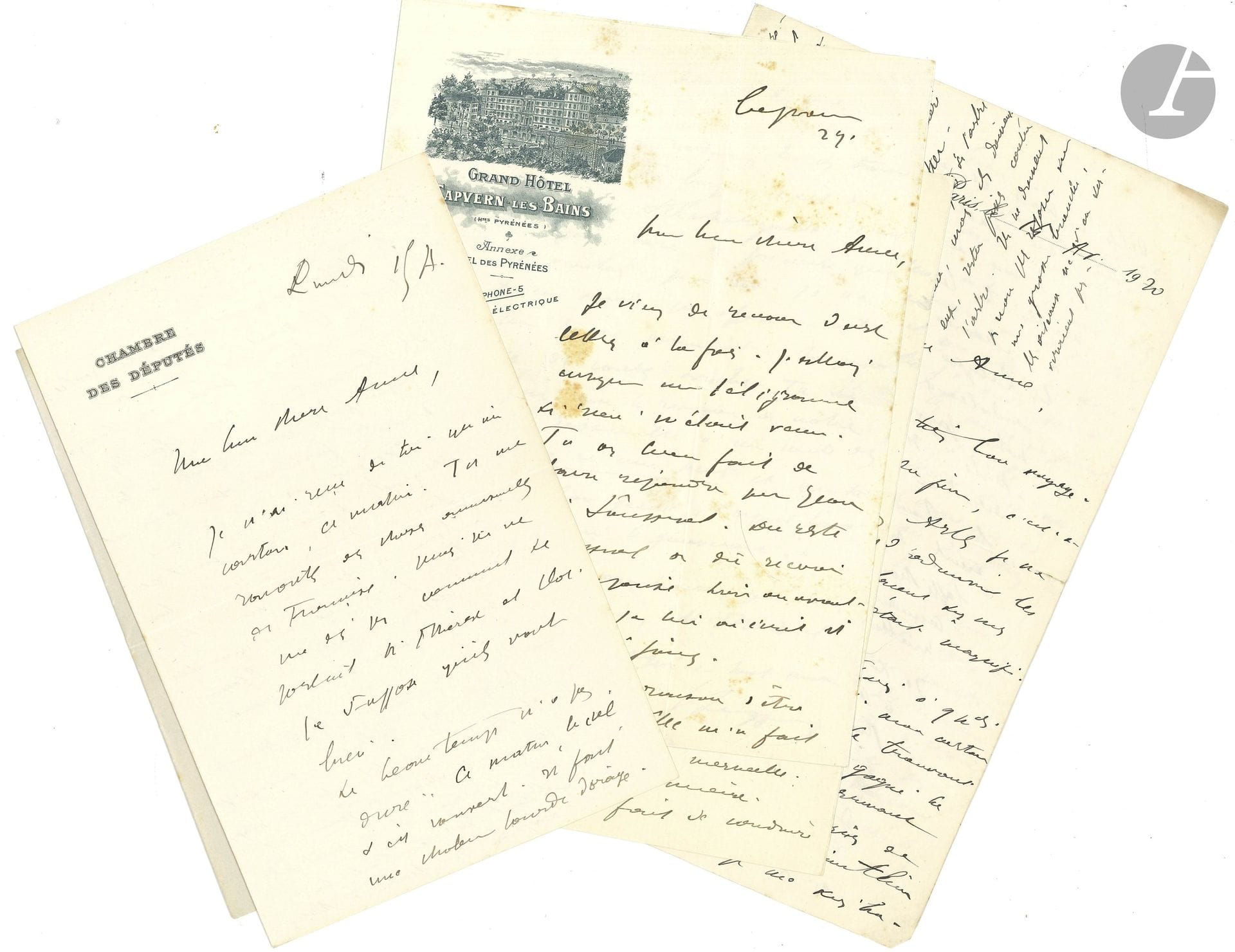
Georges LEYGUES (1857–1933), politician and minister. 9 letters from the author, 1918–1924 and undated, to his wife Anne; 31 pages in various formats, with letterhead from the Chamber of Deputies (4), the Ministry of the Navy, and the Grand Hôtel de Capvern-les-Bains (3). Leygues informs his wife [née Marie-Anne Desclaux (1857–1951)] of events during World War I in a very interesting 6-page letter dated June 12, 1918. “Our troops counterattacked yesterday along a 12-kilometer front […]. This is a highly significant victory. It enabled us to drive Von Hutier’s soldiers out of the plain they had managed to reach. […] The Germans are showing signs of hesitation and disarray. They have called upon divisions from the Bavarian Crown Prince’s Army to fill the enormous gaps that our machine guns and artillery have torn in their ranks. […] While we are halting their advance, the Americans are arriving in droves. There are nearly 800,000 of them in France. In two months, there will be 1,200,000. The outcome of the war will be decided”… He also alludes to the disciplinary measures taken by Clemenceau following the Battle of the Chemin des Dames: “Clemenceau has taken disciplinary measures. I pushed with all my might for action against the generals who lacked foresight or energy in the Chemin des Dames affair. Major General Anthoine of the General Headquarters was relieved of his duties. General Duchêne was demoted. Generals de Maud’huy, Corvisart, and Chrétien were suspended. I would have gone further with Duchêne”… The rest of the correspondence is more personal. Leygues mentions his family, his health, his search for an apartment, and a ring he recently gave his wife: “It is a rare and precious piece of jewelry that I wanted for you. […] You know full well that the story of our life is like a tale from *One Thousand and One Nights*”… Enclosed is a collection of 20 letters (+ 2 telegrams) addressed to Georges Leygues. Marie Frédéric Mistral (regarding the monument in honor of Mistral). – Pol Neveux, 6 long letters (+ 2 telegrams) to his “dear boss and friend,” a lovely, friendly exchange. – Alexandre Millerand, a handwritten note following his defeat in the January 1927 Senate elections. – Louis Barthou, a letter as Minister of Justice (1929), regarding the former prison in Villeneuve-sur-Lot. – Martial Sicard (3 letters, 1913–1917). – Georges Tholin (1912, on the history of Villeneuve-sur-Lot). – Charles Cottet. – Jean Pelissier (a long letter requesting Leygues’ support for a pro-French propaganda project in the Balkans, 1915). – Lucien-Victor Guirand de Scévola (on his watercolor exhibition). Etc.
Estimate
€400 - €500
Result
Not sold
Buyer's premium
32%
Georges LEYGUES (1857–1933), politician and minister. 9 letters from the author, 1918–1924 and undated, to his wife Anne; 31 pages in various formats, with letterhead from the Chamber of Deputies (4), the Ministry of the Navy, and the Grand Hôtel de Capvern-les-Bains (3).
Leygues informs his wife [née Marie-Anne Desclaux (1857–1951)] of events during World War I in a very interesting 6-page letter dated June 12, 1918. “Our troops counterattacked yesterday along a 12-kilometer front […]. This is a highly significant victory. It enabled us to drive Von Hutier’s soldiers out of the plain they had managed to reach. […] The Germans are showing signs of hesitation and disarray. They have called upon divisions from the Bavarian Crown Prince’s Army to fill the enormous gaps that our machine guns and artillery have torn in their ranks. […] While we are halting their advance, the Americans are arriving in droves. There are nearly 800,000 of them in France. In two months, there will be 1,200,000. The outcome of the war will be decided”… He also alludes to the disciplinary measures taken by Clemenceau following the Battle of the Chemin des Dames: “Clemenceau has taken disciplinary measures. I pushed with all my might for action against the generals who lacked foresight or energy in the Chemin des Dames affair. Major General Anthoine of the General Headquarters was relieved of his duties. General Duchêne was demoted. Generals de Maud’huy, Corvisart, and Chrétien were suspended. I would have gone further with Duchêne”… The rest of the correspondence is more personal. Leygues mentions his family, his health, his search for an apartment, and a ring he recently gave his wife: “It is a rare and precious piece of jewelry that I wanted for you. […] You know full well that the story of our life is like a tale from *One Thousand and One Nights*”…
Enclosed is a collection of 20 letters (+ 2 telegrams) addressed to Georges Leygues. Marie Frédéric Mistral (regarding the monument in honor of Mistral). – Pol Neveux, 6 long letters (+ 2 telegrams) to his “dear boss and friend,” a lovely, friendly exchange. – Alexandre Millerand, a handwritten note following his defeat in the January 1927 Senate elections. – Louis Barthou, a letter as Minister of Justice (1929), regarding the former prison in Villeneuve-sur-Lot. – Martial Sicard (3 letters, 1913–1917). – Georges Tholin (1912, on the history of Villeneuve-sur-Lot). – Charles Cottet. – Jean Pelissier (a long letter requesting Leygues’ support for a pro-French propaganda project in the Balkans, 1915). – Lucien-Victor Guirand de Scévola (on his watercolor exhibition). Etc.
Sale
Wednesday 14 October・14:00 (Europe/Paris)
Sale location coming soon
3, rue Favart
75002 Paris