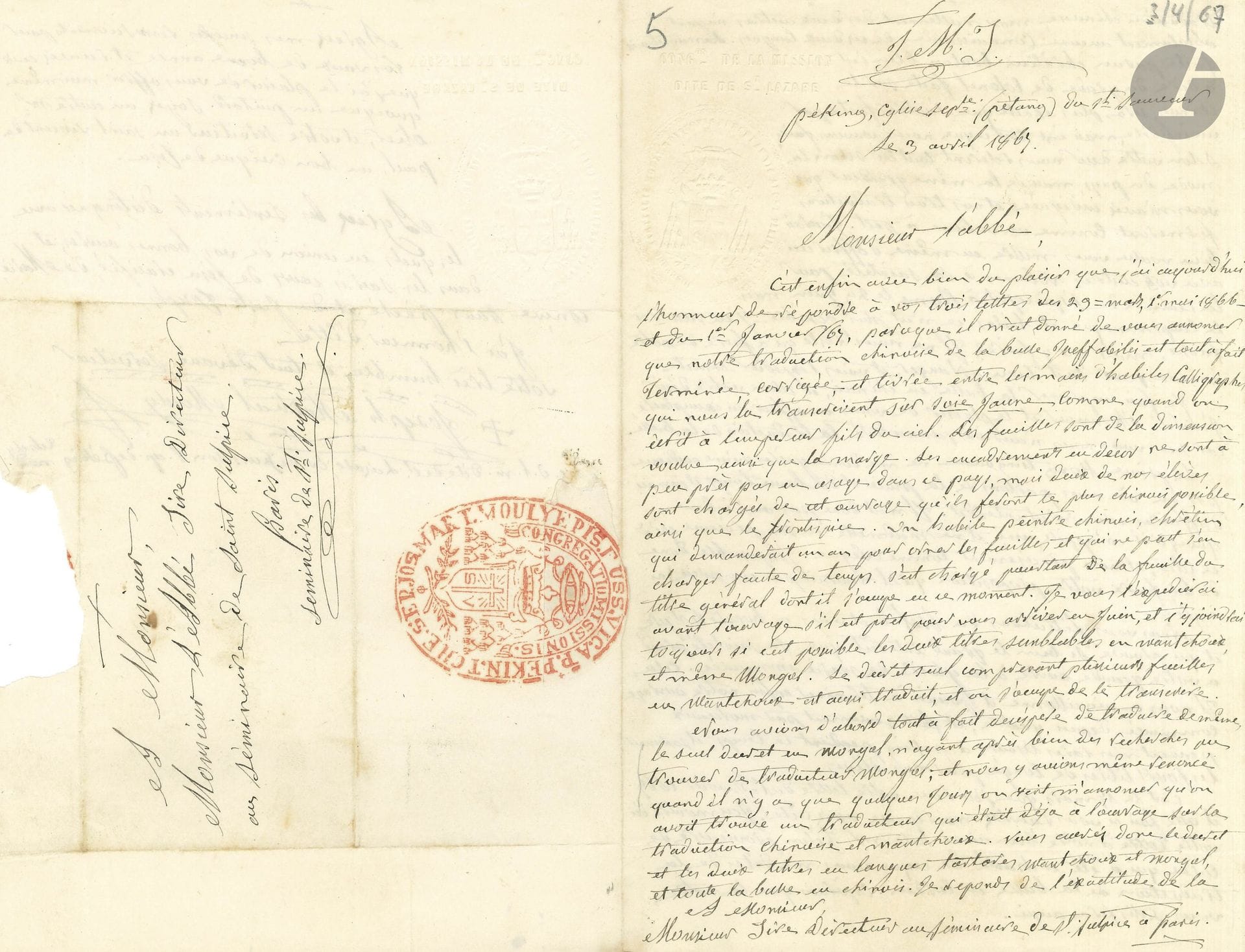
CHINA. Joseph-Martial MOULY (1807–1868), a Lazarist missionary who served as bishop of Beijing. 7 letters from the author and one letter to the author, Beijing 1865–1868, addressed to Father Dominique Sire, director of the Saint-Sulpice Seminary in Paris; 17 pages in-8 and 3 pages in-4, 3 address labels and 5 envelopes with a large red ink seal. Very rare and interesting correspondence. Bishop Mouly wrote most of his letters from the Northern Church of the Holy Savior. November 14, 1865: “We are having two young theologians from our seminary translate the bull *Ineffabilis* [on the Immaculate Conception] into Chinese, delighted as we were to contribute a little to the outward glory of our Immaculate Mother Mary and to please His Holiness Pius IX […] But I must confess to you that the task could not have been more difficult, as the lofty style of the bull, with its constant circumlocutions and interminable sentences, could not have been less suited to Chinese. Its subject matter, above all, was no less so. […] “this work is nearing completion”; but he fears he may have to abandon the translations into Mongolian and Manchu… April 3, 1867: “Our Chinese translation of the bull *Ineffabilis* is completely finished, proofread, and delivered into the hands of skilled calligraphers who are transcribing it onto yellow silk, just as one would write to the Son of Heaven.” He is going to have it printed in Chinese… – April 18. The Chinese and Manchu translations are complete, and the single decree is being translated into Mongolian… “The Chinese border depicts, at the very top, the imperial throne hall of the Son of Heaven, with its two corresponding buildings. On the right is a tower similar to the porcelain one that once stood in Nanking and is said to have been erected in the Imperial Palace in Beijing. On the left is one of the four towers erected at the corners of the city—or rather, the imperial palace—on the high wall of its great enclosure. At the bottom is a view of three door frames commonly used in cities, with merchants’ shops, their signs, inscriptions, & & &. This painting was done by a Christian physician and painter [...] The Chinese calligraphy is by one of our young seminarians who studies Latin”… – September 24. Pope Pius IX wished to receive “the complete collection of translations of the bull on the Immaculate Conception of the Most Holy Virgin Mary […] so that he might show it to the bishops from around the world who were then gathered in Rome. [...] Each translation still forms a sort of small book. The complete Chinese manuscript seems to us to be the most beautiful and the most interesting in every respect”; depicted on its frontispiece are “the facades of our old cathedral and our new Gothic Church of the Holy Savior […] I had the entire work printed in these three languages in a single volume, although Chinese script begins on the right, written from top to bottom—completely opposite to our custom—and Manchu and Mongolian begin on the left, like ours, but are also written from top to bottom. I am sending two copies to all our lords, the Apostolic Vicars of China and neighboring countries, where they write in Chinese—such as Korea, Japan, Tonkin, and Cochinchina […] in order to further spread, if possible, the glory of Mary conceived without sin, and to obtain from her immense goodness special protection for the Chinese Empire”… He will also present copies to the Pope and to Cardinal Barnabo, “for the Propaganda Fide library”… He hoped, through the intercession of the Virgin Mary, to obtain “the conversion of at least a large portion of the some twenty million infidels said to be within our Apostolic Vicariate of Peking, North Chely”… – July 15, 1868. He sent about a hundred copies of the papal bull “to all the heads of missions in the surrounding areas where the Chinese language is known,” via the French legation’s diplomatic pouch… – November 21, 1868, a letter begun by Bishop Mouly, interrupted by his death, and completed by his apostolic vicar and Bishop of Danaba, Edmond-François Guierry: “In his last letter, what ‘His Excellency wished to write before leaving this earth’ was, for us, a final testimony of his tender affection for the Immaculate Mary.” Enclosed: – 2 handwritten letters from Bishop Zéphyrin Guillemin, Bishop of Canton, dated November 10, 1862, and October 20, 1863, to Father Sire, regarding the papal bull *Ineffabilis*. – 1 original letter from Bishop Emmanuel Verrolles of Manchuria, dated December 20, 1868: “The Manchu people are dying out and disappearing more and more; the Chinese have taken over everything”; as for religious festivals, “alas! in our lands, where certain regions are scattered far apart from one another among the pagans, and since at the time we did not have a single church in the entire mission, but only a few shabby oratories, we were unable to accomplish anything spectacular”… Plus 3 newspaper clippings from
Estimate
€1,000 - €1,500
Result
€2,242
Buyer's premium
32%
CHINA. Joseph-Martial MOULY (1807–1868), a Lazarist missionary who served as bishop of Beijing. 7 letters from the author and one letter to the author, Beijing 1865–1868, addressed to Father Dominique Sire, director of the Saint-Sulpice Seminary in Paris; 17 pages in-8 and 3 pages in-4, 3 address labels and 5 envelopes with a large red ink seal.
Very rare and interesting correspondence. Bishop Mouly wrote most of his letters from the Northern Church of the Holy Savior.
November 14, 1865: “We are having two young theologians from our seminary translate the bull *Ineffabilis* [on the Immaculate Conception] into Chinese, delighted as we were to contribute a little to the outward glory of our Immaculate Mother Mary and to please His Holiness Pius IX […] But I must confess to you that the task could not have been more difficult, as the lofty style of the bull, with its constant circumlocutions and interminable sentences, could not have been less suited to Chinese. Its subject matter, above all, was no less so. […] “this work is nearing completion”; but he fears he may have to abandon the translations into Mongolian and Manchu…
April 3, 1867: “Our Chinese translation of the bull *Ineffabilis* is completely finished, proofread, and delivered into the hands of skilled calligraphers who are transcribing it onto yellow silk, just as one would write to the Son of Heaven.” He is going to have it printed in Chinese… – April 18. The Chinese and Manchu translations are complete, and the single decree is being translated into Mongolian… “The Chinese border depicts, at the very top, the imperial throne hall of the Son of Heaven, with its two corresponding buildings. On the right is a tower similar to the porcelain one that once stood in Nanking and is said to have been erected in the Imperial Palace in Beijing. On the left is one of the four towers erected at the corners of the city—or rather, the imperial palace—on the high wall of its great enclosure. At the bottom is a view of three door frames commonly used in cities, with merchants’ shops, their signs, inscriptions, & & &. This painting was done by a Christian physician and painter [...] The Chinese calligraphy is by one of our young seminarians who studies Latin”… – September 24. Pope Pius IX wished to receive “the complete collection of translations of the bull on the Immaculate Conception of the Most Holy Virgin Mary […] so that he might show it to the bishops from around the world who were then gathered in Rome. [...] Each translation still forms a sort of small book. The complete Chinese manuscript seems to us to be the most beautiful and the most interesting in every respect”; depicted on its frontispiece are “the facades of our old cathedral and our new Gothic Church of the Holy Savior […] I had the entire work printed in these three languages in a single volume, although Chinese script begins on the right, written from top to bottom—completely opposite to our custom—and Manchu and Mongolian begin on the left, like ours, but are also written from top to bottom. I am sending two copies to all our lords, the Apostolic Vicars of China and neighboring countries, where they write in Chinese—such as Korea, Japan, Tonkin, and Cochinchina […] in order to further spread, if possible, the glory of Mary conceived without sin, and to obtain from her immense goodness special protection for the Chinese Empire”… He will also present copies to the Pope and to Cardinal Barnabo, “for the Propaganda Fide library”… He hoped, through the intercession of the Virgin Mary, to obtain “the conversion of at least a large portion of the some twenty million infidels said to be within our Apostolic Vicariate of Peking, North Chely”… – July 15, 1868. He sent about a hundred copies of the papal bull “to all the heads of missions in the surrounding areas where the Chinese language is known,” via the French legation’s diplomatic pouch… – November 21, 1868, a letter begun by Bishop Mouly, interrupted by his death, and completed by his apostolic vicar and Bishop of Danaba, Edmond-François Guierry: “In his last letter, what ‘His Excellency wished to write before leaving this earth’ was, for us, a final testimony of his tender affection for the Immaculate Mary.”
Enclosed: – 2 handwritten letters from Bishop Zéphyrin Guillemin, Bishop of Canton, dated November 10, 1862, and October 20, 1863, to Father Sire, regarding the papal bull *Ineffabilis*. – 1 original letter from Bishop Emmanuel Verrolles of Manchuria, dated December 20, 1868: “The Manchu people are dying out and disappearing more and more; the Chinese have taken over everything”; as for religious festivals, “alas! in our lands, where certain regions are scattered far apart from one another among the pagans, and since at the time we did not have a single church in the entire mission, but only a few shabby oratories, we were unable to accomplish anything spectacular”… Plus 3 newspaper clippings from
Sale
Wednesday 14 October・14:00 (Europe/Paris)
Sale location coming soon
3, rue Favart
75002 Paris