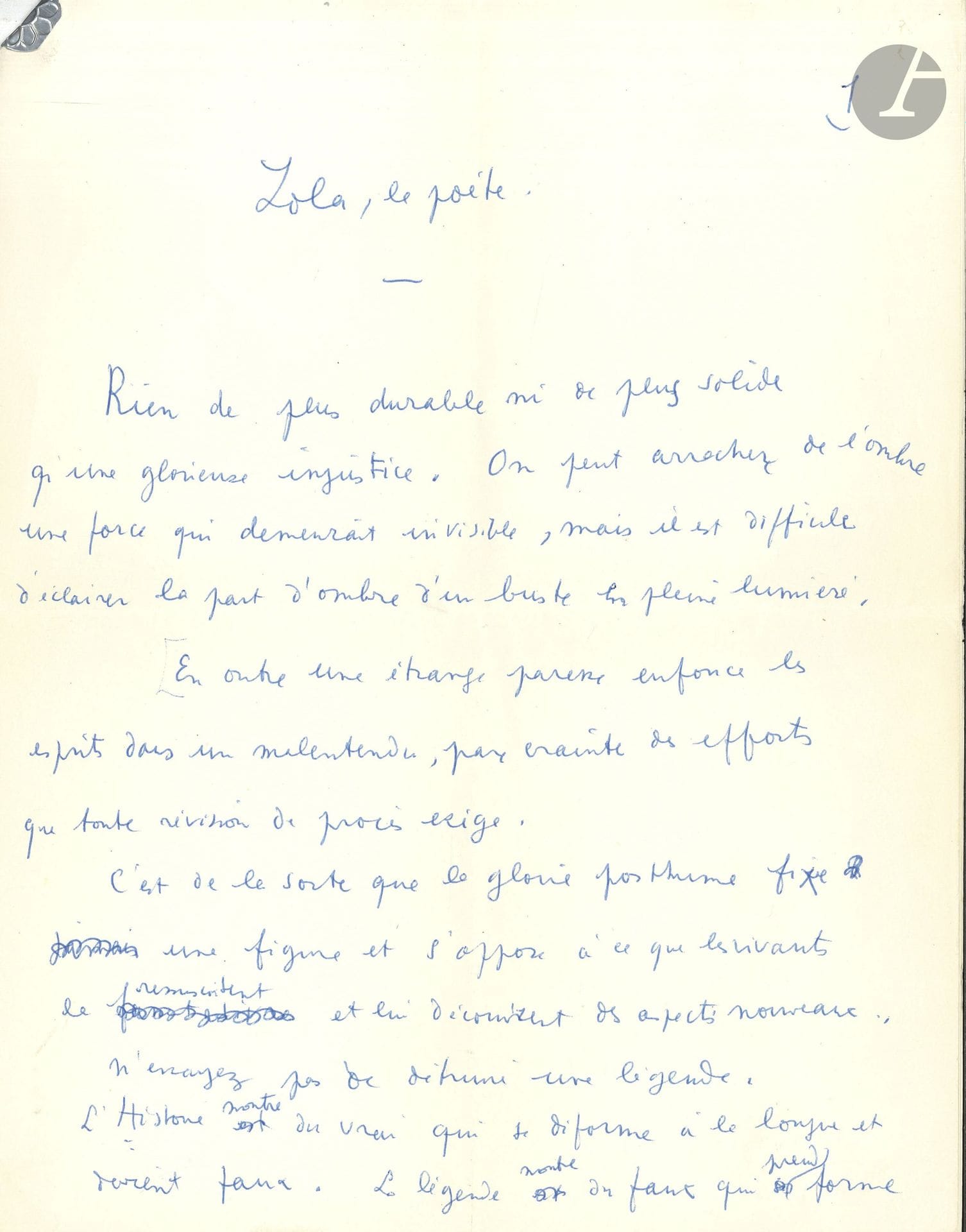
Jean COCTEAU. Signed autograph manuscript, *Zola, the Poet*, [1958]; 4 pages, in-4. A tribute to Émile Zola, read in Médan and published in 1958 in issue No. 11 of *Les Cahiers naturalistes*. “Nothing is more enduring or more solid than a glorious injustice”… Cocteau seeks to rescue Zola from his “posthumous glory” by showing that “this great realist was a great poet.” How I would love to plead the case for true realism and say: ‘Realism consists in accurately depicting the objects of a world unique to the artist and having no connection whatsoever with what we customarily take to be reality.’ Immediately, we would see emerge from the wings of a theater—one accused of being a sort of transcendence of the Grand-Guignol— a procession of scenes so singular, so lofty, so noble—and so moving—that I find it hard to understand why their wonder does not heal the blind and force them to acknowledge their error. What? Is it from this crude Zola, this block of peat, this obscure monster, enemy of all grace, that emerge the white horses from the mine, the locomotive buried under the snow, the child bleeding on the Épinal prints, the drunken man ablaze, a thousand and a thousand examples of a sophisticated lyricism analogous to the naive lyricism of Fantomas—which enchanted Guillaume Apollinaire and which I believe should always serve as our guide. Poetry defies analysis. Its contagious power expresses itself in spite of obstacles, and, in this exhibition in Brussels from which I have just returned, it triumphs by honoring artists whose works were laughed at by the conformists of 1913. Brancusi, Archipenko, Zadkine, and Lipchitz reign there architecturally, after a long wait. And now, in 1958, the tender heroism of Zola’s *J’accuse* is beginning to emerge and to overcome the absurd verdict of the 19th century.”
Estimate
€1,000 - €1,200
Result
€1,055
Buyer's premium
32%
Jean COCTEAU. Signed autograph manuscript, *Zola, the Poet*, [1958]; 4 pages, in-4.
A tribute to Émile Zola, read in Médan and published in 1958 in issue No. 11 of *Les Cahiers naturalistes*.
“Nothing is more enduring or more solid than a glorious injustice”… Cocteau seeks to rescue Zola from his “posthumous glory” by showing that “this great realist was a great poet.” How I would love to plead the case for true realism and say: ‘Realism consists in accurately depicting the objects of a world unique to the artist and having no connection whatsoever with what we customarily take to be reality.’ Immediately, we would see emerge from the wings of a theater—one accused of being a sort of transcendence of the Grand-Guignol— a procession of scenes so singular, so lofty, so noble—and so moving—that I find it hard to understand why their wonder does not heal the blind and force them to acknowledge their error. What? Is it from this crude Zola, this block of peat, this obscure monster, enemy of all grace, that emerge the white horses from the mine, the locomotive buried under the snow, the child bleeding on the Épinal prints, the drunken man ablaze, a thousand and a thousand examples of a sophisticated lyricism analogous to the naive lyricism of Fantomas—which enchanted Guillaume Apollinaire and which I believe should always serve as our guide. Poetry defies analysis. Its contagious power expresses itself in spite of obstacles, and, in this exhibition in Brussels from which I have just returned, it triumphs by honoring artists whose works were laughed at by the conformists of 1913. Brancusi, Archipenko, Zadkine, and Lipchitz reign there architecturally, after a long wait. And now, in 1958, the tender heroism of Zola’s *J’accuse* is beginning to emerge and to overcome the absurd verdict of the 19th century.”
Sale
Wednesday 14 October・14:00 (Europe/Paris)
Sale location coming soon
3, rue Favart
75002 Paris