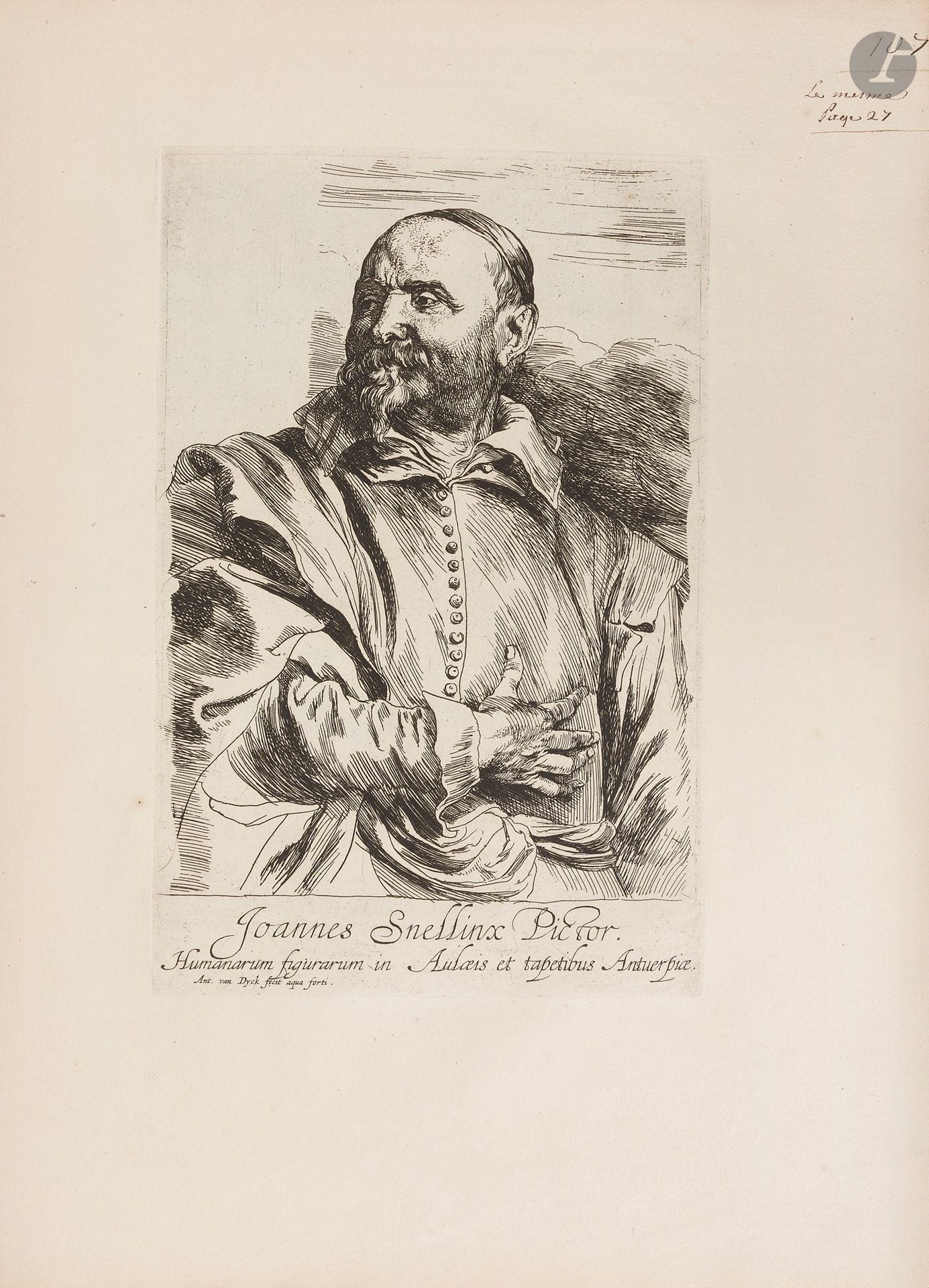
VAN DYCK (Anthony). [Icones principum virorum doctorum pictorum chalcographorum statuariorum nec non amatorum pictoriae artis numero centum]. S.l., ca. 1665-1675. -Large collection in-4, 376x294: 121 plates. Black chagrin, cold-stamped fillets framing the boards, ornate ribbed spine, red edges (19th century binding). Mauquoy-Hendrickx, L'Iconographie d'Antoine Van Dyck, 1991. Precious collection of 121 portraits engraved by or after the famous Flemish painter and engraver Anthony VAN DYCK (1599-1641). Most come from the collection Icones principum virorum... Anthony van Dyck (1599-1641), considered the greatest Flemish painter of the 17th century after Rubens, drew his inspiration both from the work of his predecessor and from the Italian masters, notably Titian, whose influence had a profound effect on his style. A virtuoso portraitist, painter of religious and mythological subjects, but also an exceptional draughtsman and engraver, he revolutionized the art of portraiture, both in painting and etching. A native of Antwerp, he distinguished himself early on by his exceptional talent. By 1615-1616, at just 17 years of age, he was already independently signing his first works. After an initial spell in England in the service of James I (1621), he moved to Italy (1621-1627), where his portraits of the aristocracy, such as the Balbi Children, won him immediate renown. Returning to the Netherlands, he settled permanently at the English court in 1632. His effigies of Charles I and his family revolutionized portraiture, leaving a lasting mark on British artistic history. At the same time, Van Dyck was working on a bold graphic project: a series of prints conceived between his return from Italy (1626) and his departure for England (1632). Based on extremely fine preparatory drawings (in chalk or brush), this undertaking called on the best engravers in Rubens' workshop, and included among its highlights plates engraved in his own hand, such as the striking portrait of Pieter Brueghel the Younger. The first edition of this collection, entitled Icones principum virorum..., appeared incompletely in Antwerp between 1635 and 1636. After Van Dyck's death, the original plates were probably acquired by Maarten van den Enden and passed on to Gillis Hendricx. He published a complete edition in 1645, with a frontispiece engraved by Jacob Neefs, and continued to distribute them until his death in 1677. Reissues appeared in the 17th and 18th centuries, notably thanks to Johannes Meyssens, who added 74 additional portraits in the same spirit. The present collection includes the portraits from the 1645 edition, in a later print run, without the publisher's credits, and with the watermark of the 7-tooth folly, referenced as number 115 by Mauquoy-Hendrickx, placing the print run between 1665 and 1675. Of the first 109 portraits found here, 13 were drawn and engraved by Van Dyck himself. These are those of the painters Willem de Vos or Guillaume de Vos (c. 1593 - c. 1629), Frans Sniders (1579-1657), Paulus Pontius (1603-1658), Pieter Bruegel the Younger (1564-1638), Giusto Sustermans (1597-1681), Josse de Momper (1564-1635), Adam Van Noort (1562-1641), Jan Baptiste de Wael, Joannes Snellinx, Jan Bruegel (1568-1625), Franciscus Franck, the engraver Lucas Vorsterman (1595-1675), and the humanist Erasmus (1469-1536). The portrait of the painter Joannes Snellinx is in two copies, one engraved by Van Dyck, the second by Pieter de Jode. Four portraits are of women: Marie de Médicis (1573-1642), Isabelle-Claire-Eugénie, infanta of Spain (1566-1633), Geneviève d'Urfé (1598?-1656), Marguerite de Lorraine, duchesse d'Orléans (1615-1672). Following is the superb series of twelve portraits, known as Van Dyck's Countesses, engraved by the French engraver Pierre Lombart (1612-1681), featuring countesses and barons of England. The series was engraved in the early 1660s. Rubbing to binding, headpieces damaged, corners dulled. First cover and spine unbound. Soiling to some plates and some rare foxing. Staining to the third plate and restorations to this same plate and to plates 4, 22, 46, 61, 67, 86, and 96, with damage only to engraving 22.
Estimate
€2,000 - €3,000
Result
€3,538
Buyer's premium
30%
VAN DYCK (Anthony).
[Icones principum virorum doctorum pictorum chalcographorum statuariorum nec non amatorum pictoriae artis numero centum].
S.l., ca. 1665-1675. -Large collection in-4, 376x294: 121 plates. Black chagrin, cold-stamped fillets framing the boards, ornate ribbed spine, red edges (19th century binding).
Mauquoy-Hendrickx, L'Iconographie d'Antoine Van Dyck, 1991.
Precious collection of 121 portraits engraved by or after the famous Flemish painter and engraver Anthony VAN DYCK (1599-1641).
Most come from the collection Icones principum virorum...
Anthony van Dyck (1599-1641), considered the greatest Flemish painter of the 17th century after Rubens, drew his inspiration both from the work of his predecessor and from the Italian masters, notably Titian, whose influence had a profound effect on his style. A virtuoso portraitist, painter of religious and mythological subjects, but also an exceptional draughtsman and engraver, he revolutionized the art of portraiture, both in painting and etching.
A native of Antwerp, he distinguished himself early on by his exceptional talent. By 1615-1616, at just 17 years of age, he was already independently signing his first works. After an initial spell in England in the service of James I (1621), he moved to Italy (1621-1627), where his portraits of the aristocracy, such as the Balbi Children, won him immediate renown.
Returning to the Netherlands, he settled permanently at the English court in 1632. His effigies of Charles I and his family revolutionized portraiture, leaving a lasting mark on British artistic history.
At the same time, Van Dyck was working on a bold graphic project: a series of prints conceived between his return from Italy (1626) and his departure for England (1632). Based on extremely fine preparatory drawings (in chalk or brush), this undertaking called on the best engravers in Rubens' workshop, and included among its highlights plates engraved in his own hand, such as the striking portrait of Pieter Brueghel the Younger.
The first edition of this collection, entitled Icones principum virorum..., appeared incompletely in Antwerp between 1635 and 1636. After Van Dyck's death, the original plates were probably acquired by Maarten van den Enden and passed on to Gillis Hendricx. He published a complete edition in 1645, with a frontispiece engraved by Jacob Neefs, and continued to distribute them until his death in 1677. Reissues appeared in the 17th and 18th centuries, notably thanks to Johannes Meyssens, who added 74 additional portraits in the same spirit.
The present collection includes the portraits from the 1645 edition, in a later print run, without the publisher's credits, and with the watermark of the 7-tooth folly, referenced as number 115 by Mauquoy-Hendrickx, placing the print run between 1665 and 1675.
Of the first 109 portraits found here, 13 were drawn and engraved by Van Dyck himself. These are those of the painters Willem de Vos or Guillaume de Vos (c. 1593 - c. 1629), Frans Sniders (1579-1657), Paulus Pontius (1603-1658), Pieter Bruegel the Younger (1564-1638), Giusto Sustermans (1597-1681), Josse de Momper (1564-1635), Adam Van Noort (1562-1641), Jan Baptiste de Wael, Joannes Snellinx, Jan Bruegel (1568-1625), Franciscus Franck, the engraver Lucas Vorsterman (1595-1675), and the humanist Erasmus (1469-1536). The portrait of the painter Joannes Snellinx is in two copies, one engraved by Van Dyck, the second by Pieter de Jode.
Four portraits are of women: Marie de Médicis (1573-1642), Isabelle-Claire-Eugénie, infanta of Spain (1566-1633), Geneviève d'Urfé (1598?-1656), Marguerite de Lorraine, duchesse d'Orléans (1615-1672).
Following is the superb series of twelve portraits, known as Van Dyck's Countesses, engraved by the French engraver Pierre Lombart (1612-1681), featuring countesses and barons of England. The series was engraved in the early 1660s.
Rubbing to binding, headpieces damaged, corners dulled. First cover and spine unbound. Soiling to some plates and some rare foxing. Staining to the third plate and restorations to this same plate and to plates 4, 22, 46, 61, 67, 86, and 96, with damage only to engraving 22.
Sale
Wednesday 17 June・14:00 (Europe/Paris)
Sale location coming soon
3, rue Favart
75002 Paris