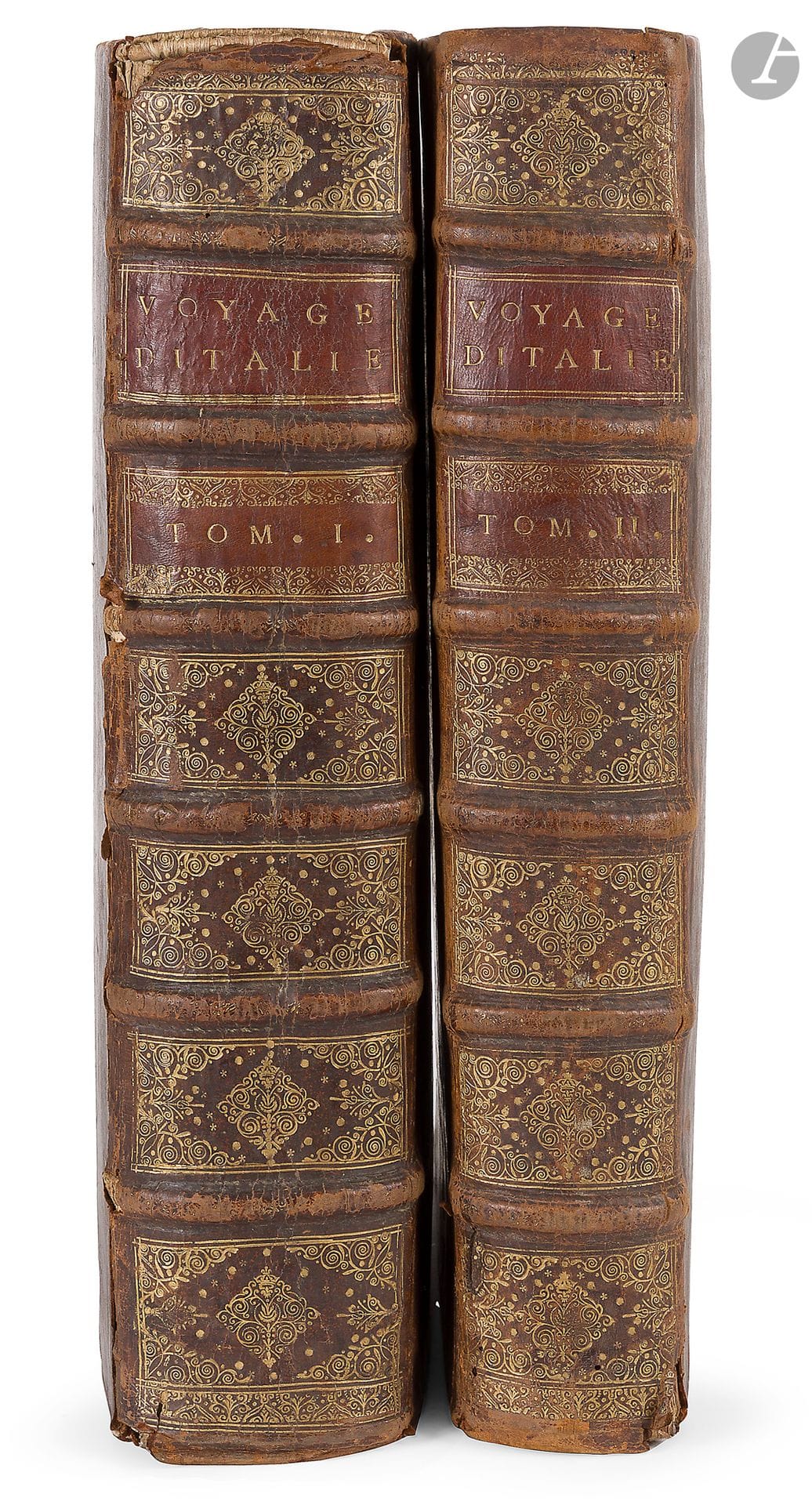
[MANUSCRIPT - VOYAGE]. Voyage d'Italie 1700. S.l., early eighteenth century. - 2 volumes in-folio, 422x270: 332 pp. 23 plates; pp. 330-841. Brown calf, ornate ribbed spine, interior gilt roulette, red speckled edges (period binding). A precious unpublished manuscript of over 800 pages, recounting the journey to Italy of an anonymous young man in his twenties. Written with remarkable erudition, this account begins with an intimate declaration: "One of my strongest inclinations has always been to travel; of all the countries that Europe offers to my curiosity, none has ever seemed more capable of fulfilling it than Rome and Italy; the superb and pompous descriptions that I had read, the extraordinary ideas with which a Pope and Cardinals fill the mind, and above all a burning desire to see places that the reading of authors and poets made familiar to me, contributed much to make me want to make this journey; I was about to enter my twentieth year, my studies of philosophy and law finished, and I thought I could make no better use of these early years of youth, when my uncertain mind did not know what to choose, than in a useful and pleasant journey. I hoped that the accidents to which one is exposed when one is outside one's country, and the knowledge of the customs and geniuses of the different peoples among whom I would be passing, would put me in a position to make solid reflections, and to embrace on my return a state of life with more reason and judgment." Leaving Paris on January 12, 1700, this young traveler crossed France and Italy, passing through Fontainebleau, Nevers, Moulin, Lyon, Avignon, Marseille, Genoa, Florence, Rome, Venice, Milan, Turin and many other cities. Each stage is carefully described, combining social, historical and personal observations. He devotes most of his narrative to Rome, where he arrived on March 23, 1700 and left on January 1, 1701. The city, its monuments and surroundings are depicted with great precision, enriched by historical digressions that bear witness to his profound culture. He also spent a long time in Venice, from January 25 to February 10, where he depicted the city of the Doges with the same rigor. Of particular note is this interesting passage on commedia dell'arte, which he wrote in connection with his stopover in Bergamo: "The Bergamasque patois is so ridiculous that all the harlequins who, in Italian comedies, play the roles of valets, use it; this gives me reason to make a small remark about the Comedies, they are always the same actors, and each one speaks his own particular language; the Doctor uses Bolonois; the Pantaloon affects the Venetian; the Scaramouche is Neapolitan; the Lovers and the Mistresses Roman; Arlequin Bergamasque, et le polichinelle genois; en sorte qu'on ne peut bien entendre une comédie italienne si l'on ne possède tout à la fois ces différens langages; Il est vray que tout est italien, mais il y a la même différence que celle qui se trouve entre la manière dont on parle parmi le beau monde de Paris, et celle dont on parle en Gascogne, ou dont le menu peuple de Normandie se sert pour s'exprimer" (pp. 806-807). His journey ended on March 21, 1701. The author has enriched his account with 44 beautiful fold-out engravings, taken from various late 17th-century collections, 32 of which are mounted on canvas. These engravings mainly concern Rome and its surroundings. On the provenance and identity of the author, we find this note on the first endpaper of the first volume: "This account comes from the library of Madame de Paillot, née Hélène de l'Horme, widow of Colonel Anatole de Paillot, who died at Château de Ternan, near Pont-de-Vaux (Ain) on March 10, 1926. She believed it to have been written by a member of the Paillot family. She gave it to me in [...]. Joseph Roserot de Melin." Joseph Roserot de Melin (1879-1968) was a paleographic archivist and a member of the École française de Rome from 1919 to 1921. Rubbing to bindings, cracks to two hinges, head cap of first volume damaged and missing, corners dulled. Tears to several engravings, some wet. Soiling to several leaves. Provenance: Paillot family: Paillot family. - Joseph Roserot de Melin.
Estimate
€1,000 - €1,500
Result
€8,580
Buyer's premium
30%
[MANUSCRIPT - VOYAGE].
Voyage d'Italie 1700.
S.l., early eighteenth century. - 2 volumes in-folio, 422x270: 332 pp. 23 plates; pp. 330-841. Brown calf, ornate ribbed spine, interior gilt roulette, red speckled edges (period binding).
A precious unpublished manuscript of over 800 pages, recounting the journey to Italy of an anonymous young man in his twenties. Written with remarkable erudition, this account begins with an intimate declaration:
"One of my strongest inclinations has always been to travel; of all the countries that Europe offers to my curiosity, none has ever seemed more capable of fulfilling it than Rome and Italy; the superb and pompous descriptions that I had read, the extraordinary ideas with which a Pope and Cardinals fill the mind, and above all a burning desire to see places that the reading of authors and poets made familiar to me, contributed much to make me want to make this journey; I was about to enter my twentieth year, my studies of philosophy and law finished, and I thought I could make no better use of these early years of youth, when my uncertain mind did not know what to choose, than in a useful and pleasant journey. I hoped that the accidents to which one is exposed when one is outside one's country, and the knowledge of the customs and geniuses of the different peoples among whom I would be passing, would put me in a position to make solid reflections, and to embrace on my return a state of life with more reason and judgment."
Leaving Paris on January 12, 1700, this young traveler crossed France and Italy, passing through Fontainebleau, Nevers, Moulin, Lyon, Avignon, Marseille, Genoa, Florence, Rome, Venice, Milan, Turin and many other cities. Each stage is carefully described, combining social, historical and personal observations.
He devotes most of his narrative to Rome, where he arrived on March 23, 1700 and left on January 1, 1701. The city, its monuments and surroundings are depicted with great precision, enriched by historical digressions that bear witness to his profound culture. He also spent a long time in Venice, from January 25 to February 10, where he depicted the city of the Doges with the same rigor.
Of particular note is this interesting passage on commedia dell'arte, which he wrote in connection with his stopover in Bergamo: "The Bergamasque patois is so ridiculous that all the harlequins who, in Italian comedies, play the roles of valets, use it; this gives me reason to make a small remark about the Comedies, they are always the same actors, and each one speaks his own particular language; the Doctor uses Bolonois; the Pantaloon affects the Venetian; the Scaramouche is Neapolitan; the Lovers and the Mistresses Roman; Arlequin Bergamasque, et le polichinelle genois; en sorte qu'on ne peut bien entendre une comédie italienne si l'on ne possède tout à la fois ces différens langages; Il est vray que tout est italien, mais il y a la même différence que celle qui se trouve entre la manière dont on parle parmi le beau monde de Paris, et celle dont on parle en Gascogne, ou dont le menu peuple de Normandie se sert pour s'exprimer" (pp. 806-807).
His journey ended on March 21, 1701.
The author has enriched his account with 44 beautiful fold-out engravings, taken from various late 17th-century collections, 32 of which are mounted on canvas. These engravings mainly concern Rome and its surroundings.
On the provenance and identity of the author, we find this note on the first endpaper of the first volume: "This account comes from the library of Madame de Paillot, née Hélène de l'Horme, widow of Colonel Anatole de Paillot, who died at Château de Ternan, near Pont-de-Vaux (Ain) on March 10, 1926. She believed it to have been written by a member of the Paillot family. She gave it to me in [...]. Joseph Roserot de Melin."
Joseph Roserot de Melin (1879-1968) was a paleographic archivist and a member of the École française de Rome from 1919 to 1921.
Rubbing to bindings, cracks to two hinges, head cap of first volume damaged and missing, corners dulled. Tears to several engravings, some wet. Soiling to several leaves.
Provenance: Paillot family:
Paillot family. - Joseph Roserot de Melin.
Sale
Wednesday 17 June・14:00 (Europe/Paris)
Sale location coming soon
3, rue Favart
75002 Paris