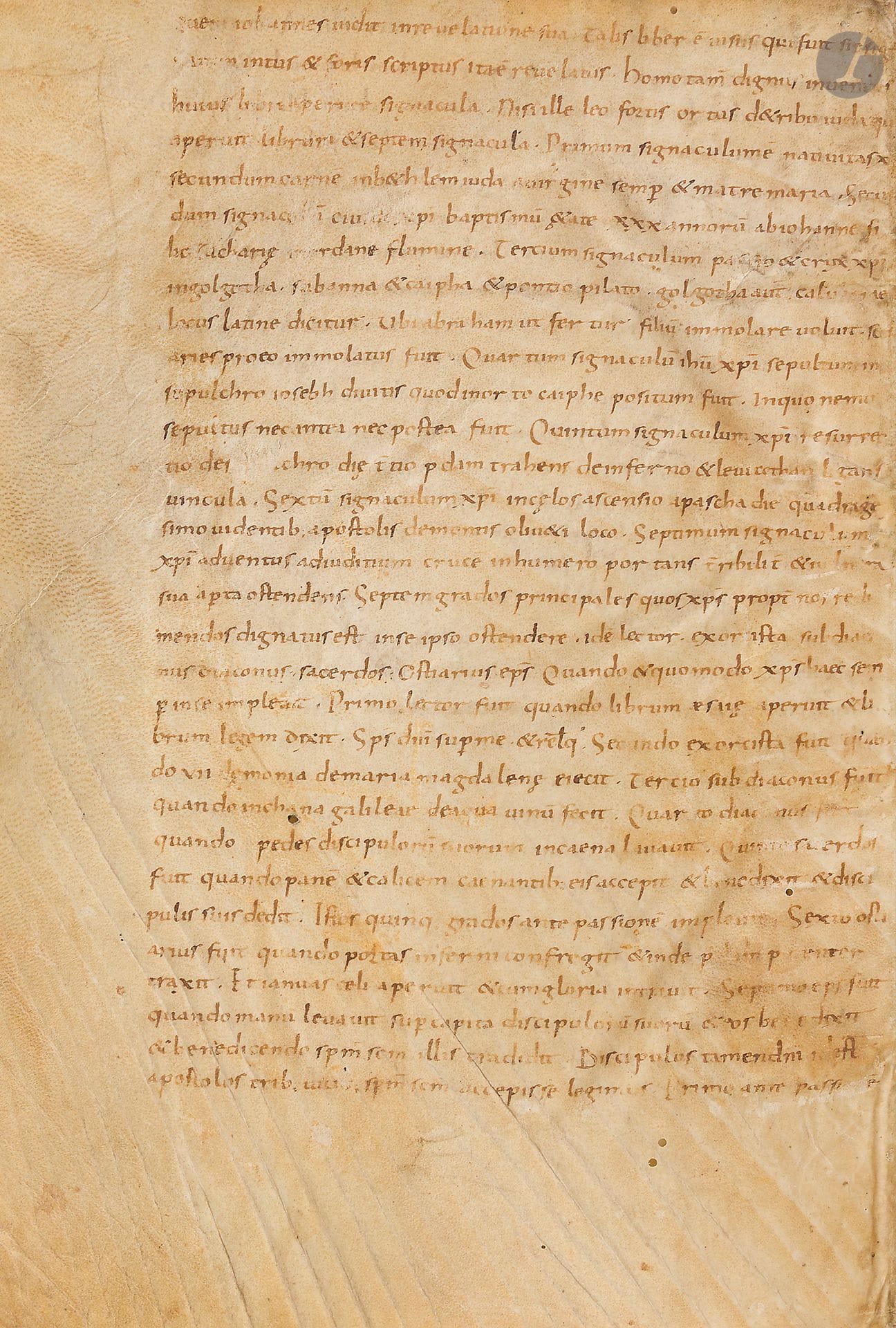
[INCUNABLE] - AUGUSTIN (Saint). Opus Quinquaginta Homeliaru(m) divi Aurelij Augustini. [Followed by]: Sermones sancti Augustini de tempore. [And of]: Sermones sancti Augustini de Sanctis. [Basel: Johannes Amerbach, 1494-1495]. - 3 parts in one volume in-folio, 310x223: (356 ff.) [sig. a-f8/6 g6 h8 A6 a-k8/6 l8 m-x8/6 y12 A8 B-K6 A8 B-C6 D8 a8 b6 c-d8 e6 f8]. Sow skin on wooden boards, boards decorated with cold-stamped decoration, remnants of brass clasps, spine ribbed (period binding). Hain 2008. - Pellechet, I, 1518. - Goff A-1308. - BMC, III, p. 756 IB 37380. Rare incunabula edition of the last three parts of the first collective edition of Saint Augustine's Sermons. These are precisely parts 5, 6 and 7, comprising successively the Quinquaginta homiliae, a collection of fifty homilies by Saint Augustine, followed by his sermons "de tempore", and those on the Saints. These last two parts represent some three hundred sermons gleaned by Augustin Dodo, canon of St. Leonard's in Basel, from medieval homilies. Printed in Gothic type on two 52-line columns, by the German printer Johannes Amerbach (1441?-1513), active in Nuremberg with Anton Koberger and later in Basel, where he settled towards the end of 1477. Each part is preceded by a separate title and table of contents, and followed by an annotation of the main sentences. On the verso of the title of the sermon section "De Tempore", there is a fine woodcut depicting an eagle holding a shield adorned with a heart pierced by two arrows (Saint Augustine's coat of arms), which is revered by two monks. Below: "Frater Augustinus Dodo de frisia canonicq reglaris." Part 5 appeared in 1494, while the last two were printed in 1495. Copy in contemporary binding, entirely rubricated in red at the time. The lettering on folio a1 of the Sermones de tempore was painted, probably at a later date. The three parts present in this volume are absolutely complete with all their leaves, including the blank ones. It contains several 16th-century annotations in Latin, as well as a few headlines. The binding includes several unbound medieval manuscripts, including a two-page folio extracted from an 11th-century manuscript composed in France and featuring: extracts in Latin from Isidore of Seville [Isidorus Hispalensis], Questiones [Isidore of Seville, Sententiae, Patrologia latina, 83, col. 256, Questio XXXV]; Extract from Macharius, Epistola domini Machari ad Monachos; Extract from Pierre Lombard, De septem ordinibus ecclesiasticis gradibus [Liber sententiae 4 dist. 24] (or version of De septem gradibus Christi (see A. Wilmart, "Les ordres du Christ", in Revue des Sciences religieuses 3 (1923), pp. 305-327). Incipit: "[...] & disperatio futuri stultitia sapientiae oblivio generatur..." [Isidore of Seville, Sententiae, Patrologia latina, 83, col. 638] (recto); explicit, "[...] discipulos tamen... accepisse legimus primo..." Very damaged binding, with numerous chips, soiling and a large number of wormholes. The clasps are missing, and only the brass brackets are partly present. Large halo on first cover. The first quire is unbound. Wormholes and some light wetness, not serious. Tears to the leaves of the first quire as well as to leaf h5 of the Quinquaginta homiliae, and to leaves x6 and y2 of the last part. Leaves q5 and q6 of the Sermones de tempore are stained. Provenance: Benedictine Abbey of Schuttern, commune of Friesenheim (Germany), with handwritten bookplates dated 1538. - Eugène Stern, with bookplate.
Estimate
€1,500 - €2,000
Result
€6,500
Buyer's premium
30%
[INCUNABLE] - AUGUSTIN (Saint).
Opus Quinquaginta Homeliaru(m) divi Aurelij Augustini. [Followed by]: Sermones sancti Augustini de tempore. [And of]: Sermones sancti Augustini de Sanctis.
[Basel: Johannes Amerbach, 1494-1495]. - 3 parts in one volume in-folio, 310x223: (356 ff.) [sig. a-f8/6 g6 h8 A6 a-k8/6 l8 m-x8/6 y12 A8 B-K6 A8 B-C6 D8 a8 b6 c-d8 e6 f8]. Sow skin on wooden boards, boards decorated with cold-stamped decoration, remnants of brass clasps, spine ribbed (period binding).
Hain 2008. - Pellechet, I, 1518. - Goff A-1308. - BMC, III, p. 756 IB 37380.
Rare incunabula edition of the last three parts of the first collective edition of Saint Augustine's Sermons.
These are precisely parts 5, 6 and 7, comprising successively the Quinquaginta homiliae, a collection of fifty homilies by Saint Augustine, followed by his sermons "de tempore", and those on the Saints. These last two parts represent some three hundred sermons gleaned by Augustin Dodo, canon of St. Leonard's in Basel, from medieval homilies.
Printed in Gothic type on two 52-line columns, by the German printer Johannes Amerbach (1441?-1513), active in Nuremberg with Anton Koberger and later in Basel, where he settled towards the end of 1477. Each part is preceded by a separate title and table of contents, and followed by an annotation of the main sentences. On the verso of the title of the sermon section "De Tempore", there is a fine woodcut depicting an eagle holding a shield adorned with a heart pierced by two arrows (Saint Augustine's coat of arms), which is revered by two monks. Below: "Frater Augustinus Dodo de frisia canonicq reglaris."
Part 5 appeared in 1494, while the last two were printed in 1495.
Copy in contemporary binding, entirely rubricated in red at the time. The lettering on folio a1 of the Sermones de tempore was painted, probably at a later date. The three parts present in this volume are absolutely complete with all their leaves, including the blank ones.
It contains several 16th-century annotations in Latin, as well as a few headlines.
The binding includes several unbound medieval manuscripts, including a two-page folio extracted from an 11th-century manuscript composed in France and featuring: extracts in Latin from Isidore of Seville [Isidorus Hispalensis], Questiones [Isidore of Seville, Sententiae, Patrologia latina, 83, col. 256, Questio XXXV]; Extract from Macharius, Epistola domini Machari ad Monachos; Extract from Pierre Lombard, De septem ordinibus ecclesiasticis gradibus [Liber sententiae 4 dist. 24] (or version of De septem gradibus Christi (see A. Wilmart, "Les ordres du Christ", in Revue des Sciences religieuses 3 (1923), pp. 305-327). Incipit: "[...] & disperatio futuri stultitia sapientiae oblivio generatur..." [Isidore of Seville, Sententiae, Patrologia latina, 83, col. 638] (recto); explicit, "[...] discipulos tamen... accepisse legimus primo..."
Very damaged binding, with numerous chips, soiling and a large number of wormholes. The clasps are missing, and only the brass brackets are partly present. Large halo on first cover. The first quire is unbound. Wormholes and some light wetness, not serious. Tears to the leaves of the first quire as well as to leaf h5 of the Quinquaginta homiliae, and to leaves x6 and y2 of the last part. Leaves q5 and q6 of the Sermones de tempore are stained.
Provenance:
Benedictine Abbey of Schuttern, commune of Friesenheim (Germany), with handwritten bookplates dated 1538. - Eugène Stern, with bookplate.
Sale
Wednesday 17 June・14:00 (Europe/Paris)
Sale location coming soon
3, rue Favart
75002 Paris