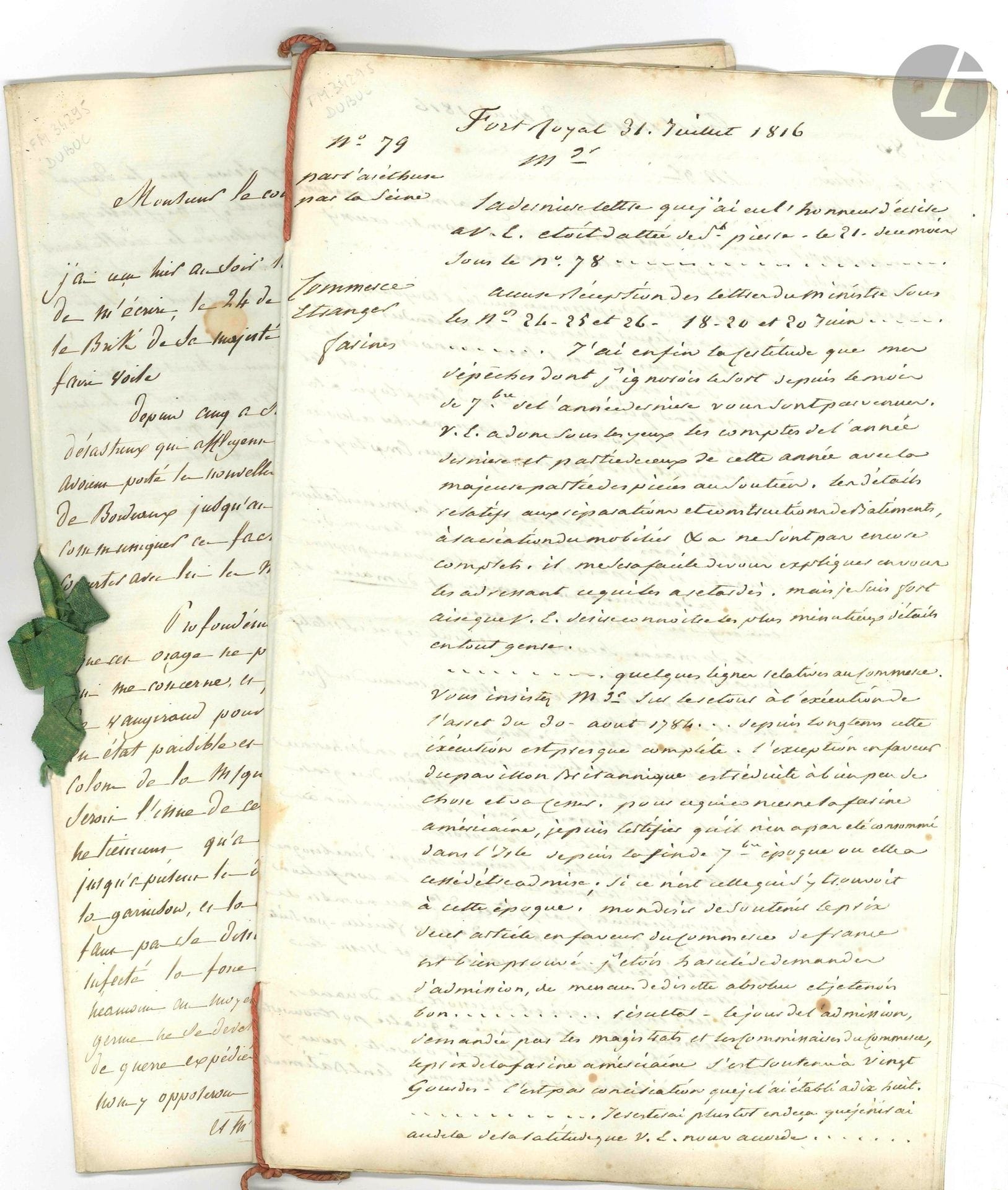
MARTINIQUE. Louis-François DUBUC (1759-1827). Manuscript of 2 notebooks of correspondence, Fort-Royal, Saint-Pierre (Martinique), 1815-1816; 2 in-fol. notebooks of 13 and 9pages, stapled with a green silk ribbon (1st) and a red cord (2nd), preserved in a modern black cloth slipcase. Very interesting document on Martinique at the beginning of the Restoration. [Planter on Martinique and spokesman for the colonists, Louis-François Dubuc sided with the English during the Revolution, and in 1793 signed the Treaty of Whitehall, which placed the island under British protection, stipulating that it would return to France upon the return of the Bourbons. A first British occupation took place from 1794 to 1802, followed by a second from 1809 to 1814. On this date, Dubuc was appointed Intendant of Martinique by Louis XVIII. He held this position until 1817, when the colonial intendants were abolished]. The first correspondence book contains 9 copies of letters, mainly to the Comte de La Châtre, and covers the period from May 5 to August 9, 1815. The second contains 10 copies or summaries of letters, between July 31 and September 20, 1816. This correspondence discusses Napoleon's return, the desire to keep the colony for the King, and the state of mind of the garrison and the naval station (May 5, 1815), the support of England and the allied powers for ships flying the royal flag, rumors of an English expedition against Martinique from Saint Lucia, the denial of this rumor and the futility of ceding Martinique's sovereignty to Great Britain, the situation being different from that of 1793 (May 14). Other subjects are dealt with: negotiations between the Governor, the Comte de Vaugiraud, and Sir James Leith, to land British forces at Fort-Royal, to defend the island against attack (June 13, 1815), exports of colonial foodstuffs and increased duties for foreign ships (with the exception of English vessels), prohibition of trade with French ports held by the "usurper", reduction in the price of sugar and coffee (June 15), case of Guadeloupe, where the tricolor flag has been flown for a month (July 17), defeat at Waterloo, English attack on Guadeloupe, which remained loyal to the Emperor, resumption of trade and increase in customs revenues (August 9). Let's quote the letter of May 14: "I have [...] the slightest doubt about England's conduct with regard to the flag of His Majesty, with whom she is in alliance; and if, as a consequence of the violation of the Treaty of Paris and the declaration of the Congress of Vienna dated March 13 last, hostilities take place on the part of England, against the flag flown again by Bonaparte and his adherents, the King's flag, which alone is truly that of France, will not only be respected, but also protected and defended by the allied powers in a common cause"... And that of August 9: "The English expedition against Guadeloupe has been assembled for several days at Les Saintes, and the attack must have begun the day before yesterday. We expect news of it any minute. We have reason to hope that we won't encounter any resistance. It would be futile in the end, but it could cause great harm. It is to be presumed that, despite some rash and threatening measures by the effervescents, the leaders will be sufficiently in control of their movements, and wise enough to capitulate immediately"... The second notebook also deals with various subjects: stopping the import of American flour, in order to support prices (July 31, 1816), the importance of maritime traffic on the island (August 3), the purchase of merchandise by the Caracas government (August 13), conflict between Dubuc and the Count of Vaugiraud, first over the salary of the colony's clerks (August 16 and September 2), then over trade with the Spanish possessions that Dubuc is trying to develop (September 10), etc. Let's quote the letter of September 2: ""I know that the disunity between the two administrators is detrimental to the service [...] M de Vaugiraud, without my knowledge, convened twelve or thirteen people who met as a committee - with president, secretary... and what a composition - the majority consisted of men some of whom are known for their revolutionary doctrine and practices and all of whom are odious to the colony"... Etc.
Estimate
€1,000 - €1,200
Result
€1,319
Buyer's premium
32%
MARTINIQUE. Louis-François DUBUC (1759-1827). Manuscript of 2 notebooks of correspondence, Fort-Royal, Saint-Pierre (Martinique), 1815-1816; 2 in-fol. notebooks of 13 and 9pages, stapled with a green silk ribbon (1st) and a red cord (2nd), preserved in a modern black cloth slipcase.
Very interesting document on Martinique at the beginning of the Restoration.
[Planter on Martinique and spokesman for the colonists, Louis-François Dubuc sided with the English during the Revolution, and in 1793 signed the Treaty of Whitehall, which placed the island under British protection, stipulating that it would return to France upon the return of the Bourbons. A first British occupation took place from 1794 to 1802, followed by a second from 1809 to 1814. On this date, Dubuc was appointed Intendant of Martinique by Louis XVIII. He held this position until 1817, when the colonial intendants were abolished].
The first correspondence book contains 9 copies of letters, mainly to the Comte de La Châtre, and covers the period from May 5 to August 9, 1815. The second contains 10 copies or summaries of letters, between July 31 and September 20, 1816.
This correspondence discusses Napoleon's return, the desire to keep the colony for the King, and the state of mind of the garrison and the naval station (May 5, 1815), the support of England and the allied powers for ships flying the royal flag, rumors of an English expedition against Martinique from Saint Lucia, the denial of this rumor and the futility of ceding Martinique's sovereignty to Great Britain, the situation being different from that of 1793 (May 14). Other subjects are dealt with: negotiations between the Governor, the Comte de Vaugiraud, and Sir James Leith, to land British forces at Fort-Royal, to defend the island against attack (June 13, 1815), exports of colonial foodstuffs and increased duties for foreign ships (with the exception of English vessels), prohibition of trade with French ports held by the "usurper", reduction in the price of sugar and coffee (June 15), case of Guadeloupe, where the tricolor flag has been flown for a month (July 17), defeat at Waterloo, English attack on Guadeloupe, which remained loyal to the Emperor, resumption of trade and increase in customs revenues (August 9). Let's quote the letter of May 14: "I have [...] the slightest doubt about England's conduct with regard to the flag of His Majesty, with whom she is in alliance; and if, as a consequence of the violation of the Treaty of Paris and the declaration of the Congress of Vienna dated March 13 last, hostilities take place on the part of England, against the flag flown again by Bonaparte and his adherents, the King's flag, which alone is truly that of France, will not only be respected, but also protected and defended by the allied powers in a common cause"... And that of August 9: "The English expedition against Guadeloupe has been assembled for several days at Les Saintes, and the attack must have begun the day before yesterday. We expect news of it any minute. We have reason to hope that we won't encounter any resistance. It would be futile in the end, but it could cause great harm. It is to be presumed that, despite some rash and threatening measures by the effervescents, the leaders will be sufficiently in control of their movements, and wise enough to capitulate immediately"...
The second notebook also deals with various subjects: stopping the import of American flour, in order to support prices (July 31, 1816), the importance of maritime traffic on the island (August 3), the purchase of merchandise by the Caracas government (August 13), conflict between Dubuc and the Count of Vaugiraud, first over the salary of the colony's clerks (August 16 and September 2), then over trade with the Spanish possessions that Dubuc is trying to develop (September 10), etc. Let's quote the letter of September 2: ""I know that the disunity between the two administrators is detrimental to the service [...] M de Vaugiraud, without my knowledge, convened twelve or thirteen people who met as a committee - with president, secretary... and what a composition - the majority consisted of men some of whom are known for their revolutionary doctrine and practices and all of whom are odious to the colony"... Etc.
Sale
Thursday 21 May・14:00 (Europe/Paris)
Sale location coming soon
3, rue Favart
75002 Paris