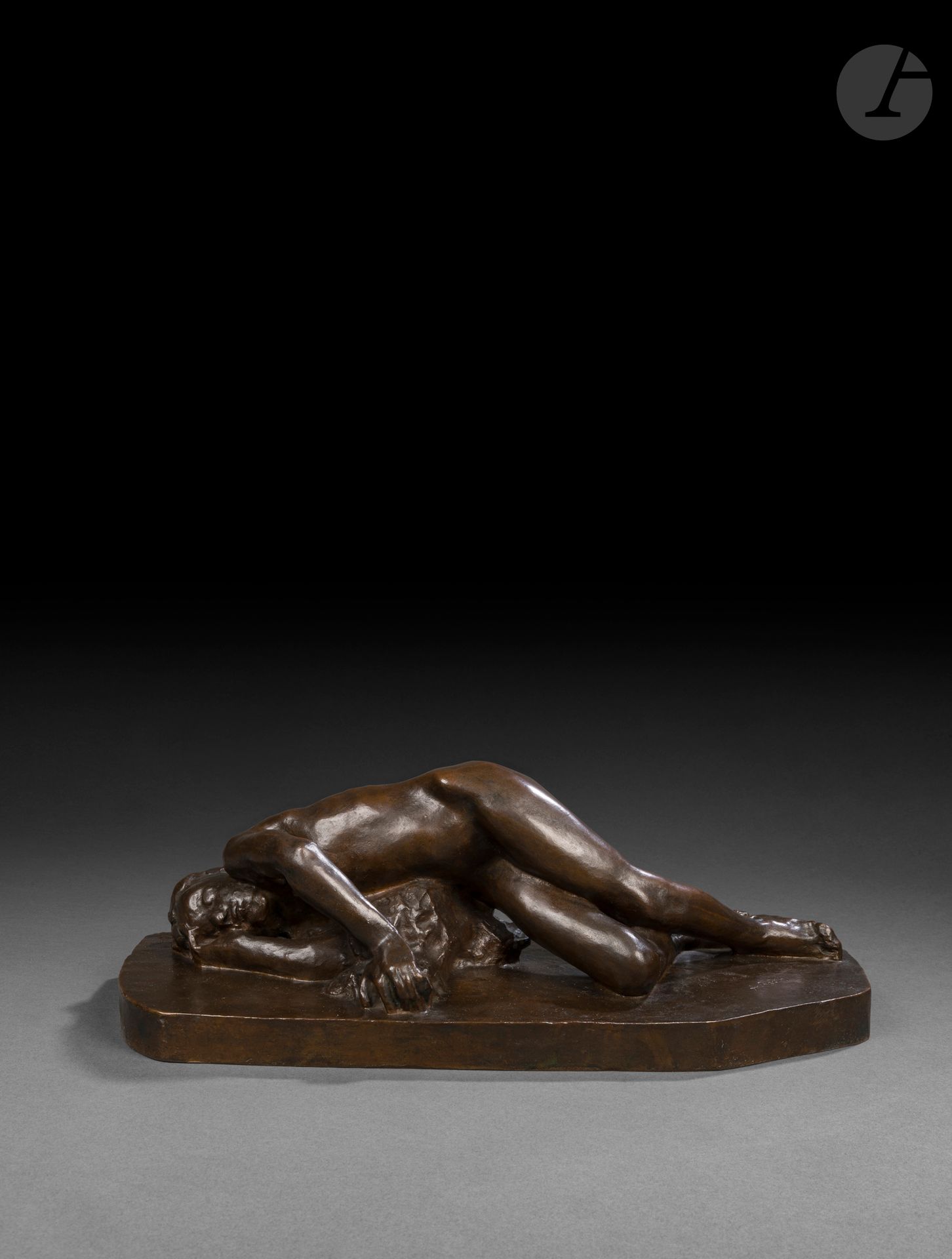
Auguste Rodin (1840 - 1917) Female nude lying on her side, known as La Fatigue Model created before 1884, posthumously cast in 1931 Bronze with brown patina Signed "A. Rodin" and numbered "1/12" on the base, in front of the foot Bears the founder's mark "ALEXIS. RUDIER / Fondeur / PARIS" on the edge of the terrace. embossed stamp "A. Rodin" on the inside Bears a label inscribed "La Fatigue" on the inside. H. 17 cm, W. 51 cm, D. 19.5 cm Provenance : Former Maurice Fenaille collection Piasa sale June 21, 2006 Galerie Univers du Bronze, Paris Private collection. Related literature : Claudie Judrin, Rodin et les écrivains de son temps : sculptures, dessins, lettres et livres du fonds Rodin, cat. exp., Paris, musée Rodin, June 23 - October 18, 1976, Paris, musée Rodin, 1976, p. 63 Éric Hoppenot, "Auguste Rodin et la littérature française du XIXème siècle", in Alberto Fiz (ed.), Rodin et les écrivains : Dante, Balzac, Hugo, Baudelaire, cat. exp., Aosta, Centro Saint-Bénin, December 18, 2004 - April 3, 2005, Milan, Arte & cultura, 2004, pp. 65-69 Bibliography : Antoinette Le Normand-Romain, Les Bronzes de Rodin. Catalog des œuvres au Musée Rodin, 2 volumes, Paris, Musée Rodin, RMN, 2007, vol.1, model listed under no. S486, p.355-366, our copy quoted on p. 355. Related works : Auguste Rodin, La Fatigue, before 1888, plaster, H. 17 x W. 51.5 x D. 22.5 cm, Paris, Musée Rodin, inv. S.03059 Auguste Rodin, La Fatigue, 1887, plaster, H. 17 x W. 51.5 x D. 21.3 cm, Paris, Musée Rodin, inv. S.02888 Auguste Rodin, La Fatigue, 1887, plaster, dedicated "To my friend Dayot. Rodin", H. 17 x W. 48.4 x D. 21 cm, Paris, Musée Rodin, inv. S.02223 Auguste Rodin, La Fatigue, foundry model in plaster covered with release agent (Godard foundry), H. 17 x W. 51.5 x D. 21.3 cm, Paris, Musée Rodin, inv. S.02961 Auguste Rodin, La Mort d'Enguerrande et de Gaëtan, 1884, pen and ink on wove paper, signed "A. Rodin" lower left, H. 14.9 x W. 26.6 cm, Paris, Musée Rodin, inv. D.09449 After Auguste Rodin, Enguerrande pour Les Fleurs du Mal, etching, H. 28.2 x W. 15 cm, Paris, Musée Rodin, inv. G.09479 Other bronzes in public collections: Auguste Rodin, Nu féminin couché sur le côté droit, dit La Fatigue, cast in 1931, bronze, signed "A. Rodin", inscribed "Alexis Rudier / Fondeur. Paris", marked "A. Rodin" on the inside, Paris, Musée Rodin, inv. S.00486 Auguste Rodin, La Fatigue, model before 1884, cast by Georges Rudier in 1974, bronze, signed "A. Rodin", inscribed "Georges. Rudier / Fondeur Paris", inscribed "(c) by Musée Rodin 1974", numbered "5/12", H. 15.88 x W. 20.96 x D. 52.07 cm, Stanford, Cantor Arts Center, inv. 1992.152 Auguste Rodin, La Fatigue, bronze, signed "Rodin", inscribed "Alexis Rudier Fondeur Paris", dim. 16 x 51 x 19 cm, Cairo, Mahmoud Khalil Museum, inv. 40S. Very similar to La Misère, with which it is sometimes confused, La Fatigue depicts a female nude lying on her right side, her head resting on her bent right arm, while her left arm rests on a mound. The languid body's attitude of abandonment conveys an inner exhaustion imbued with a graceful melancholy. Although the exact date of creation is not known, Rodin used the figure from the back in 1884 to illustrate the tragic end of Enguerrande and Gaëtan, the heroes of Émile Bergerat's dramatic poem Enguerrande. Between October 1887 and January 1888, Paul Gallimard commissioned the sculptor to illustrate a copy of Charles Baudelaire's Les Fleurs du Mal, using in the margins several of his sculptures and drawings from his research on Dante for La Porte de l'Enfer. La Fatigue is featured in the poem La Martyre. This association evokes Rodin's source of inspiration: the famous Saint Cecilia sculpted by Stefano Maderno for the church of Santa Cecilia in Trastevere, Rome, which the sculptor most probably admired during his trip to Italy in the winter of 1875-1876. It was under the title "Christian Martyrdom" that the dealer commissioned a marble version shortly after its presentation at the Galerie Georges Petit in 1889. Attached to the practice of assemblage, Rodin brought together La Fatigue and one of Ugolin's sons in an exhibition at the Galerie Georges Petit in 1886. In 1899, it was vertically integrated into the group La Terre et la Lune. In 1905, she was transformed into the sleeping Adam alongside Eve in the Adam and Eve group. From this model, two bronzes were probably executed by Griffoul and Lorge in 1889 and 1898. Three bronzes, including our fine example from
Estimate
€50,000 - €70,000
Result
Not sold
Buyer's premium
30%
Auguste Rodin (1840 - 1917)
Female nude lying on her side, known as La Fatigue
Model created before 1884, posthumously cast in 1931
Bronze with brown patina
Signed "A. Rodin" and numbered "1/12" on the base, in front of the foot
Bears the founder's mark "ALEXIS. RUDIER / Fondeur / PARIS" on the edge of the terrace.
embossed stamp "A. Rodin" on the inside
Bears a label inscribed "La Fatigue" on the inside.
H. 17 cm, W. 51 cm, D. 19.5 cm
Provenance :
Former Maurice Fenaille collection
Piasa sale June 21, 2006
Galerie Univers du Bronze, Paris
Private collection.
Related literature :
Claudie Judrin, Rodin et les écrivains de son temps : sculptures, dessins, lettres et livres du fonds Rodin, cat. exp., Paris, musée Rodin, June 23 - October 18, 1976, Paris, musée Rodin, 1976, p. 63
Éric Hoppenot, "Auguste Rodin et la littérature française du XIXème siècle", in Alberto Fiz (ed.), Rodin et les écrivains : Dante, Balzac, Hugo, Baudelaire, cat. exp., Aosta, Centro Saint-Bénin, December 18, 2004 - April 3, 2005, Milan, Arte & cultura, 2004, pp. 65-69
Bibliography :
Antoinette Le Normand-Romain, Les Bronzes de Rodin. Catalog des œuvres au Musée Rodin, 2 volumes, Paris, Musée Rodin, RMN, 2007, vol.1, model listed under no. S486, p.355-366, our copy quoted on p. 355.
Related works :
Auguste Rodin, La Fatigue, before 1888, plaster, H. 17 x W. 51.5 x D. 22.5 cm, Paris, Musée Rodin, inv. S.03059
Auguste Rodin, La Fatigue, 1887, plaster, H. 17 x W. 51.5 x D. 21.3 cm, Paris, Musée Rodin, inv. S.02888
Auguste Rodin, La Fatigue, 1887, plaster, dedicated "To my friend Dayot. Rodin", H. 17 x W. 48.4 x D. 21 cm, Paris, Musée Rodin, inv. S.02223
Auguste Rodin, La Fatigue, foundry model in plaster covered with release agent (Godard foundry), H. 17 x W. 51.5 x D. 21.3 cm, Paris, Musée Rodin, inv. S.02961
Auguste Rodin, La Mort d'Enguerrande et de Gaëtan, 1884, pen and ink on wove paper, signed "A. Rodin" lower left, H. 14.9 x W. 26.6 cm, Paris, Musée Rodin, inv. D.09449
After Auguste Rodin, Enguerrande pour Les Fleurs du Mal, etching, H. 28.2 x W. 15 cm, Paris, Musée Rodin, inv. G.09479
Other bronzes in public collections:
Auguste Rodin, Nu féminin couché sur le côté droit, dit La Fatigue, cast in 1931, bronze, signed "A. Rodin", inscribed "Alexis Rudier / Fondeur. Paris", marked "A. Rodin" on the inside, Paris, Musée Rodin, inv. S.00486
Auguste Rodin, La Fatigue, model before 1884, cast by Georges Rudier in 1974, bronze, signed "A. Rodin", inscribed "Georges. Rudier / Fondeur Paris", inscribed "(c) by Musée Rodin 1974", numbered "5/12", H. 15.88 x W. 20.96 x D. 52.07 cm, Stanford, Cantor Arts Center, inv. 1992.152
Auguste Rodin, La Fatigue, bronze, signed "Rodin", inscribed "Alexis Rudier Fondeur Paris", dim. 16 x 51 x 19 cm, Cairo, Mahmoud Khalil Museum, inv. 40S.
Very similar to La Misère, with which it is sometimes confused, La Fatigue depicts a female nude lying on her right side, her head resting on her bent right arm, while her left arm rests on a mound. The languid body's attitude of abandonment conveys an inner exhaustion imbued with a graceful melancholy.
Although the exact date of creation is not known, Rodin used the figure from the back in 1884 to illustrate the tragic end of Enguerrande and Gaëtan, the heroes of Émile Bergerat's dramatic poem Enguerrande.
Between October 1887 and January 1888, Paul Gallimard commissioned the sculptor to illustrate a copy of Charles Baudelaire's Les Fleurs du Mal, using in the margins several of his sculptures and drawings from his research on Dante for La Porte de l'Enfer. La Fatigue is featured in the poem La Martyre.
This association evokes Rodin's source of inspiration: the famous Saint Cecilia sculpted by Stefano Maderno for the church of Santa Cecilia in Trastevere, Rome, which the sculptor most probably admired during his trip to Italy in the winter of 1875-1876. It was under the title "Christian Martyrdom" that the dealer commissioned a marble version shortly after its presentation at the Galerie Georges Petit in 1889.
Attached to the practice of assemblage, Rodin brought together La Fatigue and one of Ugolin's sons in an exhibition at the Galerie Georges Petit in 1886. In 1899, it was vertically integrated into the group La Terre et la Lune. In 1905, she was transformed into the sleeping Adam alongside Eve in the Adam and Eve group.
From this model, two bronzes were probably executed by Griffoul and Lorge in 1889 and 1898. Three bronzes, including our fine example from
Sale
Wednesday 25 March・14:00 (Europe/Paris)
Salle 1 - Hôtel Drouot
9, rue Drouot
75009 Paris