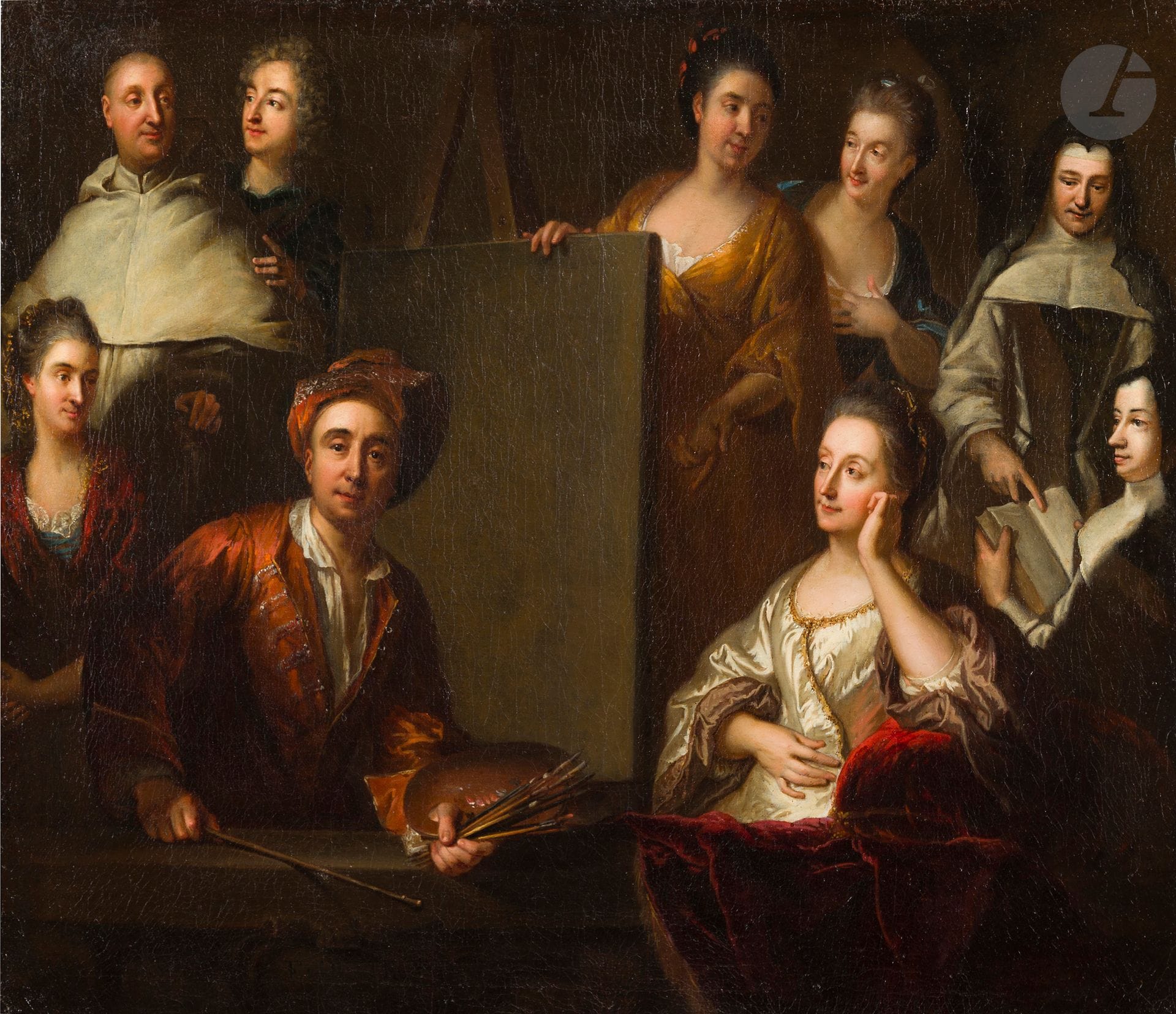
François de TROY (Toulouse, 1645 - Paris, 1730) Self-portrait with the artist's family Canvas 50.8 x 62.9 cm Old restorations Louis XIV period carved and gilded presentation frame lent by Michel Guillanton, 37 bis, rue Montreuil, 75011 Paris. Localized, signed and dated lower left 'Peint à P... / François de Tr... / ... in 170.' Inscribed on reverse 'Portraits of a noble / family or his own family himself / by Hyacinth Rigaud'. Provenance: Possibly James Watson Gerard (1794-2874), like Hyacinthe Rigaud; his son, James Watson Gerard Jr. (1823-1900) as Hyacinthe Rigaud; his son Summer K. Gerard (1874-1966) as Hyacinthe Rigaud; his son Charles Henry Coster Gerard (1909-2012) as Hyacinthe Rigaud; his son, as Hyacinthe Rigaud; sale Old masters, New York, Christie's, May 23, 2024, no. 35 (as attributed to François de Troy). Recent cleaning has revealed the signature. This recently discovered portrait of his family is an exciting addition to the François de Troy corpus. We were already familiar with a full-height representation of the same figures in feet (130 x 95 cm, Musée du domaine départemental de Sceaux, inv. no. 2020.1.1), where the painter also works with the effigy of his wife posed on an easel, where they are surrounded by their children. Here, he adopts a small, wide format, highly original for a group portrait, in a completely different, more focused composition. At the beginning of the 18th century, François de Troy developed more intimate and less solemn formulas for his group portraits, as seen in Portrait présumé de la famille Franqueville (canvas, 138 x 164 cm, Montreal Museum of Fine Arts, inv. no. 1982.21) and Jeu du pousse-épingle (canvas, 52.6 x 64.8 cm, Sceaux, Musée du Grand Siècle). This détente marked the end of the reign of Louis XIV and the Regency. On our canvas, de Troy quotes several of his own paintings. His self-portrait, center left holding a palette, derives from a model that exists in several versions, with or without bonnet (Musée de Châlons-en-Champagne, inv. no. 861.1. 155; Sarah Campbell Blaffer Foundation, Houston, inv. no. BF.1991.1), while the portrait of Jeanne de Troy, née Cotelle, his wife on the right, is taken from her painting in the Hermitage Museum, St. Petersburg (canvas, 103 x 78.5 cm, inv. no. ГЭ-1209, preparatory drawing in the Paul Dupuy Museum, Toulouse). The other figures are the couple's children. The monk in the background, Dom de Troy, is in the arms of his brother, the famous painter Jean-François de Troy (1679-1752), an affectionate gesture found in the painting conserved at Sceaux, where the place of each of the two protagonists is reversed. The young women are five of his six daughters, whom he painted on numerous occasions (see Dominique Brême, François de Troy 1645-1730, Paris-Toulouse, 1997, pp. 24-25). The nuns visible on the right of the composition are his two daughters, who entered the Cistercian women's monastery of Pont-aux-Dames in the commune of Couilly-Pont-aux-Dames. Their faces are a little less clear, probably because their father hasn't seen them since they took their vows. The high quality of the canvas has been revealed by recent cleaning. François de Troy is watching us. He is dressed in artist's clothes, with a velvet turban (as in Rigaud's self-portrait) and an interior gown with brandebourgs; he is holding a hand rest, palette and brushes. His wife looks on tenderly in a satin-finish jacket. This section is inspired by Rembrandt's style, as conceived by Santerre and Grimou in the same period, around 1700: the harmony of tones between the bright red curtain on the parapet, the white shirt and the gold embroidered border on a dark background evokes the portraits by the Dutch master. Admire the psychological finesse of the dialogue created by the glances between the different family members. We would like to thank Mr. Dominique Brème for confirming the attribution to François de Troy by direct examination of the work in February 2026.
Estimate
€120,000 - €150,000
Result
€158,250
Buyer's premium
30%
François de TROY (Toulouse, 1645 - Paris, 1730)
Self-portrait with the artist's family
Canvas
50.8 x 62.9 cm
Old restorations
Louis XIV period carved and gilded presentation frame lent by Michel Guillanton, 37 bis, rue
Montreuil, 75011 Paris.
Localized, signed and dated lower left 'Peint à P... / François de Tr... / ... in 170.' Inscribed on reverse 'Portraits of a noble / family or his own family himself / by Hyacinth Rigaud'.
Provenance:
Possibly James Watson Gerard (1794-2874), like Hyacinthe Rigaud; his son, James Watson Gerard Jr.
(1823-1900) as Hyacinthe Rigaud; his son Summer K. Gerard (1874-1966) as Hyacinthe Rigaud; his son Charles Henry Coster Gerard (1909-2012) as Hyacinthe Rigaud; his son, as Hyacinthe Rigaud; sale Old masters, New York, Christie's, May 23, 2024, no. 35 (as attributed to François de Troy).
Recent cleaning has revealed the signature.
This recently discovered portrait of his family is an exciting addition to the François de Troy corpus. We were already familiar with a full-height representation of the same figures in feet (130 x 95 cm, Musée du domaine départemental de Sceaux, inv. no. 2020.1.1), where the painter also works with the effigy of his wife posed on an easel, where they are surrounded by their children. Here, he adopts a small, wide format, highly original for a group portrait, in a completely different, more focused composition. At the beginning of the 18th century, François de Troy developed more intimate and less solemn formulas for his group portraits, as seen in Portrait présumé de la famille Franqueville (canvas, 138 x 164 cm, Montreal Museum of Fine Arts, inv. no. 1982.21) and Jeu du pousse-épingle (canvas, 52.6 x 64.8 cm, Sceaux, Musée du Grand Siècle). This détente marked the end of the reign of Louis XIV and the Regency. On our canvas, de Troy quotes several of his own paintings. His self-portrait, center left holding a palette, derives from a model that exists in several versions, with or without bonnet (Musée de Châlons-en-Champagne, inv. no. 861.1. 155; Sarah Campbell Blaffer Foundation, Houston, inv. no. BF.1991.1), while the portrait of Jeanne de Troy, née Cotelle, his wife on the right, is taken from her painting in the Hermitage Museum, St. Petersburg (canvas, 103 x 78.5 cm, inv. no. ГЭ-1209, preparatory drawing in the Paul Dupuy Museum, Toulouse). The other figures are the couple's children. The monk in the background, Dom de Troy, is in the arms of his brother, the famous painter Jean-François de Troy (1679-1752), an affectionate gesture found in the painting conserved at Sceaux, where the place of each of the two protagonists is reversed. The young women are five of his six daughters, whom he painted on numerous occasions (see Dominique Brême, François de Troy 1645-1730, Paris-Toulouse, 1997, pp. 24-25). The nuns visible on the right of the composition are his two daughters, who entered the Cistercian women's monastery of Pont-aux-Dames in the commune of Couilly-Pont-aux-Dames. Their faces are a little less clear, probably because their father hasn't seen them since they took their vows. The high quality of the canvas has been revealed by recent cleaning. François de Troy is watching us. He is dressed in artist's clothes, with a velvet turban (as in Rigaud's self-portrait) and an interior gown with brandebourgs; he is holding a hand rest, palette and brushes. His wife looks on tenderly in a satin-finish jacket. This section is inspired by Rembrandt's style, as conceived by Santerre and Grimou in the same period, around 1700: the harmony of tones between the bright red curtain on the parapet, the white shirt and the gold embroidered border on a dark background evokes the portraits by the Dutch master. Admire the psychological finesse of the dialogue created by the glances between the different family members.
We would like to thank Mr. Dominique Brème for confirming the attribution to François de Troy by direct examination of the work in February 2026.
Sale
Wednesday 25 March・14:00 (Europe/Paris)
Salle 1 - Hôtel Drouot
9, rue Drouot
75009 Paris