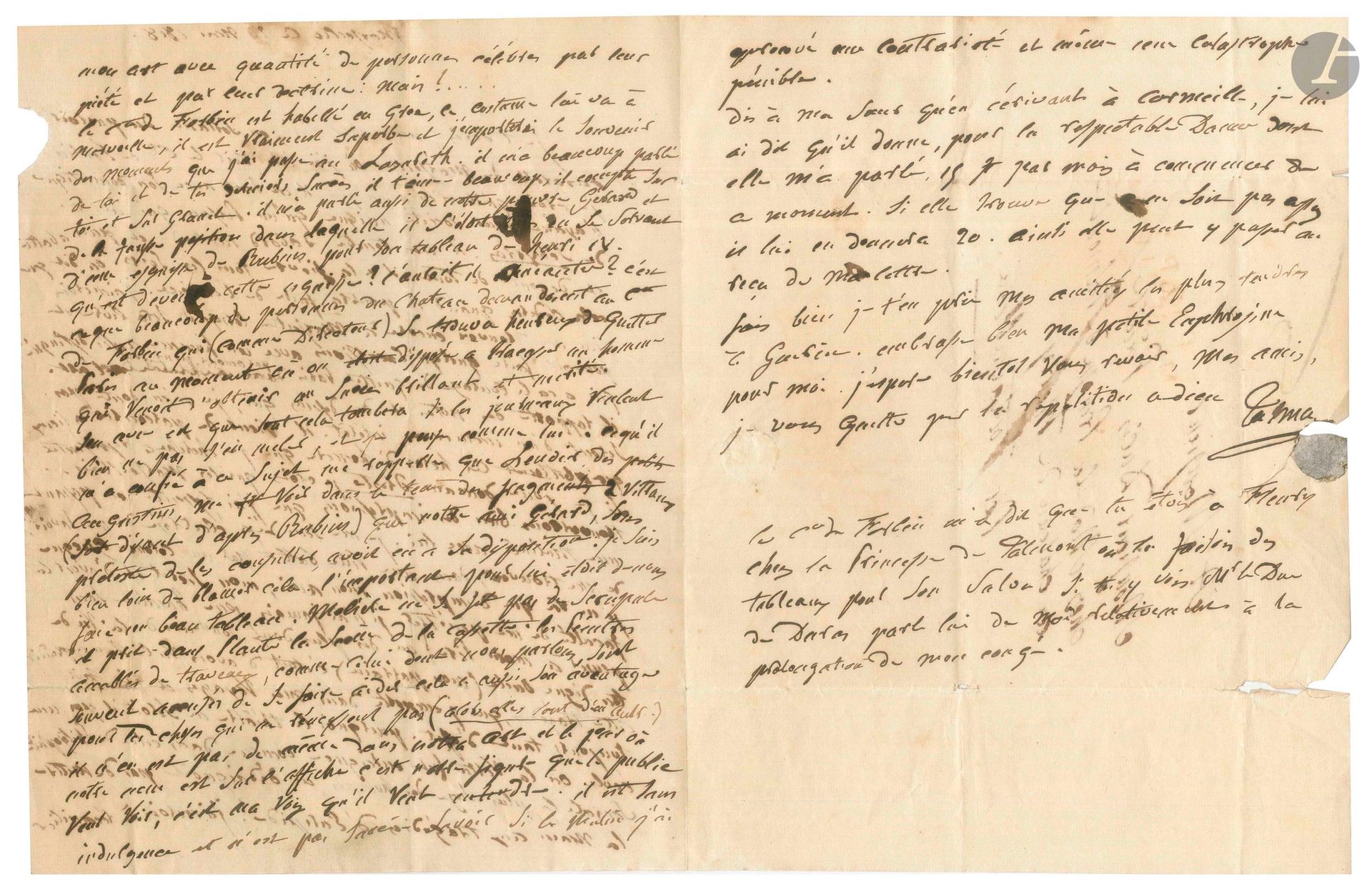
François-Joseph TALMA. L.A.S., Marseille May 12, 1818, to painter Louis Ducis, his brother-in-law; 3pages in-4, addressed (slight tear and marginal splits). Beautiful letter about his theatrical tour of Marseille, his art and painters. [Talma was granted a three-month leave of absence to perform the roles in his repertoire in the provinces, in order to shore up his personal finances. He made his debut in Avignon on March 25, then in Marseille in April with Hamlet, Andromaque (Orestes), Britannicus (Nero) and Agamemnon by Népomucène Lemercier. Here he met up with his long-time friend Count Auguste de Forbin, Director of the Royal Museums, who had just returned from a trip to Greece and the Orient. The painter Louis Ducis (1773-1847), nephew of the poet Jean-François Ducis, had married Talma's younger sister Euphrosine]. He visited the Comte de Forbin at the Marseilles lazaret: "he is alone with his servant, having for sole company a Persian who arrives from Schyrras [Chiraz]. First he got sick, then he got depressed and disgusted with everything, and he has a fever every night. They say it will subside when he can exercise. I'd love to be in Marseille again when he's free, and to be able to go on excursions with such a distinguished man who had the courage to leave Paris for the sake of his art. He is bringing back notes and drawings which, I have no doubt, will be of immense interest. He has just visited places inhabited by the Homeric heroes I'm trying to portray. If I play Orestes tomorrow, I think the people of Marseilles will find many of the impressions I felt when I spent a morning with him. I already feel electrified by knowing myself, by finding myself in a city beaten by a Greek colony. I live by impressions, my friend, and my secret is to have the ability to penetrate myself. I have never played Hamlet without thinking of my Father! One of the sweetest memories of the life of your worthy uncle (my godfather) was to have seen his applaud this tragedy, which I take with me on my travels and which always has such an effect. Why shouldn't the theater be a school where Virtue was taught as in that of Philosophy? Socrates, the wisest of men, did not disdain to put his hand to Euripides' tragedies! I'd like to reconcile my art with a number of people famous for their piety and doctrine: but... Cte de Forbin is dressed as a Greek, a costume that suits him perfectly, he's really superb, and I'll take away the memory of the times I spent at the Lazareth. He told me a lot about you and your latest successes, he likes you a lot, he's counting on you and Granet. He also told me about our poor Gérard and the false position he had put himself in by using a sketch by Rubins for his painting of Henri IV. This is what many people at the Château were asking Cte de Forbin, who (as Director) was happy to leave Paris at a time when people were prepared to hassle a man who had just achieved a brilliant and well-deserved success. What he confided to me on this subject reminds me that [Alexandre] Lenoir of the petits Augustins [at the Musée des monuments français], once showed me fragments of stained glass (supposedly after Rubins) that our friend Gérard, under the pretext of looking them up, had had at his disposal. I'm far from blaming him for this. The important thing for him was to make us a beautiful picture. Molière had no qualms about taking the cassette scene from Plautus. Painters overburdened with work, like the one we're talking about, are often accused of getting help, which also has its advantage for things that don't succeed (so they're someone else's). It's not the same in our art, and the day our name is on the bill, it's our face the public wants to see, it's my voice they want to hear. He is without indulgence and is not supposed to know if in the morning I have experienced a vexation or even a painful catastrophe"... Then Talma talks about his sister and relatives... He adds that he learned from Forbin that Ducis was "at Fleury at the Princesse de Talmont's where you were making paintings for her salon. If you see Mr. le Duc de Duras there, tell him about me and the extension of my leave".
Estimate
€1,000 - €1,200
Result
€1,319
Buyer's premium
30%
François-Joseph TALMA. L.A.S., Marseille May 12, 1818, to painter Louis Ducis, his brother-in-law; 3pages in-4, addressed (slight tear and marginal splits).
Beautiful letter about his theatrical tour of Marseille, his art and painters. [Talma was granted a three-month leave of absence to perform the roles in his repertoire in the provinces, in order to shore up his personal finances. He made his debut in Avignon on March 25, then in Marseille in April with Hamlet, Andromaque (Orestes), Britannicus (Nero) and Agamemnon by Népomucène Lemercier. Here he met up with his long-time friend Count Auguste de Forbin, Director of the Royal Museums, who had just returned from a trip to Greece and the Orient. The painter Louis Ducis (1773-1847), nephew of the poet Jean-François Ducis, had married Talma's younger sister Euphrosine].
He visited the Comte de Forbin at the Marseilles lazaret: "he is alone with his servant, having for sole company a Persian who arrives from Schyrras [Chiraz]. First he got sick, then he got depressed and disgusted with everything, and he has a fever every night. They say it will subside when he can exercise. I'd love to be in Marseille again when he's free, and to be able to go on excursions with such a distinguished man who had the courage to leave Paris for the sake of his art. He is bringing back notes and drawings which, I have no doubt, will be of immense interest. He has just visited places inhabited by the Homeric heroes I'm trying to portray. If I play Orestes tomorrow, I think the people of Marseilles will find many of the impressions I felt when I spent a morning with him. I already feel electrified by knowing myself, by finding myself in a city beaten by a Greek colony. I live by impressions, my friend, and my secret is to have the ability to penetrate myself. I have never played Hamlet without thinking of my Father! One of the sweetest memories of the life of your worthy uncle (my godfather) was to have seen his applaud this tragedy, which I take with me on my travels and which always has such an effect. Why shouldn't the theater be a school where Virtue was taught as in that of Philosophy? Socrates, the wisest of men, did not disdain to put his hand to Euripides' tragedies! I'd like to reconcile my art with a number of people famous for their piety and doctrine: but...
Cte de Forbin is dressed as a Greek, a costume that suits him perfectly, he's really superb, and I'll take away the memory of the times I spent at the Lazareth. He told me a lot about you and your latest successes, he likes you a lot, he's counting on you and Granet. He also told me about our poor Gérard and the false position he had put himself in by using a sketch by Rubins for his painting of Henri IV. This is what many people at the Château were asking Cte de Forbin, who (as Director) was happy to leave Paris at a time when people were prepared to hassle a man who had just achieved a brilliant and well-deserved success. What he confided to me on this subject reminds me that [Alexandre] Lenoir of the petits Augustins [at the Musée des monuments français], once showed me fragments of stained glass (supposedly after Rubins) that our friend Gérard, under the pretext of looking them up, had had at his disposal. I'm far from blaming him for this. The important thing for him was to make us a beautiful picture. Molière had no qualms about taking the cassette scene from Plautus. Painters overburdened with work, like the one we're talking about, are often accused of getting help, which also has its advantage for things that don't succeed (so they're someone else's). It's not the same in our art, and the day our name is on the bill, it's our face the public wants to see, it's my voice they want to hear. He is without indulgence and is not supposed to know if in the morning I have experienced a vexation or even a painful catastrophe"...
Then Talma talks about his sister and relatives... He adds that he learned from Forbin that Ducis was "at Fleury at the Princesse de Talmont's where you were making paintings for her salon. If you see Mr. le Duc de Duras there, tell him about me and the extension of my leave".
Sale
Tuesday 10 March・14:00 (Europe/Paris)
Sale location coming soon
3, rue Favart
75002 Paris