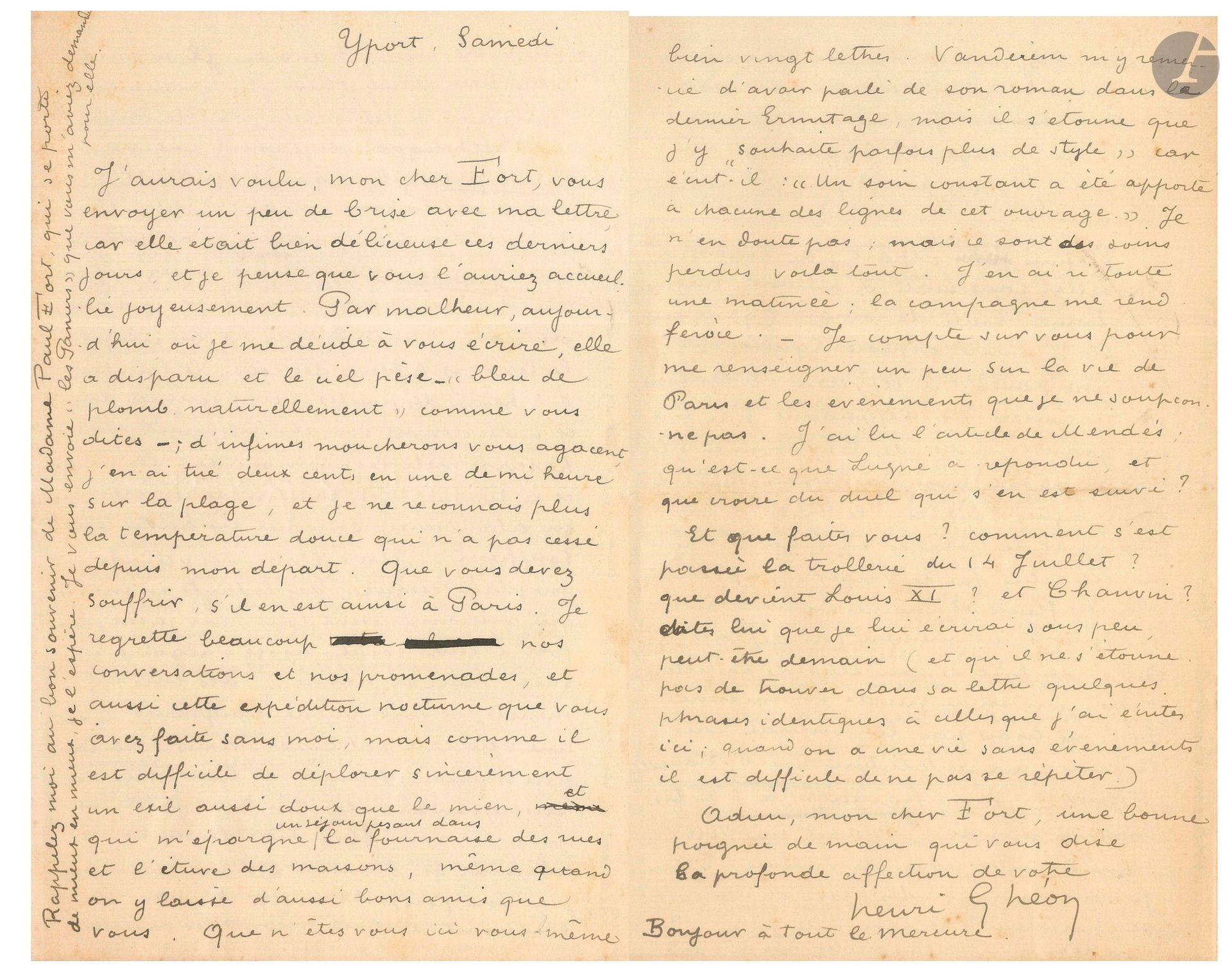
Henri GHÉON (1875-1944). 2 L.A.S., [1897], to Paul Fort; 4pages in-8 each. Beautiful poetic letters, talking about André Gide. Yport Saturday [August 1897?] He is by the sea, leading "a bucolic life. [...] By bucolic life, I mean getting up at cockerel time, going to bed at hen-dog time, a long, empty day ahead, and no plans. [...] A very small village, a small beach, lots of children who all know me, because I enjoy their rather vulgar and dirty society, but so "natural", immense woods and very few bathers. [...] I drink milk and cider, I eat vegetables and fish, and I don't think about absinthe with sugar." He worked a lot: "fragments of an eglogue, bits of a novel (how terrible it is to write in prose! when will Mercury pay for verse!), songs about springs, and so on. However, I have done a large part of the Chansons en Fleur which will open my second volume of Campagnes simples: the Parterre, the Prairie and the Potager in their entirety; all that remains is the Verger; I have sung many flowers and vegetables with a lyricism that is certainly out of place". The magazine L'Œuvre asked him for verses, and he received a letter from Vanderem expressing surprise at the criticism of his novel in L'Ermitage for its lack of style, "because," he wrote, "constant care has been taken with each and every line of this work". I don't doubt it; but it's lost care, that's all. I laughed about it all morning; the campaign makes me fierce". He greets the entire Mercure team, asks for news from Paris and Gide... [Paris, around September 10, 1897]. He is impatient to see Fort again. He congratulates him on his "ballades de la Province Nouvelle". He recounts his vacation at André Gide's: "I come back full of sensations and unable to express them; I stopped working as soon as I felt away from the fields, and my stay at Gide's gave me a taste for reading and idleness. We spent many admirable days together, taking long walks [...] We killed vipers, roped down cliffs, faced the waves beating the rocks around us [...] Gide talked to me at length about his projects, which were truly gigantic. He's a frightening brain and a heightened sensitivity, and with that a delightful companion. I read him my Eglogues"... He talks about his new poems, and the completion of Le Geste de l'Eté [to be published as La Solitude de l'été], at the same time as he prepares for his medical exam... We enclose 4 L.A.S.July 29, 1921, to Mme Théo van Rysselberghe (la Petite Dame), who has just lost her mother, beautiful letter of condolence; - Maison Neuve October 1, 1934, to Mme Paul-Albert Laurens, long letter of condolence and spiritual hope, on the death of the painter Paul-Albert Laurens, evoking their friend Gide; - November 30 and December 20, 1939, to Max Fischer, literary director at Flammarion, on the subject of his contracted and forthcoming works and reprints (L'Homme né de la guerre:Témoignage d'un converti, Saint Vincent Ferrier, and his book of poems Foi en la France....
Estimate
€400 - €500
Result
€528
Buyer's premium
30%
Henri GHÉON (1875-1944). 2 L.A.S., [1897], to Paul Fort; 4pages in-8 each.
Beautiful poetic letters, talking about André Gide.
Yport Saturday [August 1897?] He is by the sea, leading "a bucolic life. [...] By bucolic life, I mean getting up at cockerel time, going to bed at hen-dog time, a long, empty day ahead, and no plans. [...] A very small village, a small beach, lots of children who all know me, because I enjoy their rather vulgar and dirty society, but so "natural", immense woods and very few bathers. [...] I drink milk and cider, I eat vegetables and fish, and I don't think about absinthe with sugar." He worked a lot: "fragments of an eglogue, bits of a novel (how terrible it is to write in prose! when will Mercury pay for verse!), songs about springs, and so on. However, I have done a large part of the Chansons en Fleur which will open my second volume of Campagnes simples: the Parterre, the Prairie and the Potager in their entirety; all that remains is the Verger; I have sung many flowers and vegetables with a lyricism that is certainly out of place". The magazine L'Œuvre asked him for verses, and he received a letter from Vanderem expressing surprise at the criticism of his novel in L'Ermitage for its lack of style, "because," he wrote, "constant care has been taken with each and every line of this work". I don't doubt it; but it's lost care, that's all. I laughed about it all morning; the campaign makes me fierce". He greets the entire Mercure team, asks for news from Paris and Gide...
[Paris, around September 10, 1897]. He is impatient to see Fort again. He congratulates him on his "ballades de la Province Nouvelle". He recounts his vacation at André Gide's: "I come back full of sensations and unable to express them; I stopped working as soon as I felt away from the fields, and my stay at Gide's gave me a taste for reading and idleness. We spent many admirable days together, taking long walks [...] We killed vipers, roped down cliffs, faced the waves beating the rocks around us [...] Gide talked to me at length about his projects, which were truly gigantic. He's a frightening brain and a heightened sensitivity, and with that a delightful companion. I read him my Eglogues"... He talks about his new poems, and the completion of Le Geste de l'Eté [to be published as La Solitude de l'été], at the same time as he prepares for his medical exam...
We enclose 4 L.A.S.July 29, 1921, to Mme Théo van Rysselberghe (la Petite Dame), who has just lost her mother, beautiful letter of condolence; - Maison Neuve October 1, 1934, to Mme Paul-Albert Laurens, long letter of condolence and spiritual hope, on the death of the painter Paul-Albert Laurens, evoking their friend Gide; - November 30 and December 20, 1939, to Max Fischer, literary director at Flammarion, on the subject of his contracted and forthcoming works and reprints (L'Homme né de la guerre:Témoignage d'un converti, Saint Vincent Ferrier, and his book of poems Foi en la France....
Sale
Tuesday 10 March・14:00 (Europe/Paris)
Sale location coming soon
3, rue Favart
75002 Paris