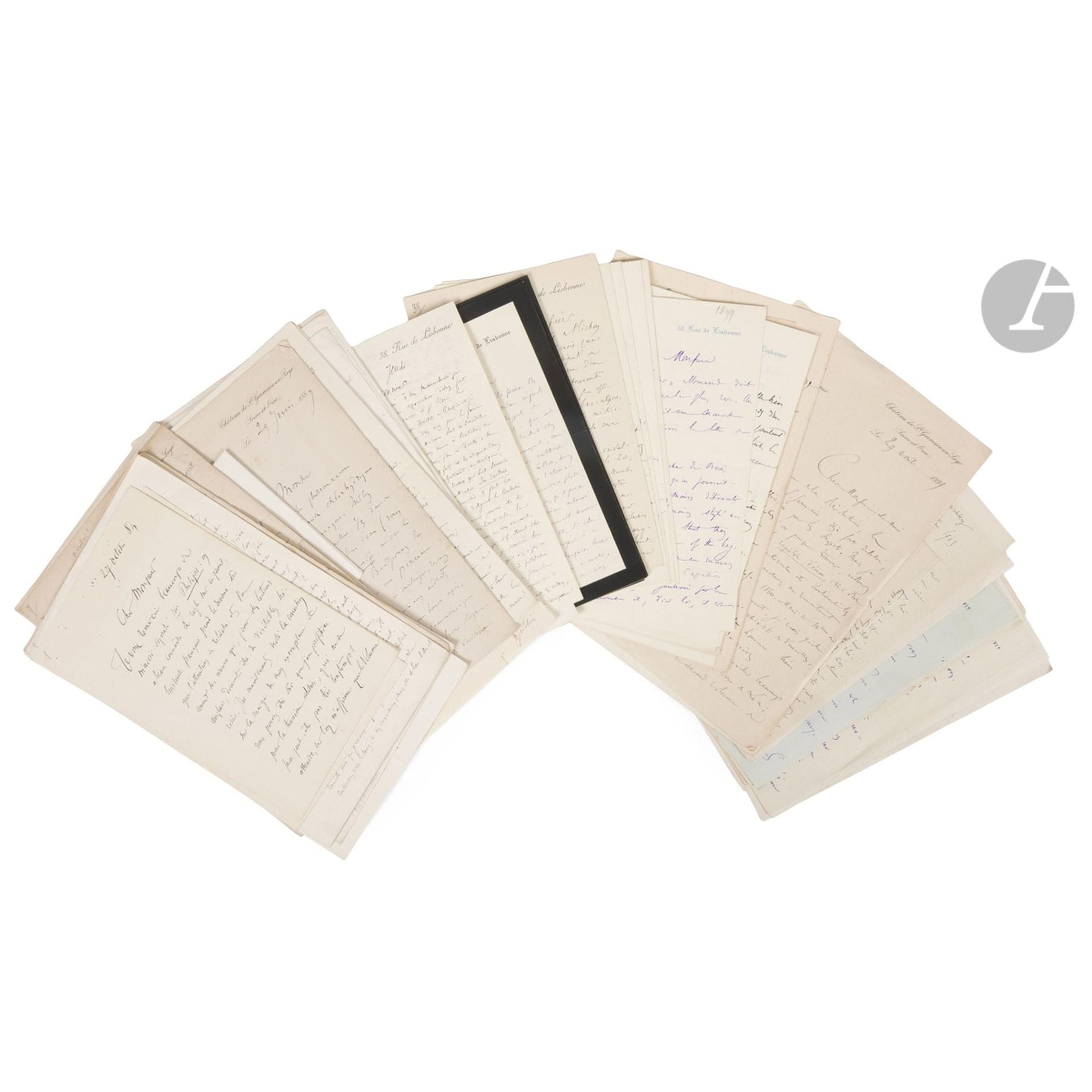
Salomon REINACH (1858-1932) 69 L.A.S., 1884-1907, to Edward Lee Childe; 192 pages in-8, several letterheads Musée Gallo-Romain de St-Germain, then Musée de St Germain, several addresses. Important and interesting correspondence from the archaeologist to the husband of his great friend. We can only give a brief overview here, with a few brief quotations. [Part of the correspondence between Blanche Lee Childe and Salomon Reinach has been published by Hervé Duchêne, Nous sommes de vieux amis qui allons refaire connaissance (Le Passeur, 2022)]. The correspondence is marked by the cult and memory of Blanche: Reinach celebrates the anniversary of their first meeting on the ship Saint-Augustin, and will visit her grave, where he plans to have a Latin quotation from Saint Jerome engraved (Nov. 24, 1886). He confesses to Edward: "I can't reproach myself for having lived a single day, nor seen sleep come once without thinking about it"... He feels "every day, no less deeply than when I lived with her, the immense height where she was above me" (February 26, 1890)... Etc. In October 1884, he discusses the problem of art objects taken by Napoleon and their restitution to the countries of origin, and defends Lord Elgin. He talks about his weekly meetings with Gustave Schlumberger, his fellow archaeologists and historians, his work at the Museum ("I've had a hard time in Saint-Germain, with a collection of over 2,000 objects given to me by the Musée Guimet that need to be inventoried"), his own research, his study trips... He announces his engagement "to a young Russian woman who is a doctor of medicine at the Faculty of Paris and who has other amiable qualities for which there is no parchment diploma. [...] Is it necessary to tell you that nothing has changed and that the past is intangible, not because it is too far away, but because it is too high?" (January 14, 1891). In the next letter, he expands on the subject of marriage. On his return from a working visit to London, he analyzes the political situation in France: "Clemenceau is a highly disreputable character, a demagogic pleasure-seeker, a politician with narrow-minded views; but I can only view with disgust the campaign of infamous slander that some jokers, blackmailers by profession, have waged against him. I don't think he's a man overboard; he has defended himself with a cocksureness which, sooner or later, in the eyes of a public opinion as generous as it is ignorant, ends up passing for heroism"... (Sept. 6, 1893). A year later: "I cannot escape the impression that I am witnessing the long suicide of the Republic", and the Dreyfus affair has "deeply disturbed and brought him down [...] it is not the crime of an individual that causes me this emotion. He is as innocent as you or as myself. His lawyer has not the slightest doubt; he told the Palais three days ago that this was the greatest judicial error of the century. And what a mistake! A conviction authorized by a single apocryphal document"... (Dec. 31, 1894). He expresses his sorrow at the death of the Duc d'Aumale (May 1897). He is indignant at the "Israelite martyrology in Russia"... He speaks of a "delicious portrait" of Leonardo da Vinci bought in Rome by Theodore Davis, on Berenson's advice... And on the Dreyfus affair: "I insisted very much that Picquart should take to court those who accuse him of being a spy, and I am very happy that he has decided to do so. Whatever the outcome of the elections, the war will go on; it's a matter of life and death for France. So much the worse if there are casualties; "truth on the march" has often demanded bloodshed. The Dreyfus affair will only be settled the day a monster trial reveals to the world what S. 7 is, what infamies it is capable of, and how much more dangerous it is to world peace than the International" (May 6, 1898). He lists the "intellectuals" who support Dreyfus, while "all that is notoriously evil and venal in France is on Esterhazy's side"; then he traces the itinerary of a trip to Greece (1899). "The Jews have no pope, no councils, no orthodoxy. You can be a Jew, just as you can be a Protestant, without believing in a miracle, without believing in the immortality of the soul and the resurrection. One must only admit the Schema of Moses, which affirms the unity of God"... Etc. Provenance: Château du Perthuis.
Estimate
€2,500 - €3,000
Result
€3,297
Buyer's premium
30%
Salomon REINACH (1858-1932)
69 L.A.S., 1884-1907, to Edward Lee Childe; 192 pages in-8, several letterheads Musée Gallo-Romain de St-Germain, then Musée de St Germain, several addresses.
Important and interesting correspondence from the archaeologist to the husband of his great friend. We can only give a brief overview here, with a few brief quotations. [Part of the correspondence between Blanche Lee Childe and Salomon Reinach has been published by Hervé Duchêne, Nous sommes de vieux amis qui allons refaire connaissance (Le Passeur, 2022)].
The correspondence is marked by the cult and memory of Blanche: Reinach celebrates the anniversary of their first meeting on the ship Saint-Augustin, and will visit her grave, where he plans to have a Latin quotation from Saint Jerome engraved (Nov. 24, 1886). He confesses to Edward: "I can't reproach myself for having lived a single day, nor seen sleep come once without thinking about it"... He feels "every day, no less deeply than when I lived with her, the immense height where she was above me" (February 26, 1890)... Etc.
In October 1884, he discusses the problem of art objects taken by Napoleon and their restitution to the countries of origin, and defends Lord Elgin. He talks about his weekly meetings with Gustave Schlumberger, his fellow archaeologists and historians, his work at the Museum ("I've had a hard time in Saint-Germain, with a collection of over 2,000 objects given to me by the Musée Guimet that need to be inventoried"), his own research, his study trips... He announces his engagement "to a young Russian woman who is a doctor of medicine at the Faculty of Paris and who has other amiable qualities for which there is no parchment diploma. [...] Is it necessary to tell you that nothing has changed and that the past is intangible, not because it is too far away, but because it is too high?" (January 14, 1891). In the next letter, he expands on the subject of marriage. On his return from a working visit to London, he analyzes the political situation in France: "Clemenceau is a highly disreputable character, a demagogic pleasure-seeker, a politician with narrow-minded views; but I can only view with disgust the campaign of infamous slander that some jokers, blackmailers by profession, have waged against him. I don't think he's a man overboard; he has defended himself with a cocksureness which, sooner or later, in the eyes of a public opinion as generous as it is ignorant, ends up passing for heroism"... (Sept. 6, 1893). A year later: "I cannot escape the impression that I am witnessing the long suicide of the Republic", and the Dreyfus affair has "deeply disturbed and brought him down [...] it is not the crime of an individual that causes me this emotion. He is as innocent as you or as myself. His lawyer has not the slightest doubt; he told the Palais three days ago that this was the greatest judicial error of the century. And what a mistake! A conviction authorized by a single apocryphal document"... (Dec. 31, 1894). He expresses his sorrow at the death of the Duc d'Aumale (May 1897). He is indignant at the "Israelite martyrology in Russia"... He speaks of a "delicious portrait" of Leonardo da Vinci bought in Rome by Theodore Davis, on Berenson's advice... And on the Dreyfus affair: "I insisted very much that Picquart should take to court those who accuse him of being a spy, and I am very happy that he has decided to do so. Whatever the outcome of the elections, the war will go on; it's a matter of life and death for France. So much the worse if there are casualties; "truth on the march" has often demanded bloodshed. The Dreyfus affair will only be settled the day a monster trial reveals to the world what S. 7 is, what infamies it is capable of, and how much more dangerous it is to world peace than the International" (May 6, 1898). He lists the "intellectuals" who support Dreyfus, while "all that is notoriously evil and venal in France is on Esterhazy's side"; then he traces the itinerary of a trip to Greece (1899). "The Jews have no pope, no councils, no orthodoxy. You can be a Jew, just as you can be a Protestant, without believing in a miracle, without believing in the immortality of the soul and the resurrection. One must only admit the Schema of Moses, which affirms the unity of God"... Etc.
Provenance: Château du Perthuis.
Sale
Thursday 12 February・14:00 (Europe/Paris)
Salle 9 - Hôtel Drouot
9, rue Drouot
75009 Paris