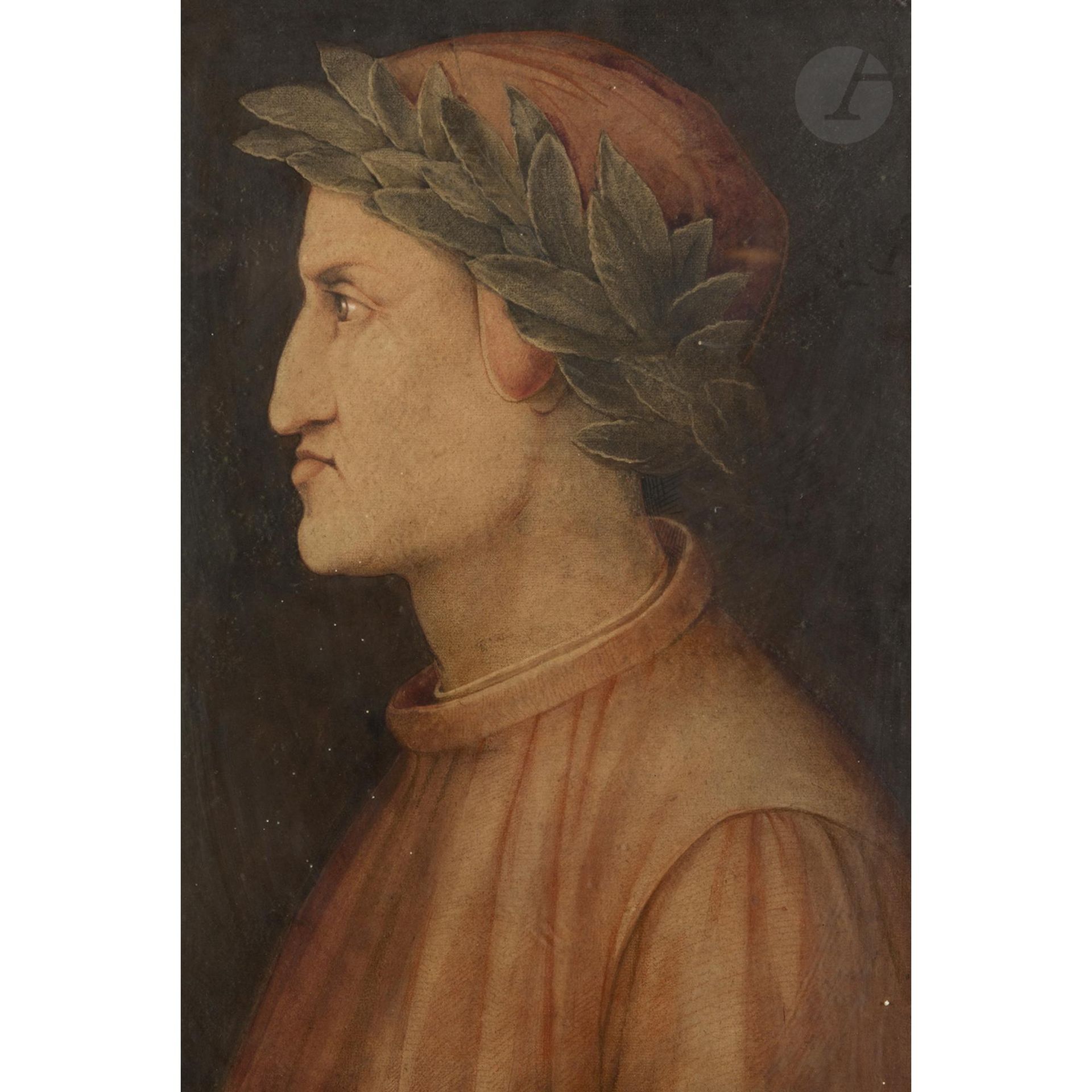
Henry de TRIQUETI (1803-1874) Head of Dante Gouache 40 x 27 cm Bears a handwritten label on the back: "Dante's head. Original at San Marco in Florence. Copied by H. de Triqueti." Triqueti was passionate about the Renaissance period, and Dante was a central figure in the sculptor's work. He depicted him in the company of Virgil in 1861 (Boston Museum of Fine Arts, bronze). The Louvre holds the vase from the Monument to Dante and Petrarch (1838). Provenance: Château du Perthuis. Note: The primacy of drawing was not an empty word for Triqueti, who subordinated all the arts he practiced to it. Sculptor, painter, writer and artistic advisor to the Duc d'Aumale, Triqueti is also known in the world of old drawings as a famous collector of drawings and engravings. Through his wife, he inherited the important collection of Thomas Banks (also a sculptor and collector), which included many drawings by Renaissance masters. A regular visitor to the Hôtel Drouot, Triqueti rubbed shoulders with a circle of illustrious collectors and curators such as His de La Salle (1795-1878) and Frédéric Reiset (1815-1891). Triqueti took his first steps as an artist under the aegis of Anne-Louis Girodet-Trioson, a family friend and neighbor. Triqueti demonstrated a perfect mastery of the art of drawing. He deploys every facet of drawing, depending on its purpose or the work's destination. Extremely precise in his drawings and copies, he uses a finely-sharpened pencil. He scratches with a feather in his search for compositions and decorations, multiplying variants and options. He can be powerful in his contours, in a Géricaldian vein, or content himself with a fine, thin line for his ornamental subjects. He sometimes drew in sanguine, particularly for academic studies and portraits. His highly finished watercolors are absolutely limpid and distant, imitating to perfection the rendering he aims to achieve in his "tarsia".
Estimate
€1,500 - €2,000
Result
€1,978
Buyer's premium
30%
Henry de TRIQUETI (1803-1874)
Head of Dante
Gouache
40 x 27 cm
Bears a handwritten label on the back: "Dante's head. Original at San Marco in Florence. Copied by H. de Triqueti."
Triqueti was passionate about the Renaissance period, and Dante was a central figure in the sculptor's work. He depicted him in the company of Virgil in 1861 (Boston Museum of Fine Arts, bronze). The Louvre holds the vase from the Monument to Dante and Petrarch (1838).
Provenance: Château du Perthuis.
Note: The primacy of drawing was not an empty word for Triqueti, who subordinated all the arts he practiced to it. Sculptor, painter, writer and artistic advisor to the Duc d'Aumale, Triqueti is also known in the world of old drawings as a famous collector of drawings and engravings. Through his wife, he inherited the important collection of Thomas Banks (also a sculptor and collector), which included many drawings by Renaissance masters. A regular visitor to the Hôtel Drouot, Triqueti rubbed shoulders with a circle of illustrious collectors and curators such as His de La Salle (1795-1878) and Frédéric Reiset (1815-1891).
Triqueti took his first steps as an artist under the aegis of Anne-Louis Girodet-Trioson, a family friend and neighbor.
Triqueti demonstrated a perfect mastery of the art of drawing. He deploys every facet of drawing, depending on its purpose or the work's destination. Extremely precise in his drawings and copies, he uses a finely-sharpened pencil. He scratches with a feather in his search for compositions and decorations, multiplying variants and options. He can be powerful in his contours, in a Géricaldian vein, or content himself with a fine, thin line for his ornamental subjects. He sometimes drew in sanguine, particularly for academic studies and portraits. His highly finished watercolors are absolutely limpid and distant, imitating to perfection the rendering he aims to achieve in his "tarsia".
Sale
Thursday 12 February・14:00 (Europe/Paris)
Salle 9 - Hôtel Drouot
9, rue Drouot
75009 Paris