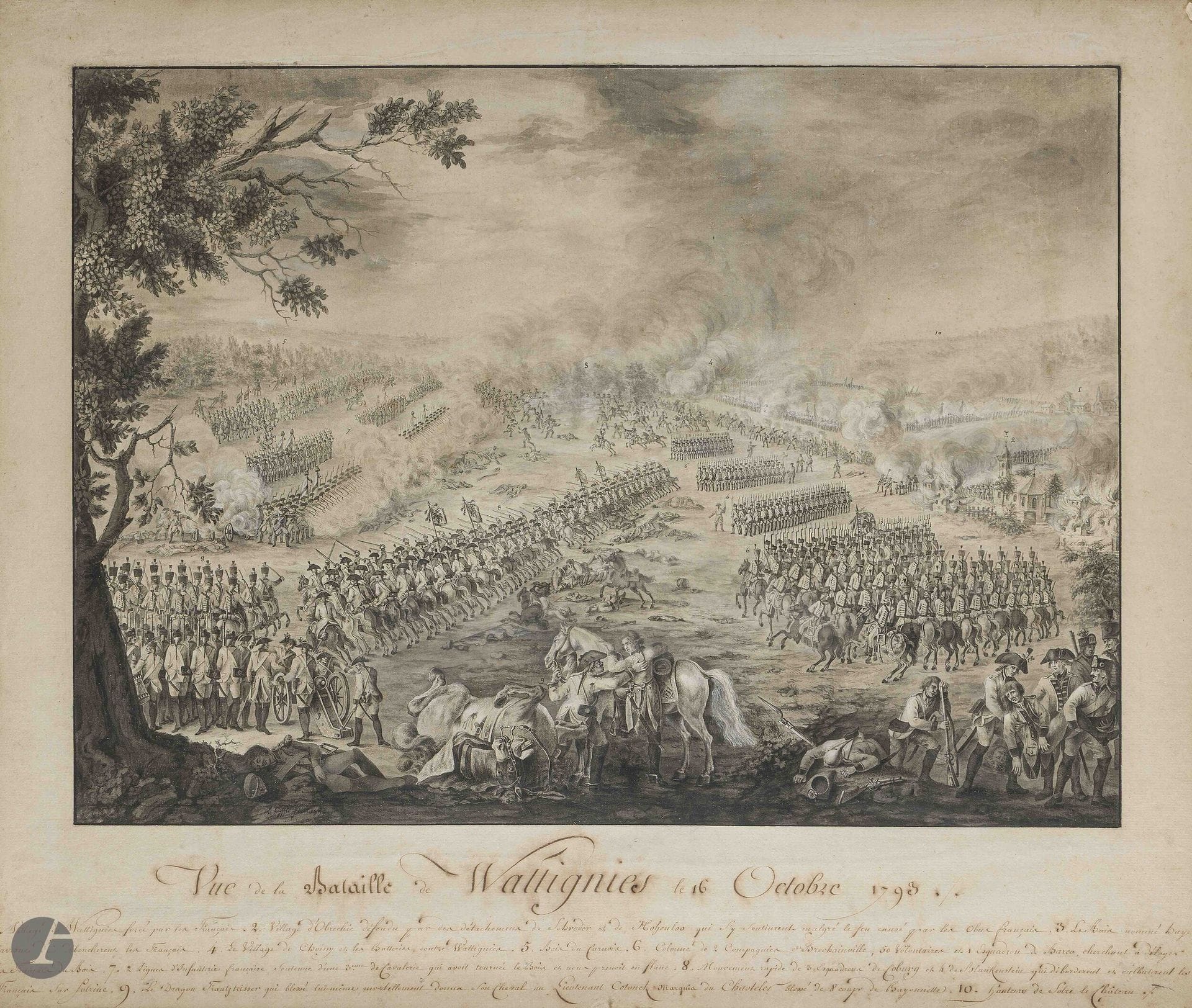
Paul Louis CYFFLE (1724-1806) View of the Battle of Wattignies, October 16, 1793 View of the battlefield with location of the site and the various troops. Large pen-and-ink drawing with white highlights, seen from the Austrian side, signed and dated 1794. Under glass. Gilded frame decorated with foliage frieze. Size of drawing with caption: 57 x 68 cm Historical background: Very fine testimony to the famous sculptor and ceramist, probably from life, who settled in Belgium after leaving France. Biography: Paul-Louis Cyfflé (1724-1806): After studying at the Bruges Academy, he moved to Paris in 1741, then to the Ducal Court of Lunéville in 1746. He became a pupil and collaborator of Barthélémy Guibal. On January 7, 1751, he married Catherine Marchal, daughter of an organ builder in Nancy's Saint Epvre parish. In 1755, he clashed with Guibal, who died in 1757, over who was to design the statue of Louis XV that was to stand in Nancy's Place Stanislas. On Guibal's death, he became ordinary sculptor to Duke Stanislas. He was responsible for the statues that adorn the fountain in Nancy's Place d'Alliance, inspired by Bernini's Fountain of the Four Rivers in Rome's Piazza Navona. In 1768, Louis XV granted him the privilege of opening an earthenware factory in Lunéville, where he produced highly refined figurines and other statuettes of excellent quality. Faced with the decline of his business, he returned to Brussels in 1777. His molds were then bought by the Niderviller faience factory.
Estimate
€500 - €600
Result
€857
Buyer's premium
30%
Paul Louis CYFFLE (1724-1806)
View of the Battle of Wattignies, October 16, 1793
View of the battlefield with location of the site and the various troops.
Large pen-and-ink drawing with white highlights, seen from the Austrian side, signed and dated 1794.
Under glass.
Gilded frame decorated with foliage frieze.
Size of drawing with caption: 57 x 68 cm
Historical background:
Very fine testimony to the famous sculptor and ceramist, probably from life, who settled in Belgium after leaving France.
Biography:
Paul-Louis Cyfflé (1724-1806):
After studying at the Bruges Academy, he moved to Paris in 1741, then to the Ducal Court of Lunéville in 1746. He became a pupil and collaborator of Barthélémy Guibal.
On January 7, 1751, he married Catherine Marchal, daughter of an organ builder in Nancy's Saint Epvre parish. In 1755, he clashed with Guibal, who died in 1757, over who was to design the statue of Louis XV that was to stand in Nancy's Place Stanislas.
On Guibal's death, he became ordinary sculptor to Duke Stanislas. He was responsible for the statues that adorn the fountain in Nancy's Place d'Alliance, inspired by Bernini's Fountain of the Four Rivers in Rome's Piazza Navona.
In 1768, Louis XV granted him the privilege of opening an earthenware factory in Lunéville, where he produced highly refined figurines and other statuettes of excellent quality. Faced with the decline of his business, he returned to Brussels in 1777. His molds were then bought by the Niderviller faience factory.
Sale
Thursday 18 December 2025・14:00 (Europe/Paris)
Sale location coming soon
3, rue Favart
75002 Paris